Seismic demographic shift as India overtakes China: Q&A / Photo: Julia Han JANICKI - AFP

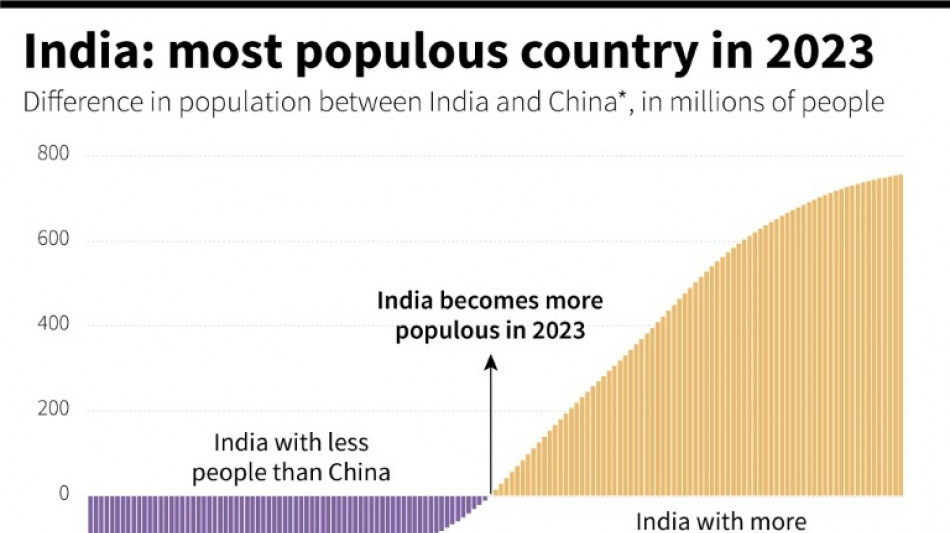
India will overtake China to become the world's most populous nation by the middle of this year, the United Nations projected Wednesday, the culmination of decades-long trends and a position the South Asian country is likely to retain for centuries to come.
It is a momentous change: China has generally been regarded as the world's most populous country since the fall of the Roman Empire, although pre-Partition British India may have overtaken it for a period.
AFP looks at the causes and effects.
- How has this happened? -
China moved decisively to curtail its population growth in the 1980s, imposing a sometimes brutally enforced one-child policy on its people.
It has become increasingly prosperous in recent decades -- a phenomenon consistently linked to smaller family sizes -- but is now reaping the demographic whirlwind with an ageing, shrinking population.
India has mounted sterilisation and family planning campaigns of its own, including a notoriously unpopular effort to target men in the 1970s.
It now focuses on women, with female sterilisation by far the most popular method of contraception, despite the associated health risks.
But India's fertility rates are consistently higher than its northern neighbour, giving it a much younger -- and now larger -- population: some 650 million Indians are under 25.
- What are the implications? -
New Delhi and Beijing are vying for geopolitical influence and the shift in the "most populous" title will bolster India's status as a rising power -- one being courted by the West as an alternative to Beijing.
It will also strengthen New Delhi's case for a long-sought permanent seat on the UN Security Council. As well as overtaking China, India has a larger population than the other four veto-holding member states combined.
Catering to so many people poses major environmental and infrastructure challenges.
But a large and young workforce also has economic benefits: India is the world's fastest-growing major economy and last year displaced former colonial power Britain to take fifth place in the global GDP rankings.
- How many people do India and China have? -
The UN estimates that India will have 1.429 billion people by July 1, with China three million behind on 1.426 billion.
But calculating actual numbers for such giant countries is fraught with difficulty.
China's National Bureau of Statistics issues a population figure every year and said in January that the mainland had 1.412 billion people at the end of 2022.
This marked the first fall in population since the disaster of Mao Zedong's Great Leap Forward in the early 1960s.
But India has not issued an official population statistic since the last census in 2011, when it recorded 1.21 billion people.
- Why doesn't India know its population? -
Birth certificates only became compulsory in India in 1969, and the once-a-decade census due in 2021 was delayed by the coronavirus pandemic before becoming bogged down by logistical problems.
It is a gargantuan exercise involving an army of data enumerators who go door-to-door to collect information, including religion, mother tongue and literacy status.
Critics accuse authorities of shying away from the issue to play down contentious questions, such as unemployment rates, ahead of elections next year.
- What does New Delhi say? -
The Hindu nationalist BJP government is normally keen to promote India's achievements -- but it has been uncharacteristically reticent about the prospect of displacing China as the world's most populous nation.
The health ministry did not comment Wednesday on the figures released by the UN, and several officially backed population clocks have been removed from public view in recent years.
In his Independence Day speech last year, Prime Minister Narendra Modi still referred to India as a country of 1.3 billion people, a milestone experts say it passed several years ago.
(A.Berg--BBZ)