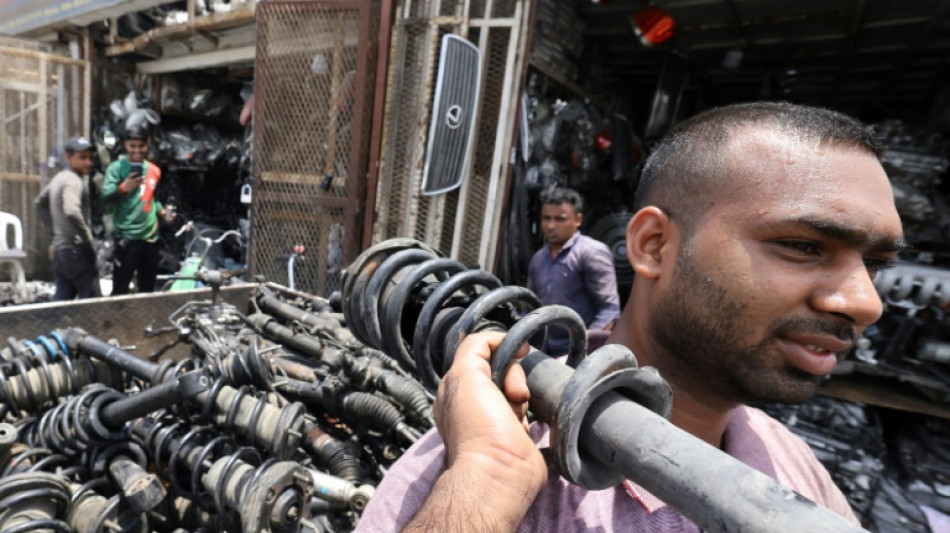
Climate change raising heat risks for workers, experts warn / Photo: Karim SAHIB - AFP

Rising global temperatures are increasing the risk of workers dying or becoming disabled from labouring in extreme heat, an international conference has been told.
The conference, held in Qatar as spring temperatures raced towards 40 degrees Celsius (104 Fahrenheit), heard that tens of thousands of workers around the world have died from chronic kidney disease and other illnesses linked with extreme heat over recent decades.
"Science tells us that all countries can do more," the International Labour Organisation's regional chief for Arab countries, Ruba Jaradat, told the Occupational Heat Stress conference, which focused on climate change and how rising temperatures threaten workers' health.
Last year's World Cup in Qatar drew attention to workers toiling in temperatures that can top 50 degrees Celsius (122 Fahrenheit) during the summer peak in countries across the Gulf.
Since 2021, Qatar has banned outdoor working between 10:00 am and 3.30 pm from June 1 to September 15.
Its reforms have been praised by the UN labour agency, though some experts say more can be done.
There is no international standard for temperatures for outdoor working, but climate change has forced new scrutiny.
The US administration promised new rules in 2021 after a deadly heatwave and the White House said that "heat is the nation's leading weather-related killer". Nothing has been produced yet, however.
Europe has also seen devastating heatwaves. But apart from Qatar, Cyprus is one of the rare countries to have restricted working hours, ordering extra breaks and heat protective clothing when temperatures rise above 35 degrees Celsius (95 Fahrenheit).
Extreme heat and sun radiation unleash heatstroke, kidney, heart and lung diseases and raise cancer rates, according to researchers.
Justin Glaser, head of La Isla Network, an occupational health group, said more than 20,000 sugar workers in Central America had died in a single decade from chronic kidney disease. He pointed to about 25,000 deaths from kidney disease in Sri Lanka.
- 'People are dying' -
Around one billion farm workers and tens of millions in construction and other outdoor industries are in the frontline, the conference was told. But swimming pool lifeguards, gardeners and postal delivery workers also face heat dangers.
Construction workers can be exposed to enough ultraviolet rays over 30 to 40 years to more than double the risk of non-melanoma skin cancer.
Taiwanese researchers warned in a 2020 study that kidney disease from extreme heat "may represent one of the first epidemics due to global warming".
According to ILO forecasts, South Asia and sub-Saharan Africa will suffer most from lost working hours due to extreme heat in coming years.
India, Bangladesh and their neighbours have huge agricultural populations and large numbers working in informal sectors with no health insurance.
Vidhya Venugopal, an occupational health professor at the Sri Ramachandra Institute in Chennai, highlighted the case of hundreds of thousands of salt farmers in India working in desert-like conditions who suffer high rates of kidney and other diseases.
"They have no cover and they are stood in salt all day long," Venugopal told AFP. In the summer months, about 80 percent suffer some kind of heat illness.
But millions of workers in India's industrial north are at risk, she said.
India and other poorer countries cannot wait for international standards to be enforced. "People are dying, people are getting disease. We need to adapt all the practices used by others and tailor it to our own culture."
Health experts say rest, water and shade are needed to ease the deadly risks.
"Owners say no, no, no, we don't want our workers to rest because we will lose productivity. But that has to change," Venugopal said.
Glaser of La Isla Network worked with sugar companies in Central America to improve conditions. Workers on a nine-hour shift cut 4.75 tonnes of sugar cane a day. With better breaks, shade and water, they cut 6.2 tonnes in four hours, he said.
(H.Schneide--BBZ)