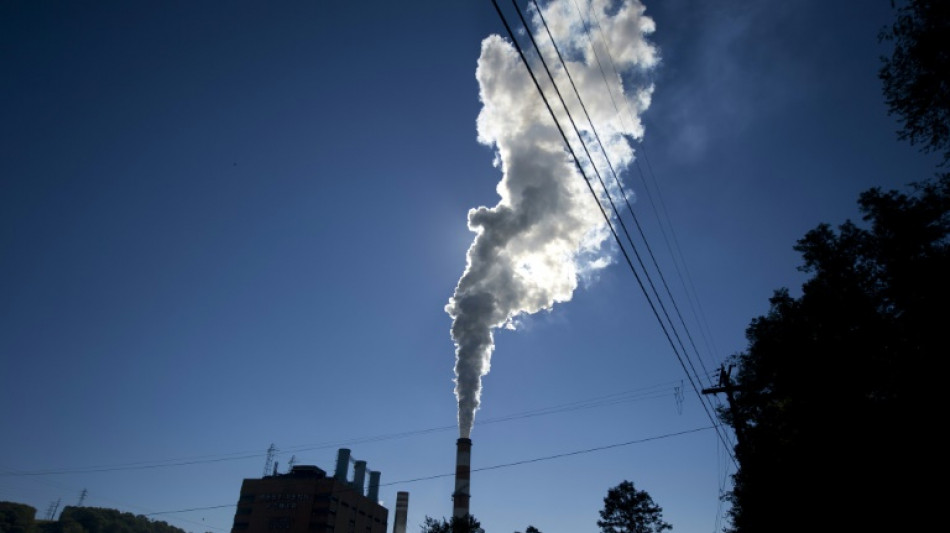
US moves to curb power plant emissions / Photo: JEFF SWENSEN - GETTY IMAGES NORTH AMERICA/AFP/File

President Joe Biden's administration on Thursday announced sweeping plans to curb planet-warming emissions from the nation's power stations, as part of the United States' efforts to combat the climate crisis.
Starting from 2030, the proposal would target fossil fuel electricity production with increasingly stringent carbon reduction requirements, including compelling some coal plants to directly capture pollution from their smokestacks.
"In every corner of our nation, Americans are seeing and feeling the devastating impacts of climate change," Environmental Protection Agency (EPA) Administrator Michael Regan said at an event announcing the draft rules.
"It's clear that we've reached a pivotal point in human history, and it's on all of us to act right now to protect our future."
The agency estimated its measures targeting coal and natural gas would prevent 617 million metric tons of total carbon dioxide entering the atmosphere through 2042, equivalent to reducing the annual emissions of half the cars in the United States.
But the proposals are certain to face legal challenges from Republican-run states that could place them before the conservative-majority Supreme Court, which has previously knocked back efforts to regulate the sector.
US Senate Republican leader Mitch McConnell denounced the proposals, saying they posed "an existential threat to providers of affordable and reliable American energy."
US power plant emissions have been declining, thanks to a drop in the cost of renewables. But they are still responsible for a quarter of greenhouse gasses produced by the world's largest economy.
That has made it a prime target for Biden, who has pledged to cut emissions from electricity production to zero by 2035.
"I think this rule is important by declaring that the era of unlimited carbon pollution from power plants is over," Dan Lashof, director of World Resources Institute, United States, told AFP.
The proposed standards "mark a pivotal turning point," with the EPA "rightfully and necessarily moving to hold coal- and gas-fired power plants to account for their ongoing carbon pollution," added Julie McNamara of the Union of Concerned Scientists.
- Carbon capture -
Under the rules, measures for fossil fuel plants would vary by the type of plant, whether it operates frequently or just to shore up the grid during peak demand, and how long it is planned to remain in service.
For example, coal-fired plants that don't have commitments to retire by 2040 would be required to remove 90 percent of their carbon starting from 2030. On the other hand, coal plants set to retire by 2032 will face no restrictions.
Natural gas power stations that run frequently will be required to either implement carbon capture technology, or partly switch to hydrogen, which burns without emissions.
Both Lashof and McNamara said they had hoped for deeper and faster reductions for gas plants.
Boosting the use of carbon capture was slammed both by climate justice groups and the fossil fuel industry.
"If we are to combat climate change we must do so with real, viable solutions -- not unproven technologies that only promise to continue the legacy of dumping pollutants onto frontline communities," said Ozawa Bineshi Albert of the Climate Justice Alliance.
The National Mining Association said that although carbon capture was key to the future, mandating its use "before this technology is technically and fully economically demonstrated is nothing more than unlawful showmanship reinforcing a destructive agenda."
The technology is in its infancy, with only "around 35" facilities globally applying it for industrial processes, fuel transformation and power generation, according to the International Energy Agency.
But the Biden administration is betting on the Inflation Reduction Act, which offers tax credits for carbon capture, coupled with advances in the technology, to speed up adoption.
- Legally defensible? -
Former president Barack Obama first tried to regulate the power sector almost a decade ago, but the high court ruled his plans were too broad and exceeded the executive branch's authority.
The new rule limits itself to acting "within the fence line" of an individual power plant, which officials hope will improve its chances of surviving legal challenges.
The proposed rules come a month after the EPA unveiled new auto emissions regulations, and plans to sharply reduce emissions of methane, a potent greenhouse gas, by the oil and gas industry.
Biden, who faces a tough re-election campaign, sees keeping his promises on climate action as key to energizing younger voters.
The plans would be subject to a public comment period and likely wouldn't be finalized until next year.
(A.Lehmann--BBZ)