Planet-friendly farming takes root in drought-hit Tunisia / Photo: FETHI BELAID - AFP

Saber Zouani lost his job as a waiter when the Covid pandemic ravaged the Tunisian tourism sector, so he decided to try something new and started a permaculture farm.
Now he grows all the food he needs and has become a pioneer of the style of ecological agriculture that is gaining fans worldwide, including in his North African country.
Many hope it will help Tunisia weather the impacts of climate change and wean it off its reliance on global supply chains, including grain and fertiliser imports from war-torn Ukraine and Russia.
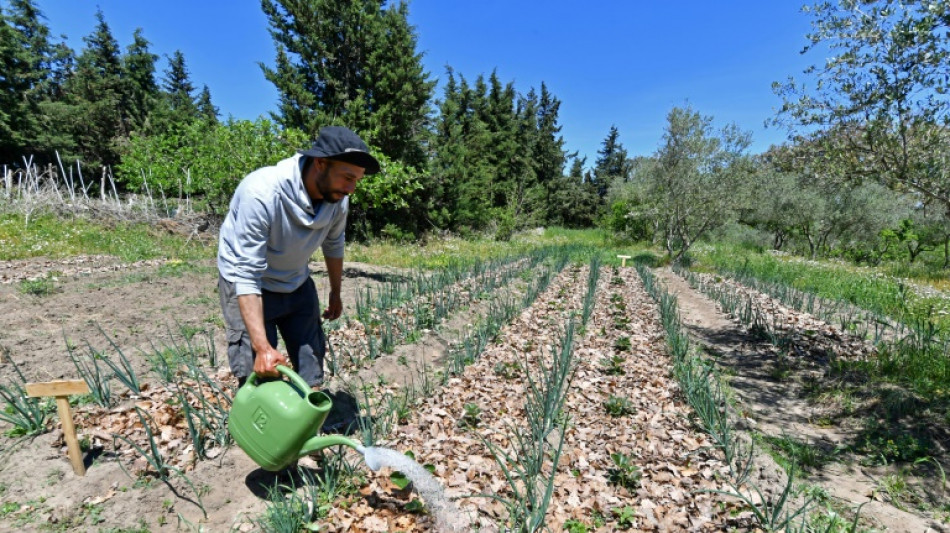
In his western home town of Cap Negro, Zouani, 37, proudly showed off his three-hectare (seven-acre) farm, set up to mimic natural ecosystems in line with ideas popularised in the 1970s by Australian ecologists.
Permaculture, as an alternative to industrial agriculture, aims to work in harmony with the environment, keep soil structures intact, and do without artificial inputs such as chemical fertilisers or pesticides.
"No, these are not weeds," said Zouani, a biotechnology graduate, pointing to nettles and dandelions growing wild all around his rows of onions, peppers and radishes.
When he harvests his vegetables, he said, he puts the excess green matter back onto the soil to slow evaporation -- hoping to keep the ground as moist as a forest floor covered with fallen leaves.
- 'Create living soil' -
Such methods are especially useful in Tunisia where an unprecedented drought has parched the countryside and left water reservoirs at dangerously low levels this spring.
At his farm, Zouani captures precious rainwater in a pond and only sparingly waters his plants, which are all grown from his own seeds.
Zouani also keeps cows, sheep, goats and chickens and composts their droppings to create soil enriched with the nitrogen-rich natural fertiliser.
"We need to create living soil, attract earthworms, fungi and all the nutrients for our plants and trees," said Zouani.
Permaculture, he said, draws on farming methods and wisdoms of centuries past -- "returning to our roots, to the traditional methods used by our grandparents".
Zouani said he earns around 300 dinars ($100) a month from selling farm produce, with enough left over to make him, his brother and their elderly parents self-sufficient.
In two or three years, he hopes to make "a decent income" and turn his farm, named "Om Hnia" in honour of his late grandmother, into an eatery and eventually a rural eco-lodge.
Zouani started off more than two years ago with the help of the Tunisian Association of Permaculture, which gave him initial training and then financial support for basic equipment.
The group's "Plant Your Farm" project aims to create 50 micro-farms over five years, of which around 30 are already up and running, said its president Rim Mathlouthi.
- 'Bring back biodiversity' -
The goal, Mathlouthi said, is to "demonstrate to the authorities and other farmers that permaculture is a profitable and efficient agricultural system which brings back biodiversity when the soil is depleted from ploughing and chemical inputs".
She said the initiative, with funding from Switzerland and others, even covers Tunisia's sun-baked arid regions and aims to entice jobless young people to cultivate abandoned family land.
It also hopes to help change a model "where the Tunisian farmer loses money because he is constantly spending, for a very small yield, on seeds, fertilisers and pesticides", said Mathlouthi.
Permaculture also aims to help Tunisia adapt to the searing drought that has badly impacted a farm sector centred on wheat, barley and other water-intensive cereals.
"Crises such as water stress or the Ukraine war are opportunities to promote solutions such as agro-ecology and permaculture," said Mathlouthi.
To help Tunisia's new eco-farmers sell their organic produce and spread the word on permaculture, the association has promoted farmers' markets and created a "citizen food" label.
Families flocked to a recent workshop at a school in the northern city of Bizerte, where they learnt green farming techniques and sampled their tasty produce.
"These are healthy products," enthused father-of-three Salem Laghouati, 44. "It's important to know what you're eating."
Maissa Haddad, a 49-year-old schoolteacher, said she was proud to be "educating children on permaculture" and teaching them that it is "beneficial for our planet and our lifestyle".
(L.Kaufmann--BBZ)