Arizona limits building as groundwater dries up / Photo: Daniel SLIM - AFP

New houses that rely on dwindling groundwater supplies around one of the United States' biggest cities are to be banned, officials said Thursday, in a sign of the strains that drought and climate change are causing across the US west.
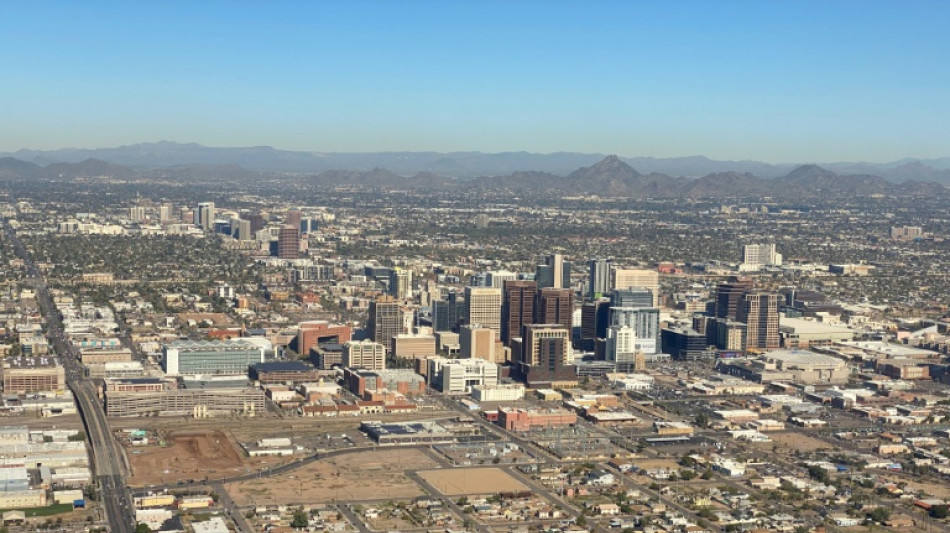
Water managers in Arizona say there is a significant shortfall in the Phoenix area, and that any more development in the fast-growing city must rely on other sources of water -- such as under-strain rivers.
"Over a period of 100 years, the Phoenix (area) will experience 4.86 million acre-feet of unmet demand for groundwater supplies," the Arizona Department of Water Resources said.
An acre-foot is the amount of water it takes to cover an acre with a foot of water -- around 326,000 gallons (1.23 million liters) -- and is equivalent to around half an Olympic-size swimming pool.
"The term 'unmet demand' refers to the amount of groundwater usage that is simulated to remain unfulfilled as a result of wells running dry."
The western United States is in the grip of a more-than two- decade drought and a long-term aridification, which scientists say is being exacerbated by human-caused climate change.
Major rivers that cross the region, among them the Colorado River, have long been over-exploited, with far more water removed every year than falls as rain or snow.
This has led to shrinking reservoirs, including the enormous Lake Mead, which last year dropped to just a quarter of its capacity, threatening "deadpool" -- the point where the river downstream dries up and hydroelectric power production ceases.
With rivers under pressure, fast-growing population centers have long tapped groundwater to provide water for homes and agriculture, in the form of wells.
But this source is easily over-exploited and can in some cases take thousands of years to be replenished.
State officials said permits already issued for developments in Maricopa County, in which Phoenix sits, will not be rescinded, but developers will have to prove any new applications have a sustainable water source other than groundwater.
"The constraints regarding the physical availability of groundwater are attributable to the cumulative results of decades of groundwater overdraft and the continued reliance on groundwater resources," the Arizona Department of Water Resources said.
Phoenix, the country's fifth largest city, is home to around five million people and is one of the fastest growing metropolitan areas in the United States.
The announcement Thursday is the latest move in a long battle over water in the US West.
Last month states that rely on the Colorado River reached an agreement on cutting the amount of water they take from the lifeblood of the region.
Around 40 million people including in Los Angeles, Las Vegas and Phoenix depend on the river.
But what was one of the world's great rivers has now shrunk.
Human-caused climate change means the once-bountiful snowpack that feeds the river has dwindled.
What snow there is melts more quickly because of higher temperatures, and more is lost to evaporation.
Scientists say a wet winter in the US West has alleviated some pressure on the system, but this is only a temporary reprieve as human-caused climate change continues to exacerbate a long-term drying trend.
(T.Renner--BBZ)