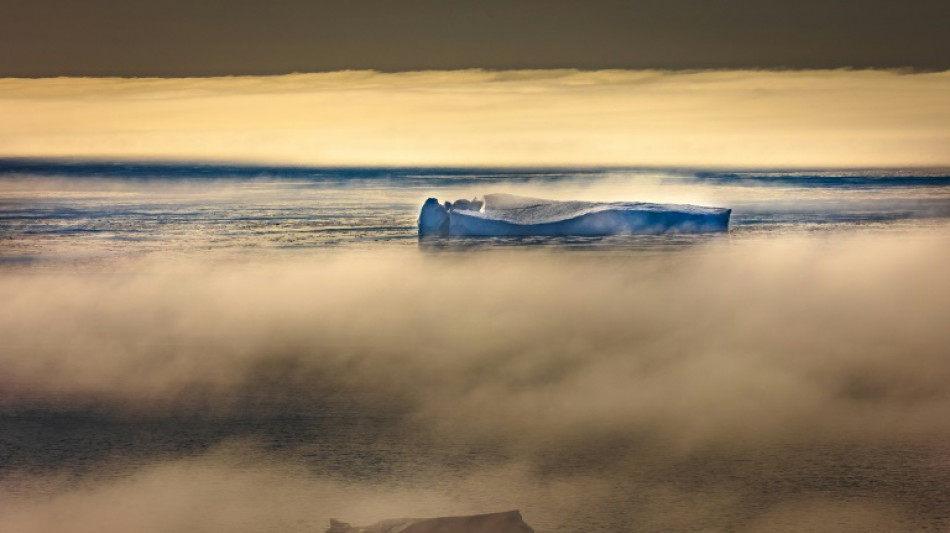
Arctic could be ice-free a decade earlier than thought / Photo: Kerem Yücel - AFP/File

The Arctic Ocean's ice cap will disappear in summer as soon as the 2030s and a decade earlier than thought, no matter how aggressively humanity draws down the carbon pollution that drives global warming, scientists said Tuesday.
Even capping global warming at 1.5 degrees Celsius in line with the Paris climate treaty will not prevent the north pole's vast expanse of floating ice from melting away in September, they reported in Nature Communications.
"It is too late to still protect the Arctic summer sea ice as a landscape and as a habitat," co-author Dirk Notz, a professor at the University of Hamburg's Institute of Oceanography, told AFP.
"This will be the first major component of our climate system that we lose because of our emission of greenhouse gases."
Decreased ice cover has serious impacts over time on weather, people and ecosystems -- not just within the region, but globally.
"It can accelerate global warming by melting permafrost laden with greenhouse gases, and sea level rise by melting the Greenland ice sheet," lead author Seung-Ki Min, a researcher at Pohang University of Science and Technology in South Korea, told AFP.
Greenland's kilometres-thick blanket of ice contains enough frozen water to lift oceans six metres.
By contrast, melting sea ice has no discernible impact on sea levels because the ice is already in ocean water, like ice cubes in a glass.
But it does feed into a vicious circle of warming.
- Three times faster -
About 90 percent of the Sun's energy that hits white sea ice is reflected back into space.
But when sunlight hits dark, unfrozen ocean water instead, nearly the same amount of that energy is absorbed by the ocean and spread across the globe.
Both the North and South Pole regions have warmed by three degrees Celsius compared to late 19th-century levels, nearly three times the global average.
An ice-free September in the 2030s "is a decade faster than in recent projections of the Intergovernmental Panel on Climate Change (IPCC)", the UN's science advisory body, said Min.
In its landmark 2021 report, the IPCC forecast with "high confidence" that the Arctic Ocean would become virtually ice-free at least once by mid-century, and even then only under more extreme greenhouse gas emissions scenarios.
The new study -- which draws from observational data covering the period 1979-2019 to adjust the IPCC models -- finds that threshold will most likely be crossed in the 2040s.
Min and his colleagues also calculated that human activity was responsible for up to 90 percent of the ice cap's shrinking, with only minor impacts from natural factors such as solar and volcanic activity.
The record minimum sea ice extent in the Arctic -- 3.4 million square kilometres (1.3 million square miles) -- occurred in 2012, with the second- and third-lowest ice-covered areas in 2020 and 2019, respectively.
Scientists describe the Arctic Ocean as "ice-free" if the area covered by ice is less than one million square kilometres, about seven percent of the ocean's total area.
Sea ice in Antarctica, meanwhile, dropped to 1.92 million square kilometres in February -- the lowest level on record and almost one million square kilometres below the 1991-2020 mean.
(Y.Berger--BBZ)