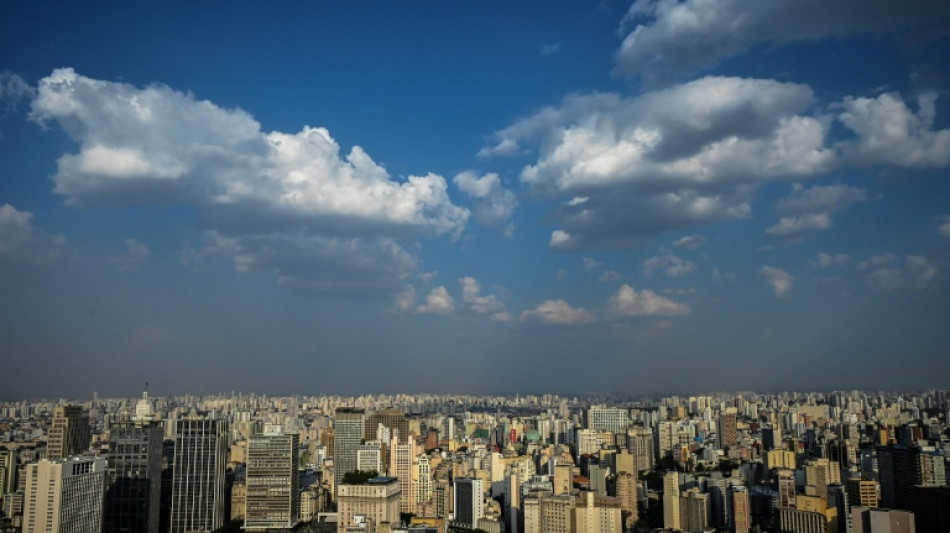
Berliner Boersenzeitung - Brazil experiencing winter heat wave

EUR -
AED 4.231182
AFN 76.040018
ALL 93.28332
AMD 419.960542
AOA 1057.652191
ARS 1711.458707
AUD 1.643934
AWG 2.073827
AZN 1.960953
BAM 1.952337
BBD 2.312508
BDT 141.778513
BHD 0.432936
BIF 3407.171149
BMD 1.152126
BND 1.473612
BOB 13.633994
BRL 5.849809
BSD 1.148148
BTN 109.45727
BWP 15.655299
BYN 3.33999
BYR 22581.676638
BZD 2.309214
CAD 1.617805
CDF 2621.087293
CHF 0.931898
CLF 0.027053
CLP 1068.193963
CNY 7.778353
CNH 7.781565
COP 3630.085168
CRC 521.479526
CUC 1.152126
CUP 30.531349
CVE 110.071189
CZK 24.204443
DJF 204.458219
DKK 7.475393
DOP 66.612421
DZD 153.121031
EGP 57.960488
ERN 17.281895
ETB 183.477644
FJD 2.553575
FKP 0.854585
GBP 0.856473
GEL 3.012759
GGP 0.854585
GHS 13.422366
GIP 0.854585
GMD 84.68235
GNF 10079.165325
GTQ 8.760575
GYD 240.177101
HKD 9.035303
HNL 30.764563
HRK 7.532716
HTG 150.130865
HUF 363.546597
IDR 20724.448947
ILS 3.51966
IMP 0.854585
INR 109.768614
IQD 1504.125456
IRR 1584317.759414
ISK 141.999892
JEP 0.854585
JMD 181.766793
JOD 0.816815
JPY 180.83793
KES 149.086432
KGS 100.75315
KHR 4645.980752
KMF 491.958073
KRW 1648.894445
KWD 0.356756
KYD 0.956807
KZT 544.057313
LAK 26002.215821
LBP 102821.361766
LKR 385.441323
LRD 207.241496
LSL 18.991261
LTL 3.401929
LVL 0.69691
LYD 7.346002
MAD 10.725814
MDL 20.064671
MGA 4910.311403
MKD 61.464255
MMK 2419.100294
MNT 4140.198973
MOP 9.275407
MRU 46.144549
MUR 54.081118
MVR 17.811624
MWK 1990.877223
MXN 19.963758
MYR 4.717923
MZN 73.632627
NAD 18.991096
NGN 1567.525326
NIO 42.255231
NOK 10.986072
NPR 175.130114
NZD 1.963586
OMR 0.442993
PAB 1.148139
PEN 3.891098
PGK 5.140903
PHP 70.237063
PKR 318.87157
PLN 4.299897
PYG 6845.886481
QAR 4.19721
RON 5.244248
RSD 117.354485
RUB 91.881726
RWF 1685.517545
SAR 4.311981
SBD 9.310454
SCR 16.117074
SDG 691.27601
SEK 10.988786
SGD 1.477625
SLE 28.449336
SOS 656.133304
SRD 43.529064
STD 23846.689499
STN 24.456725
SVC 10.046224
SZL 18.988401
THB 38.419381
TJS 10.597356
TMT 4.043964
TND 3.375357
TRY 54.769495
TTD 7.796205
TWD 37.395143
TZS 3045.742793
UAH 51.245723
UGX 4311.408559
USD 1.152126
UYU 46.197854
UZS 13743.681113
VES 859.136475
VND 30265.78339
VUV 137.160822
WST 3.150479
XAF 654.798361
XAG 0.019762
XAU 0.000284
XCD 3.113679
XCG 2.069239
XDR 0.814359
XOF 654.798361
XPF 119.331742
YER 274.548333
ZAR 18.995566
ZMK 10370.552523
ZMW 21.567837
ZWL 370.984218
  • RBGPF

    0.0000

    69.21

    0%

  • CMSD

    0.0900

    22.11

    +0.41%

  • RIO

    -0.3300

    96.85

    -0.34%

  • BCC

    1.0000

    76.38

    +1.31%

  • CMSC

    0.0300

    21.84

    +0.14%

  • BCE

    -0.0200

    21.68

    -0.09%

  • JRI

    0.0900

    12.96

    +0.69%

  • NGG

    -0.4200

    79.97

    -0.53%

  • RELX

    -1.1900

    35.42

    -3.36%

  • RYCEF

    -0.3100

    19.55

    -1.59%

  • GSK

    -0.3800

    51.69

    -0.74%

  • AZN

    -1.7000

    169.64

    -1%

  • BTI

    -1.0400

    60.65

    -1.71%

  • VOD

    -0.3600

    15.78

    -2.28%

  • BP

    1.0000

    45.22

    +2.21%

Brazil experiencing winter heat wave
Brazil experiencing winter heat wave / Photo: Nelson ALMEIDA - AFP

Brazil experiencing winter heat wave

Brazil is enduring a heat wave in the middle of the southern hemisphere's winter, with the metropolis of Sao Paulo close to breaking records for August and for the year 2023.

Text size:

The inhabitants of the largest city in Latin America, with 11.5 million people, have been surprised by temperatures almost 10 degrees above the average for the month, of 24.5 degree Celsius (76.1 degrees Fahrenheit), according to the National Institute of Meteorology (Inmet).

And thermometers hit a high of 32.3 Celsius on Wednesday, close to the 32.5 Celsius reported on January 16, in summer.

And they were also very close to the highest temperatures ever officially logged for August: 33.1 Celsius on August 31, in 1952 and 1955.

Inmet, which has measured the weather since 1943, warned that the historical records for August and 2023 could be broken on Thursday.

"Then it will get colder... But in the future the winters will probably get hotter," Fabio Luiz Teixeira, a professor at the Department of Atmospheric Sciences at the University of Sao Paulo, told AFP.

The unusual weather this month is the result of a large mass of hot and dry air hovering over Brazil, experts said.

That mass, which raises the temperature, is formed by a combination of the El Nino weather phenomenon and global warming due to human activity.

- "We're used to the heat" -

"Today we have temperatures five degrees above average in some areas or cities in Brazil," said Cleber Souza, an Inmet meteorologist.

Souza also warned of high temperatures in Mato Grosso, in the center-west of Brazil, of around 41 degrees, with the north and northeast of the country getting close to 40 degrees.

The authorities of the state of Sao Paulo, which in July had temperatures above average and rainfall below average, have identified several areas at elevated risk for forest fires.

And they have asked citizens to keep themselves hydrated, avoid exercising outdoors and even, in some areas, to use serum to refresh their noses and eyes due to the dry climate and low humidity.

In the streets of Sao Paulo, people dressed as though for a typical summer day.

"It's hot but it's windy. We're used to the heat," said Jose Carlos Antonio, a 40-year-old construction worker.

Countries of the Southern Cone have registered heat records in the middle of the southern winter. But waves of high temperatures could become a permanent phenomenon in the world due to climate change, warned a UN specialist.

"People are far too relaxed about the signs," John Nairn, an extreme heat expert at the World Meteorological Organization WMO, told AFP.

"The science has been saying this is coming your way. And this is not where it stops."

"It will only get more intense and more frequent," he warned

(S.G.Stein--BBZ)