Acai berry craze: boon or threat for the Amazon? / Photo: Evaristo SA - AFP

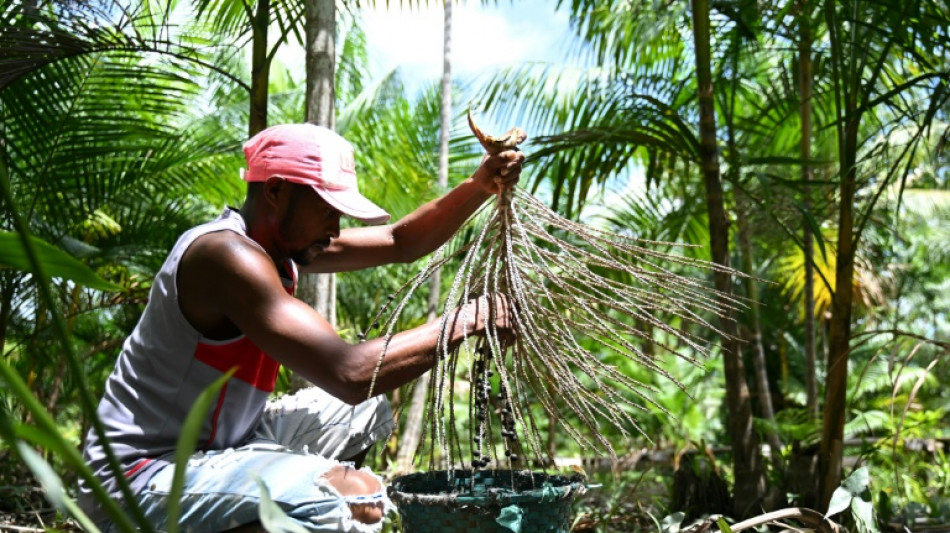
Working in the sweltering heat of the Brazilian Amazon, Jose Diogo scales a tree and harvests a cluster of black berries: acai, the trendy "superfood" reshaping the world's biggest rainforest -- for better and worse.
Diogo, 41, who lives in a poor, remote community founded by escaped slaves, is a world away from the upscale supermarket aisles of New York or Tokyo, where berries like these are sold in sorbets, smoothies, juices, powders and pills, popularized by the likes of Gwyneth Paltrow and Meghan Markle.
But he has a front-row view of the changes the acai craze is bringing to the Brazilian Amazon.
Since acai rose to international fame in the 2000s, touted for its rich nutritional and antioxidant properties, it has unleashed an economic boom for traditional farmers in the Amazon region, and been lauded as a way to bring "green development" to the rainforest without destroying it.
But experts say it is also threatening the Amazon's biodiversity, as single-crop fields of acai palms become increasingly common.
Diogo, who lives in the village of Igarape Sao Joao, in the northern state of Para, is building himself a brick house thanks to the money he has made from acai.
"Things get a lot better for us every harvest season," he says, scraping the small berries into a large basket.
He can fill 25 such baskets on a good day, bringing home between 300 and 625 reais ($60 to $128), he says.
The berries are brought by boat to Belem, the state capital, where sweating workers carry huge loads of them to market to be sold as quickly as possible, before the fragile fruit goes bad.
- 'Acai-ification' of the Amazon -
Long eaten by Indigenous groups, acai is a culinary mainstay in northeastern Brazil, eaten with manioc flour or used to accompany fish and other dishes.
Its deep-purple pulp shot to popularity across Brazil over the past two decades, often drunk as juice or made into a sweetened sorbet and served with fruit and granola.
From there, acai went on to win fans worldwide, from the United States to Europe, Australia and Japan, where it can sell from around $5 per bowl to upwards of $20 for a 100-gram packet of organic acai powder.
Brazilian exports of acai and its derivatives surged from 60 kilograms in 1999 to more than 15,000 tonnes in 2021.
Para, the source of 90 percent of Brazil's acai, produced almost 1.4 million tonnes of it in 2021, worth more than $1 billion for the state's economy.
But studies show the expansion of acai palms in the Amazon is causing a loss of biodiversity in some regions by replacing other species.
"Leave nature to its own devices, and you get 50 or maybe 100 acai plants per hectare," says biologist Madson Freitas of the Museu Goeldi research institute in Belem.
"When you go beyond 200, you lose 60 percent of the diversity of other native species."
He has published a study on the phenomenon, which he calls "acai-ification."
The loss of other plant species in turn has a negative effect on acai, which becomes less productive because of a loss of pollinators such as bees, ants and wasps, he says.
Longer dry periods in the Amazon, which may be exacerbated by climate change, are also hurting acai, which tends to grow on land that floods during the rainy season.
- 'Environmental service' -
Freitas, like Diogo, comes from a "quilombo," communities founded by runaway slaves in Brazil in the 17th and 18th centuries.
He says stronger conservation laws and policing are needed to combat single-crop farming -- as well as incentives for farmers to preserve the rainforest.
Salomao Santos, a local leader in Igarape Sao Joao, admits acai's dominance could become a problem.
"Those of us who live in the Amazon know we can't live on one single species," he says.
He recalls the commodity booms and busts of the past, such as sugar cane and rubber.
He wants compensation for quilombo residents and others who preserve the Amazon, whose hundreds of billions of carbon-absorbing trees are a vital resource against climate change.
"We provide a huge environmental service to the world," he says.
(F.Schuster--BBZ)