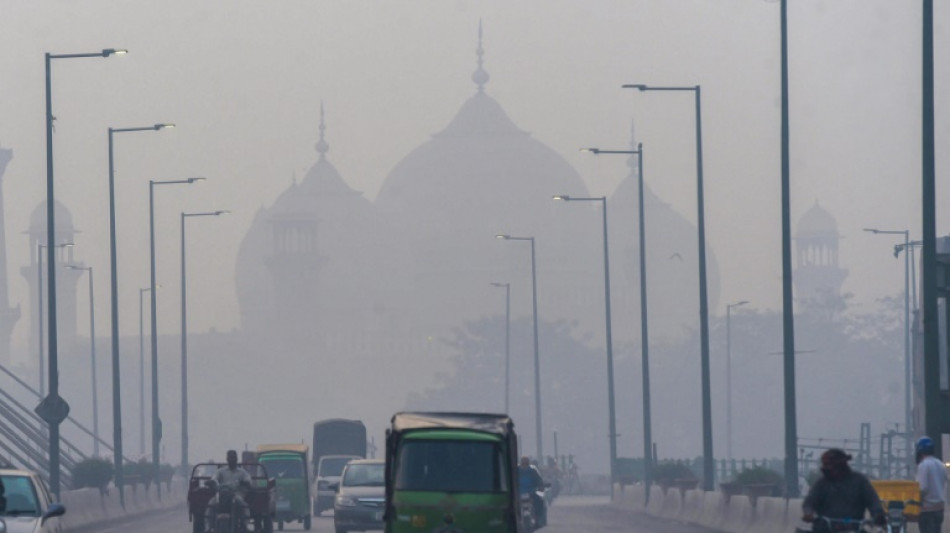
Air pollution greatest global threat to human health, says benchmark study / Photo: Arif ALI - AFP/File

Air pollution is more dangerous to the health of the average person on planet Earth than smoking or alcohol, with the threat worsening in its global epicenter South Asia even as China fast improves, a study showed Tuesday.
Yet the level of funding set aside to confront the challenge is a fraction of the amount earmarked for fighting infectious diseases, said the research from the Energy Policy Institute at the University of Chicago (EPIC).
Its annual Air Quality Life Index (AQLI) report showed that fine particulate air pollution -- which comes from vehicle and industrial emissions, wildfires and more -- remains the "greatest external threat to public health."
If the world were to permanently reduce these pollutants to meet the World Health Organization's (WHO) guideline limit, the average person would add 2.3 years onto his or her life expectancy, according to the data, which has a 2021 cutoff.
Fine particulate matter is linked to lung disease, heart disease, strokes and cancer.
Tobacco use, by comparison, reduces global life expectancy by 2.2 years while child and maternal malnutrition is responsible for a reduction of 1.6 years.
Asia and Africa bear the greatest burden yet have some of the weakest infrastructure to deliver citizens timely, accurate data. They also receive tiny slices of an already small global philanthropic pie.
For example, the entire continent of Africa receives less than $300,000 to tackle air pollution.
"There is a profound disconnect with where air pollution is the worst and where we, collectively and globally, are deploying resources to fix the problem," Christa Hasenkopf, director of air quality programs at EPIC, told AFP.
While there is an international financing partnership called the Global Fund that disburses $4 billion annually on HIV/AIDS, malaria and tuberculosis, there is no equivalent for air pollution.
"Yet, air pollution shaves off more years from the average person's life in the DRC (Democratic Republic of Congo) and Cameroon than HIV/AIDS, malaria, and other health threats," the report said.
- Bangladesh tops ranking -
Globally, South Asia is the worst impacted region. Bangladesh, India, Nepal and Pakistan are in order the top four most polluted countries in terms of annualized, population-weighted averages of fine particulate matter, which are detected by satellites and defined as particles with a diameter of 2.5 microns or less (PM2.5).
Air pollution concentrations are then fed into the AQLI metric which calculates their impact on life expectancy, based on peer-reviewed methods.
Residents of Bangladesh, where average PM2.5 levels were 74 micrograms per cubic meter, would gain 6.8 years of life if this were brought to WHO guidelines of 5 micrograms per cubic meter.
India's capital Delhi meanwhile is the "most polluted megacity in the world" with annual average particulate pollution of 126.5 micrograms per cubic meter.
China, on the other hand, "has had remarkable progress in terms of its war on air pollution" which began in 2014, said Hasenkopf.
Its air pollution dropped 42.3 percent between 2013 and 2021. If the improvements are sustained, the average Chinese citizen will be able to live 2.2 years longer.
In the United States, legislative actions like the Clean Air Act helped reduce pollution by 64.9 percent since 1970, helping Americans gain 1.4 years of life expectancy.
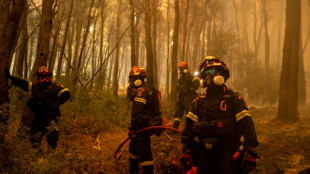
But the growing threat of wildfires -- linked to hotter temperatures and drier conditions due to climate change -- are causing pollution spikes from the western United States to Latin America and Southeast Asia.
For example, California's historic wildfire season of 2021 saw Plumas County receive an average concentration of fine particulate matter more than five times over the WHO guideline.
North America's story of air pollution improvements in recent decades is similar to Europe, but there remain stark differences between western and eastern Europe, with Bosnia the continent's most polluted country.
(S.G.Stein--BBZ)