Berliner Boersenzeitung - Elusive Attenborough echidna rediscovered in Indonesia

EUR -
AED 4.237807
AFN 72.697767
ALL 96.064347
AMD 435.561434
ANG 2.065628
AOA 1058.152067
ARS 1611.221976
AUD 1.624749
AWG 2.077071
AZN 1.949577
BAM 1.955569
BBD 2.317456
BDT 141.183313
BGN 1.972421
BHD 0.435579
BIF 3416.32219
BMD 1.153929
BND 1.470294
BOB 7.967076
BRL 5.991892
BSD 1.150629
BTN 106.255218
BWP 15.636678
BYN 3.451187
BYR 22617.000762
BZD 2.314056
CAD 1.580052
CDF 2613.648428
CHF 0.90572
CLF 0.026518
CLP 1047.086651
CNY 7.946933
CNH 7.943563
COP 4271.347526
CRC 539.319896
CUC 1.153929
CUP 30.579108
CVE 112.103849
CZK 24.436724
DJF 204.889568
DKK 7.47249
DOP 70.229569
DZD 152.429318
EGP 60.297397
ERN 17.308929
ETB 181.167229
FJD 2.548509
FKP 0.867557
GBP 0.864004
GEL 3.127009
GGP 0.867557
GHS 12.5605
GIP 0.867557
GMD 84.812672
GNF 10083.589698
GTQ 8.831444
GYD 241.21646
HKD 9.042876
HNL 30.659321
HRK 7.534351
HTG 150.928891
HUF 388.529805
IDR 19572.937088
ILS 3.576544
IMP 0.867557
INR 107.416676
IQD 1511.64648
IRR 1516262.193461
ISK 143.617514
JEP 0.867557
JMD 181.003116
JOD 0.818088
JPY 183.501164
KES 149.491232
KGS 100.91092
KHR 4617.334208
KMF 492.7277
KPW 1038.586413
KRW 1714.511206
KWD 0.353899
KYD 0.958853
KZT 554.405254
LAK 24691.332668
LBP 103211.950636
LKR 358.306782
LRD 210.558726
LSL 19.259252
LTL 3.407251
LVL 0.698
LYD 7.379338
MAD 10.805099
MDL 20.072019
MGA 4806.112939
MKD 61.644542
MMK 2423.426895
MNT 4124.715035
MOP 9.287321
MRU 46.27835
MUR 53.807791
MVR 17.828323
MWK 2004.374083
MXN 20.382539
MYR 4.529219
MZN 73.747646
NAD 19.259218
NGN 1561.127147
NIO 42.372517
NOK 11.055759
NPR 170.008749
NZD 1.970708
OMR 0.443645
PAB 1.152982
PEN 3.94355
PGK 4.962758
PHP 68.838751
PKR 322.234628
PLN 4.262439
PYG 7458.892152
QAR 4.204341
RON 5.092865
RSD 117.454953
RUB 95.049812
RWF 1683.581842
SAR 4.332489
SBD 9.283566
SCR 17.333951
SDG 693.510898
SEK 10.709503
SGD 1.473107
SHP 0.865745
SLE 28.364002
SLL 24197.318486
SOS 656.402506
SRD 43.416555
STD 23883.992461
STN 24.493178
SVC 10.067461
SYP 127.942867
SZL 19.259619
THB 37.3094
TJS 11.028605
TMT 4.050289
TND 3.383896
TOP 2.778383
TRY 50.995218
TTD 7.806807
TWD 36.797284
TZS 3010.288514
UAH 50.554091
UGX 4352.065813
USD 1.153929
UYU 46.867267
UZS 14005.806816
VES 516.738648
VND 30348.322451
VUV 137.995029
WST 3.178161
XAF 655.859587
XAG 0.014553
XAU 0.00023
XCD 3.11855
XCG 2.073683
XDR 0.815679
XOF 658.319048
XPF 119.331742
YER 275.269543
ZAR 19.26645
ZMK 10386.725812
ZMW 22.442667
ZWL 371.564542
  • RBGPF

    0.1000

    82.5

    +0.12%

  • CMSC

    -0.0400

    22.95

    -0.17%

  • CMSD

    -0.0700

    22.88

    -0.31%

  • BTI

    -0.3900

    60.55

    -0.64%

  • GSK

    -0.3600

    53.41

    -0.67%

  • RIO

    -0.0600

    89.8

    -0.07%

  • BCC

    1.2000

    72.92

    +1.65%

  • BCE

    0.1100

    26.01

    +0.42%

  • BP

    0.9500

    43.85

    +2.17%

  • RELX

    -0.1800

    34.29

    -0.52%

  • RYCEF

    0.3800

    16.5

    +2.3%

  • JRI

    -0.0800

    12.46

    -0.64%

  • AZN

    -0.7200

    191.29

    -0.38%

  • NGG

    -0.4700

    90.42

    -0.52%

  • VOD

    0.1500

    14.75

    +1.02%

Elusive Attenborough echidna rediscovered in Indonesia
Elusive Attenborough echidna rediscovered in Indonesia / Photo: Handout - EXPEDITION CYCLOPS/AFP

Elusive Attenborough echidna rediscovered in Indonesia

An elusive echidna feared extinct after disappearing for six decades has been rediscovered in a remote part of Indonesia, on an expedition that also found a new kind of tree-dwelling shrimp.

Text size:

The Zaglossus attenboroughi, a kind of long-beaked echidna named for famed British naturalist David Attenborough, had last been seen in 1961.

Echidnas are nocturnal and shy, making them difficult to find at the best of times, and the Attenborough long-beaked echidna has never been recorded outside the extremely remote Cyclops Mountains of Indonesia's Papua region.

They are the last vestiges of an ancient animal line, explained James Kempton, a biologist from the University of Oxford who led the expedition.

"The reason it appears so unlike other mammals is because it is a member of the monotremes –- an egg-laying group that separated from the rest of the mammal tree-of-life about 200 million years ago."

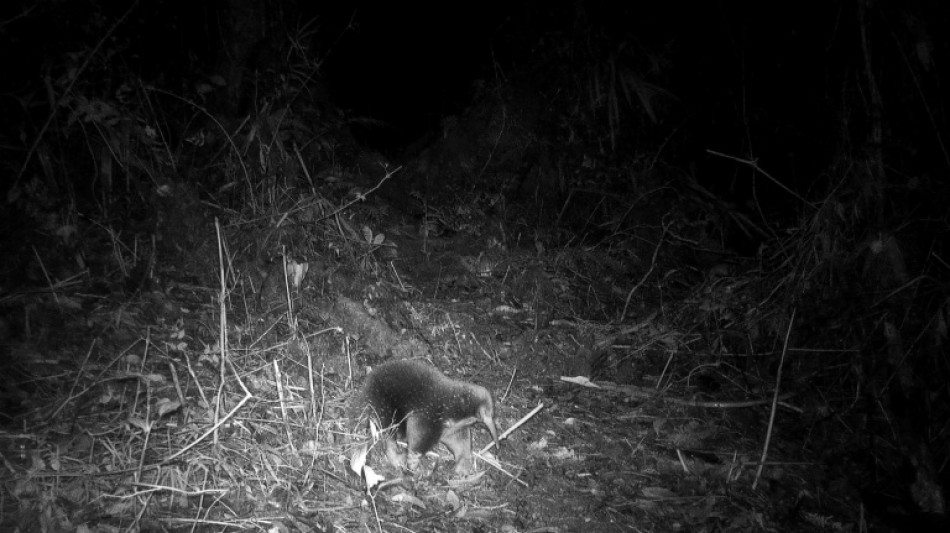
It took a team of scientists and experts from Britain and Indonesia four weeks and 80 camera traps to find the echidna, and it was only on the last day, and the final memory card of the trip, that the creature made an appearance.

Just a few seconds of black and white footage shows the slightly ungainly creature ambling through the undergrowth, apparently unaware of the excitement its very existence is likely to elicit.

"The discovery is the result of a lot of hard work and over three-and-a-half years of planning," said Kempton.

The team relied heavily on guidance from the local community, who helped them navigate difficult terrain and granted them access to areas regarded as sacred.

In addition to the rediscovered echidna, the team found a kind of honeyeater bird not recorded since 2008, and a slew of underground species that are new to science.

Blind spiders, blind harvestman and a whip scorpion were all recorded in a previously unexplored cave system that was revealed only when a team member fell through a moss-covered entrance.

Among the more unusual findings was a new kind of tree-dwelling shrimp.

"We were quite shocked to discover this shrimp in the heart of the forest," said Leonidas-Romanos Davranoglou, the team's lead entomologist, theorising that the region's heavy rainfall creates an environment humid enough for the shrimps to live on land.

The discoveries came despite perilous conditions, with Davranoglou breaking his arm on the trip and another researcher enduring a leech attached to his eye for a day and half before it was removed at a hospital.

For all the hardships, Kempton described the landscape as "magical," and the team hopes their findings will highlight the desperate need for conservation of the region and Indonesia's remaining forests elsewhere.

"Tropical rainforests are among the most important and most threatened terrestrial ecosystems," said Davranoglou.

(S.G.Stein--BBZ)