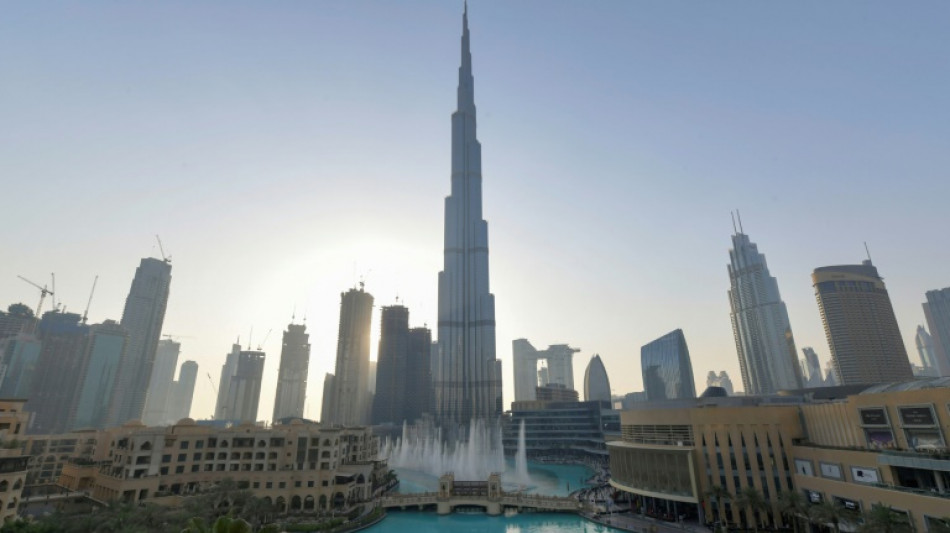
UAE: fossil fuel power and COP28 host / Photo: Karim SAHIB - AFP

A gas-guzzling fossil fuel exporter trying to spearhead more ambitious climate action, the United Arab Emirates remains heavily dependent on hydrocarbons for its prosperity.
- The carbon footprint -
The UAE may be a small country of only nine million inhabitants but it emitted 237 million tonnes of carbon dioxide (CO2) in 2021, according to the Global Carbon Atlas -- without including methane and other greenhouse gas emissions.
The United Kingdom, for comparison, emitted 348 million that year for a population of 67 million people.
The Gulf state ranks at 25 tonnes of CO2 emitted per person, higher than its fossil fuel-producing neighbour Saudi Arabia (18 tonnes) but below the record-breaking Qataris (40 tonnes) in 2021.
The tallies do not account for the oil and gas exported by these countries to other nations: they solely consider the CO2 emitted directly by inhabitants and businesses -- reflecting an economy and a way of life still heavily reliant on the combustion of oil and gas.
Energy-intensive construction and cooling activities flourish as gleaming skyscrapers sprout from the once barren desert and air conditioning is ubiquitous in the scorching heat.
Electricity in the Emirates is nearly entirely produced by burning gas (82.5 percent in 2022).
Renewables only account for five percent of its power, and a burgeoning nuclear capacity has seen atomic power's share jump to almost 13 percent in 2022, according to the energy think tank Ember.
- The climate ambition -
In July, the UAE announced an updated climate action strategy, joining a growing list of nations committed to tripling renewable energy production by 2030.
It unveiled plans to slash emissions in everything from industry to transport, including a new focus on electric cars.
It recently launched its first wind farm. And just two weeks before COP28 it inaugurated the Al Dhafra solar power plant -- one of the largest in the world.
But the UAE's climate strategy has been deemed "insufficient" or "highly insufficient", depending on the criteria, by Climate Action Tracker (CAT), a monitoring group which tracks government climate action and measures it against the global effort needed to keep warming below 1.5 degrees Celsius compared to pre-industrial levels.
CAT cited planned increases in oil production, offshore gas exploration and a 2050 net-zero target lacking credible emission reduction policies as reasons for its rating.
The Emiratis, however, highlight the rising diversification of their economy -- even if oil and gas remain dominant, they represent 30 percent of GDP compared to Saudi Arabia's 42 percent.
- ADNOC's role -
The UAE is the seventh largest producer of oil in the world, ahead of Iran and Kuwait, through their state-owned Abu Dhabi National Oil Company (ADNOC).
ADNOC plans to invest $150 billion dollars between 2023-2027 to expand its oil and gas production capacity.
In October, it announced a new off-shore gas project known as the Hail and Ghasha fields.
The project, located within a marine biosphere reserve, is spearheaded by ADNOC CEO Sultan Al Jaber -- also the founding chief executive of the renewable energy company Masdar and this year's COP28 president.
His chairmanship of the climate talks has drawn the ire of campaigners accusing the country of double dealing.
Jaber has said the UAE's oil is cheaper and less carbon-intensive than that of other producers and that ADNOC seeks to increase the capacity for extracting oil, rather than its production, to meet future demand.
Fossil fuels should only be abandoned once enough renewables can replace them, he argues.
The UAE supports carbon capture and storage (CCS) technologies that remain far from capable of storing the billions of tonnes of CO2 necessary.
"With its focus on 'emissions-free' fossil fuels and CCS, the UAE is clearly pushing an agenda to distract attention from a fossil fuel phase-out," said Mia Moisio, of the NewClimate Institute non-profit organisation.
According to the non-profit Global Witness, ADNOC is "on course" to increase its total emissions from oil and gas by more than 40 percent, reaching 684 million tonnes of CO2 by 2030 -- nearly triple the nation's 2021 emissions.
(F.Schuster--BBZ)