Red Sea attacks latest threat to Yemen's decaying oil tanker
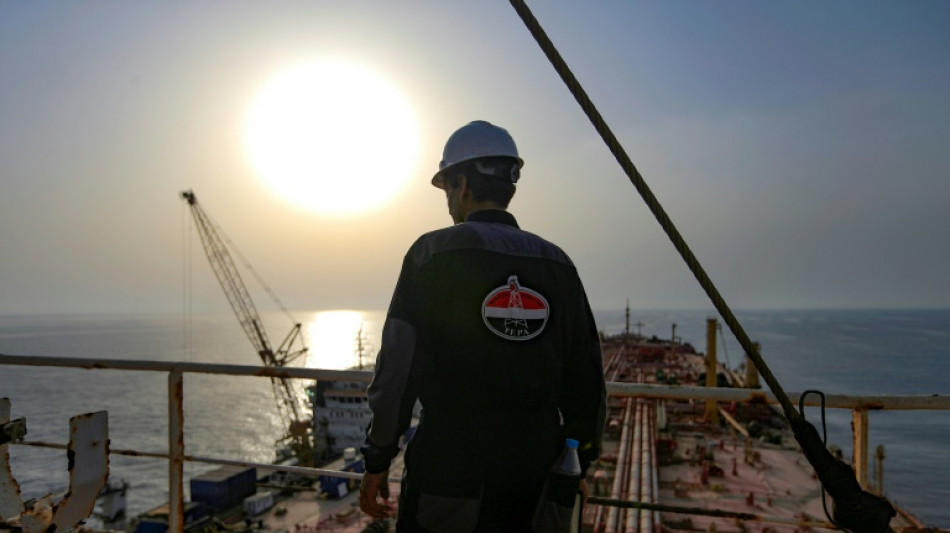
/ Photo: MOHAMMED HUWAIS - AFP

Mounting maritime security threats off Yemen's coast have stalled work on scrapping a decrepit oil tanker, officials have told AFP, jeopardising a rare success story in the war-torn country.
The FSO Safer, a 48-year-old vessel with a corroding hull, was for years described as a "ticking time bomb", going unserviced as fighting raged in Yemen and fears grew that a leak or on-board explosion could release its 1.14 million barrels of crude into the Red Sea.
But last August, the United Nations announced the completion of a complex transfer of the oil to a new vessel, a crucial step in staving off an environmental and economic calamity.
The UN said at the time that completing the project would involve towing and scrapping the Safer, which still posed "a residual environmental threat, holding viscous oil residue and remaining at risk of breaking apart".
However, after delays over a $22 million funding shortfall and other challenges, security in the Red Sea has deteriorated dramatically, a knock-on effect of the conflict between Israel and Hamas triggered by the militant group's unprecedented attacks on southern Israel on October 7.
Iran-backed Huthi forces, which control the capital Sanaa and the waters where the Safer is located, began attacking Red Sea shipping in November, and the United States has carried out several rounds of strikes on Huthi targets this month along with two joint operations with Britain.
The situation has "resulted in unforeseen operational and financial challenges" for the Safer project, making it difficult to move forward, a spokesperson for the UN Development Programme told AFP.
"After much consideration, the UN had no option but to pause the project at this time and has informed the authorities accordingly," the spokesperson said.
"We continue to follow developments on the ground very carefully and closely."
Edrees al-Shami, the Sanaa-appointed executive general manager of SEPOC, the Yemeni oil and gas company, said there was a "big risk" of the ships being struck by a stray missile as Huthi-controlled areas come under attack.
- Peace talks in peril -
Completing the Safer project was always expected to be complicated because of Yemen's war, which has killed hundreds of thousands of people, either directly in the fighting or indirectly as a result of war-induced shortages.
It pits the Huthis, who took control of Sanaa in 2014, against a Saudi-led coalition supporting the internationally recognised government based in the southern city of Aden.
Though a six-month truce that took effect in April 2022 has largely held, analysts say the recent regional turmoil threatens efforts to secure a durable ceasefire.
The Huthis say their activities in the Red Sea are aimed at Israeli-linked vessels in support of Palestinians in Gaza, where Israel's withering retaliatory campaign against Hamas has killed more than 25,000 people, mostly women and children, according to the Gaza health ministry.
The October 7 attacks resulted in the deaths of about 1,140 people, mostly civilians, according to an AFP tally based on official Israeli figures.
The Huthis have also declared American and British interests to be legitimate targets.
The group "will use all cards at their disposal to tarnish this US-led coalition", said Bader al-Saif of Kuwait University.
A delay for the Safer project "fits into the anti-US propaganda (the Huthis) are good at assembling".
- Who owns the oil? -
Yemen's rival authorities in Sanaa and Aden are at odds over who owns the oil that was on the Safer as well as the new tanker that now holds it, the MT-Yemen.
The Huthis have previously said they want to sell the oil and use the revenue to cover their employees' salaries.
They have also called for the completion of onshore storage facilities that could potentially hold the crude.
Under the terms of the handover deal announced last summer, the MT-Yemen was to be managed by a UN-contracted firm for at least six months.
But Shami, the Sanaa-appointed executive general manager of SEPOC, told AFP thefirm "wants to leave the vessel due to the recent developments in the region".
The UN says the crew is due to leave under the terms of its contract but that the MT-Yemen remains under the firm's management.
Shami raised the possibility that SEPOC "will have to take over management" of the vessel, a development sure to rile the government in Aden, which does not acknowledge Shami's authority and has named its own executive general manager of SEPOC.
Other steps yet to be completed include tethering an anchored buoy to the MT-Yemen, for stability and to aid the eventual offloading, and inspecting the underwater pipeline that stretched from Yemeni soil to the Safer and will later be connected to the MT-Yemen, Shami said.
All of these are "integral" to the project, he said.
"If the UN fails to support operating the vessel properly, MT-Yemen will be FSO Safer the sequel," he said.
(S.G.Stein--BBZ)