Scientists risk arrest to sound climate alarm

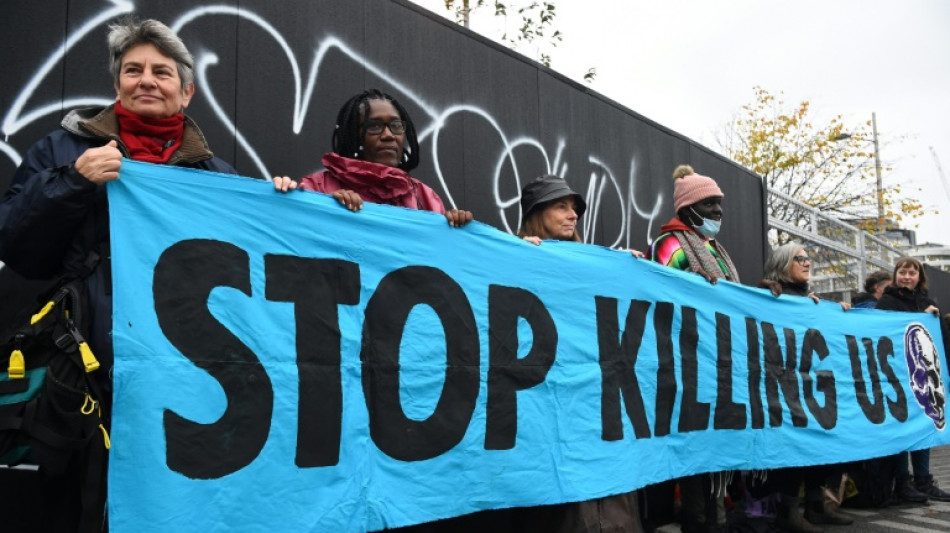
A loosely federated network of scientists in more than two dozen countries plan acts of civil disobedience starting this week to highlight the climate crisis, members of Scientist Rebellion told AFP.
Their non-violent actions are timed to the release Monday of a landmark report from the UN's climate science advisory panel laying out options for slashing carbon pollution and controversial schemes for extracting CO2 from the air, they said in interviews.
Scientist Rebellion targets universities, research institutes and major scientific journals, prodding them and their staff to speak out more forcefully on what they describe as the existential threat of global warming.
"Scientists are particularly powerful messengers, and we have a responsibility to show leadership," said Charlie Gardner, a conservation scientist at the University of Kent specialised in tropical biodiversity.
"We are failing in that responsibility. If we say it's an emergency, we have to act like it is."
Starting Monday, the group hopes to see "high levels of disobedience" with more than 1,000 scientists worldwide taking part in direct non-violent action against government and academic institutions.
The world has seen a crescendo of deadly extreme weather amplified by rising temperatures -- heatwaves, wildfires, flooding, storms engorged by rising seas -- and a torrent of recent climate science projects worse to come.
Much of that research is distilled in periodic reports from the UN's Intergovernmental Panel On Climate Change (IPCC).
Scientist Rebellion was founded in 2020 by two physics PhD students at St Andrews College in Scotland, inspired in part by the more broadly based Extinction Rebellion.
The group's first significant action with more than 100 scientists, in March 2021, targeted the British Royal Society and science publishing behemoth Springer Nature.
"We basically pasted enlarged copies of their journal articles calling for rapid transformative change onto their offices," said Kyle Topher, an environmental scientist from Australia and full-time activist for the group.
- 'It is survival' -
Last year's COP26 climate summit in Glasgow saw a score of their members arrested.
"As far as we know this was the first mass arrest of scientists anywhere in the world since Carl Sagan protested nuclear weapons testing in the 1980s," said Gardner.
They also made headlines by leaking an early draft of Monday's IPCC report, which warned that carbon dioxide emissions need to peak within three years if the world is to keep the Paris Agreement targets for global warming in reach.
"As scientists, we tend to be risk averse -- we don't want to risk our jobs, our reputations, and our time," said Rose Abramoff, a soil scientist at Oak Ridge National Laboratory in Knoxville, Tennessee and a Scientist Rebellion member.
"But it is no longer sufficient to do our research and expect others to read it and understand the severity and urgency of the climate crisis."
The aim of the group is to "make this crisis impossible to ignore", she added.
Many of its members are in the Global South, where climate change protests up to now have been more muted, even if the impacts are more keenly felt.
"I am not sure this is our last chance, but time is definitely running out," said Jordan Cruz, an environmental engineer in Ecuador who studies the devastating impact of mining industries on human communities in the Andes.
"I am terrified," he said by email. "But it's the kind of fear that motivates action. It is survival."
More information about Scientist Rebellion can be found here: https://scientistrebellion.com/take-action/
(A.Lehmann--BBZ)