Berliner Boersenzeitung - Return of hungry sea otters protects key coastal ecosystem: study

EUR -
AED 4.273873
AFN 76.929105
ALL 96.379067
AMD 444.029165
ANG 2.083178
AOA 1067.159907
ARS 1669.272238
AUD 1.756871
AWG 2.097662
AZN 1.979007
BAM 1.953746
BBD 2.344035
BDT 142.270396
BGN 1.955457
BHD 0.438721
BIF 3450.522479
BMD 1.163751
BND 1.509219
BOB 8.070548
BRL 6.320677
BSD 1.163776
BTN 104.758292
BWP 15.482786
BYN 3.365775
BYR 22809.524649
BZD 2.340649
CAD 1.612779
CDF 2597.492788
CHF 0.939101
CLF 0.027377
CLP 1074.002511
CNY 8.229703
CNH 8.229217
COP 4447.857307
CRC 568.302402
CUC 1.163751
CUP 30.839408
CVE 110.730605
CZK 24.29028
DJF 206.822123
DKK 7.468604
DOP 74.771025
DZD 151.366954
EGP 55.248856
ERN 17.456269
ETB 180.916335
FJD 2.643812
FKP 0.872848
GBP 0.873441
GEL 3.136298
GGP 0.872848
GHS 13.336175
GIP 0.872848
GMD 85.546628
GNF 10111.253446
GTQ 8.914626
GYD 243.48501
HKD 9.054869
HNL 30.651768
HRK 7.533312
HTG 152.379765
HUF 384.868819
IDR 19409.043474
ILS 3.752108
IMP 0.872848
INR 104.908859
IQD 1524.596811
IRR 49023.021981
ISK 148.913831
JEP 0.872848
JMD 186.573808
JOD 0.825087
JPY 181.472459
KES 150.414828
KGS 101.769946
KHR 4661.987879
KMF 491.10353
KPW 1047.375979
KRW 1710.377003
KWD 0.357377
KYD 0.969884
KZT 594.694649
LAK 25239.567778
LBP 104218.856453
LKR 359.122365
LRD 205.414879
LSL 19.76172
LTL 3.436255
LVL 0.703942
LYD 6.32435
MAD 10.750995
MDL 19.732335
MGA 5189.56521
MKD 61.575251
MMK 2443.911415
MNT 4128.95989
MOP 9.326693
MRU 46.412195
MUR 53.672293
MVR 17.922294
MWK 2018.086552
MXN 21.261474
MYR 4.786468
MZN 74.375604
NAD 19.76172
NGN 1687.974768
NIO 42.824967
NOK 11.789138
NPR 167.613466
NZD 2.01475
OMR 0.447463
PAB 1.163781
PEN 3.914684
PGK 4.938807
PHP 68.853362
PKR 328.919325
PLN 4.23787
PYG 8003.583833
QAR 4.242039
RON 5.08815
RSD 117.38526
RUB 89.084365
RWF 1693.31939
SAR 4.367717
SBD 9.578362
SCR 16.246878
SDG 699.998259
SEK 10.94081
SGD 1.510321
SHP 0.873115
SLE 27.58248
SLL 24403.279831
SOS 663.904724
SRD 44.989458
STD 24087.301428
STN 24.474264
SVC 10.183292
SYP 12867.40098
SZL 19.756225
THB 37.123534
TJS 10.677872
TMT 4.084767
TND 3.418505
TOP 2.802034
TRY 49.539023
TTD 7.884743
TWD 36.277034
TZS 2851.190884
UAH 49.062908
UGX 4117.670065
USD 1.163751
UYU 45.462194
UZS 13954.326331
VES 299.789534
VND 30676.48315
VUV 141.795037
WST 3.245248
XAF 655.270765
XAG 0.020015
XAU 0.000278
XCD 3.145096
XCG 2.097494
XDR 0.81481
XOF 655.267953
XPF 119.331742
YER 277.613186
ZAR 19.828029
ZMK 10475.158382
ZMW 26.912815
ZWL 374.72743
  • RBGPF

    0.8500

    79.2

    +1.07%

  • CMSC

    -0.2100

    23.22

    -0.9%

  • CMSD

    -0.0800

    23.17

    -0.35%

  • RYCEF

    0.3100

    14.8

    +2.09%

  • RIO

    -0.0400

    73.02

    -0.05%

  • SCS

    -0.0200

    16.12

    -0.12%

  • NGG

    -0.0800

    75.33

    -0.11%

  • GSK

    0.0600

    48.47

    +0.12%

  • VOD

    0.0300

    12.5

    +0.24%

  • BCC

    -1.2400

    71.81

    -1.73%

  • JRI

    -0.0700

    13.72

    -0.51%

  • AZN

    1.1000

    91.28

    +1.21%

  • BTI

    0.4000

    57.41

    +0.7%

  • BCE

    -0.2100

    23.34

    -0.9%

  • RELX

    -0.8400

    39.48

    -2.13%

  • BP

    -0.0500

    35.78

    -0.14%

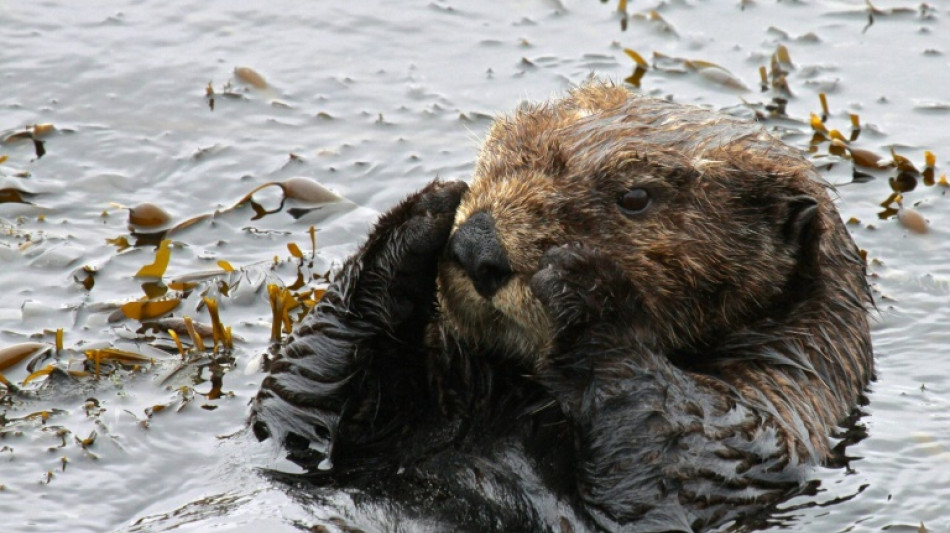
Return of hungry sea otters protects key coastal ecosystem: study
Return of hungry sea otters protects key coastal ecosystem: study / Photo: Lilian Carswell - US Fish and Wildlife Services/AFP/File

Return of hungry sea otters protects key coastal ecosystem: study

Back from the brink of extinction, sea otters in central California have started restoring the degraded landscape of a key estuary -- thanks to their insatiable appetite for crabs, according to a study published on Wednesday.

Text size:

The research depicts the ripple effects of the sea otters' return to Monterey Bay, California, highlighting how successful conservation efforts can improve the health and resilience of whole ecosystems.

Once hunted for their fur to the verge of local extinction, sea otters have made a dramatic recovery in central California after more than four decades of extensive conservation efforts in the region.

The otters have returned to coastal kelp forests and the the salt marsh-dominated coastal estuary, Elkhorn Slough.

And their return has heralded wide-ranging improvements around the estuary, a critical habitat that protects the shoreline.

In a new paper published in Nature, scientists in the United States and Canada found that the marine mammal slowed the erosion of parts of the estuary by up to 90 percent between the time they recolonised the area in the mid 1980s and 2018.

"One of the most remarkable things about this is that it's truly a conservation success story," study author Christine Angelini, director of the Center for Coastal Solutions at the University of Florida, told AFP.

Previous studies on salt marshes have shown the physical and chemical explanations for erosion.

But this study points a pincer at another culprit -- the shore crab.

These abundant crabs eat plant roots, burrow into the salt marsh soils and eventually can cause erosion and even collapse.

Sea otters eat around 25 percent of their body weight every day and researchers said they have an especially large appetite for these crabs.

"After a few decades, in areas the sea otters had recolonised, salt marshes and creekbanks were becoming more stable again, said lead author Brent Hughes, associate professor of biology at Sonoma State University, in a statement.

This was "despite rising sea levels, increased water flow from inland sources, and greater pollution".

- 'Crab feast' -

Researchers combined decades of data, over 35,000 observations of sea otters and three years of experiments manipulating the presence of top predators in a salt marsh ecosystem.

Top predators have declined in nearly every ecosystem on Earth, but conservation efforts over the past decades have helped recover species like wolves, brown bears, and eagles.

And growing research shows that reintroduction can have a wide-ranging impact on restoring ecosystems.

In this case researchers said sea otter conservation has unlocked several decades worth of benefits.

"It would cost tens of millions of dollars for humans to rebuild these creek banks and restore these marshes," said study author Brian Silliman, professor of Marine Conservation Biology at Duke University.

"The sea otters are stabilising them for free in exchange for an all-you-can-eat crab feast."

(Y.Yildiz--BBZ)