Ghana struggling with tsunami of secondhand clothes / Photo: Nipah Dennis - AFP

It takes Nii Armah and his crew of 30 fishermen hours to haul their weighty nets to shore on the bustling Korle-Gonno beach of Ghana's capital Accra.
Finally, their catch emerges -- a colossal barracuda and a less welcome bounty of bundles of discarded clothing.
Where once nets teemed with fish, they are now tangled with tonnes of clothes thrown into the Atlantic from the nearby Kantamanto market, one of the biggest secondhand markets in the world.
"Our nets are lost to the clothing from the markets," Armah told AFP. "And the fish are slipping away... our sustenance" with them.
Kantamanto market is vast, spanning over 20 acres in the heart of Accra's business district, and its stalls are dominated by used clothing and shoes from the West and China.
Its traders import a staggering 15 million garments a week, according to the OR Foundation environmental group. But roughly 40 percent of each bale ends up as waste, they say, dumped in landfills and often washed into the ocean, causing a public health crisis and harming the environment.
Ghana became the world's largest importer of used clothing in 2021, according to the Observatory of Economic Complexity (OEC) data site, with garments worth $214 million shipped mostly from China, the United Kingdom and Canada.
But the rise of fast fashion over the last two decades has caught the country in a double bind, with an even bigger wave of throw-away clothes coming from richer countries and falling prices for the Ghanaian traders as the quality drops.
- Dump exploded -
Although the business has created up to 30,000 jobs by some estimates, local NGOs say it is at the price of an "environmental and social emergency", with Ghana earning less than a million dollars in 2021 exporting the used garments it receives to other African nations.
The clothes "are mostly dumped indiscriminately because our waste treatment is not advanced", Justice Adoboe of the Ghana Water and Sanitation Journalists Network told AFP.
"When it rains, floodwaters carry the old garments and dump them in drains, ending up in our water courses and begin to cause havoc to aquatic life," he added.
The local council, the Accra Metropolitan Assembly, spends about $500,000 a year collecting and disposing of unwanted items from Kantamanto market.
But it can only handle around 70 percent of the market's waste. The rest is either burned nearby, causing air pollution, or dumped in fragile ecosystems, according to the Or Foundation.
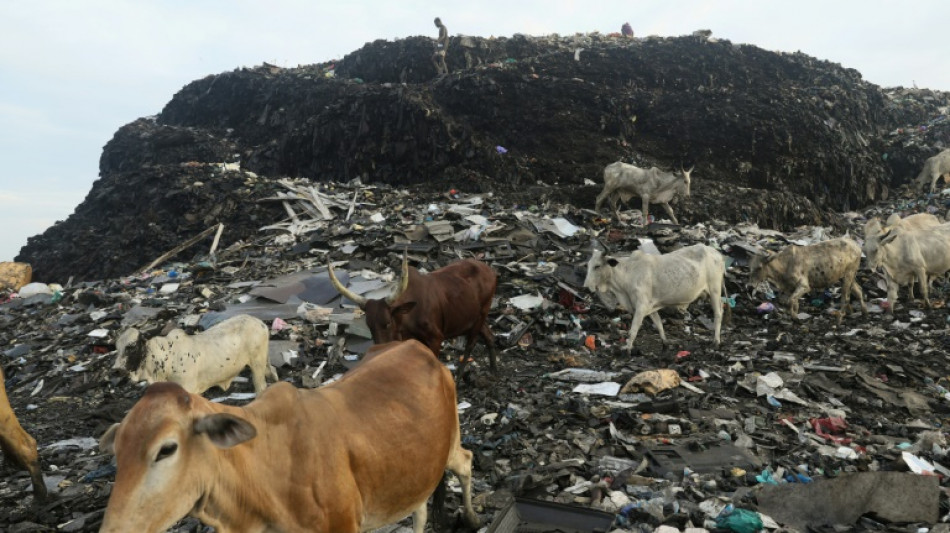
Things got even worse when Ghana's only sanitary landfill dump exploded in August 2019 after being swamped with secondhand clothing.
The Kpone Landfill was closed after the fire, leaving one of the world's fastest-growing metropolises without a properly engineered dump.
- Ocean tentacles -
The result has been disastrous. The sand is no longer visible on some sections of Accra's beaches, with mounds of discarded textiles and plastics more than 1.5 metres (five feet) high in places.
OR's beach monitors counted 2,344 textile "tentacles" -- tangled masses of secondhand clothes -- along a seven-kilometre strip of Accra's coastline over the course of a year.
That's an average of one mass of clothing every three metres, with some tentacles dozens of metres long, containing thousands of items.
Even though the Ghanaian capital lacks the infrastructure to deal with such a deluge of waste, the industry "is experiencing significant growth", warned Ganyo Kwabla Malik, manager of the Accra Compost and Recycling Plant.
The Ghanaian government has been slow to address the secondhand clothing problem, likely due to fears of a public backlash over the loss of jobs.
It did, however, ban the import and sale of used undergarments for hygiene reasons in 1994. But the law was not enforced, except for an unsuccessful attempt to implement it by the Ghana Standards Authority in 2020.
Accra's municipal officials estimate that a new landfill could cost around $250 million, and that is without addressing the environmental damage that has already been done.
Despite the environmental damage, Malik rejected a total ban of the trade, saying the waste could be burned in incinerators to generate energy. "When you have the infrastructure that supports this kind of investment, why ban it?"
But for fisherman Armah, the government needs to act fast.
"We are pleading with the authorities to do something about this," he said. "The sea is all we have."
(L.Kaufmann--BBZ)