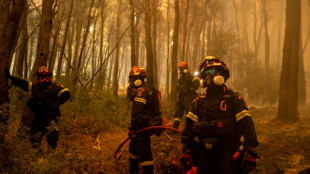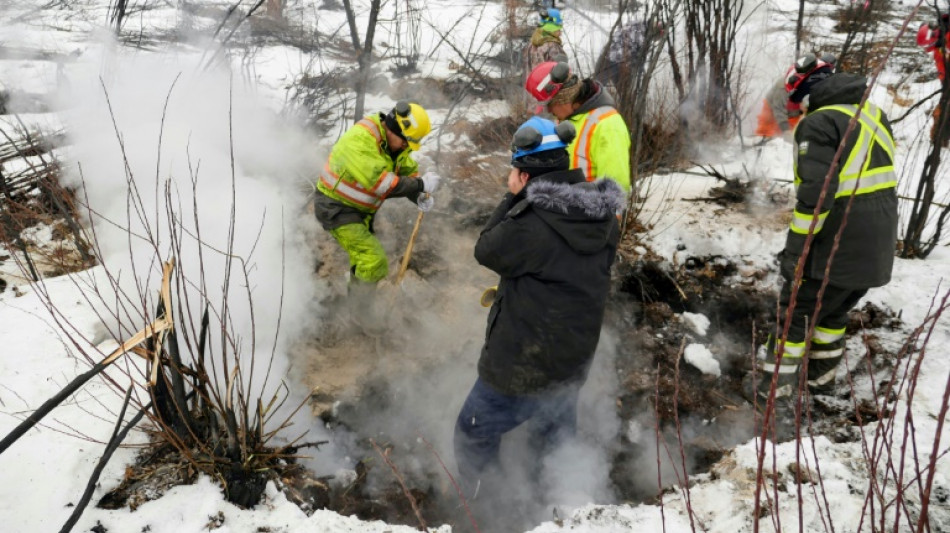
'Zombie' blazes and drought: Canada headed for another brutal fire season / Photo: Handout - Alberta wildfire/AFP

Beneath the ground in Western Canada, dozens of so-called "zombie fires" that started last year are still burning.
And even though it's the dead of winter, the lack of snow this year is compounding ongoing drought conditions, leaving Canadians already bracing for another brutal forest fire season.
"We are having an exceptional winter after an exceptional summer," laments Josee St-Onge, a spokesperson for Alberta firefighters.
It's a never-ending struggle. Even in bone-chilling temperatures, Canadian firefighters are still hard at work battling nearly 150 fires.
This year there are 10 to 12 times more zombie fires burning in Western Canada than usual. They smolder beneath the surface of the boreal forest through the winter, sustained by layers of dried peat and organic matter.
Eradicating them is painstaking work. They are difficult to detect -- only letting out wisps of smoke -- and require deep scraping of the ground to expose the humus, or all the decomposed leaves and other plant material compacted into an up to 80-centimeter (31-inch) layer that burns slowly.
In Alberta, the government on Tuesday declared an early start to wildfire season, which normally starts March 1. In addition to zombie fires from last year, authorities are also fighting new blazes that have sprung up this year.
In British Columbia, a record number of fires are currently active.
"Normally at this time of year, we might have seven or eight fires burning, but we have 91," said Forrest Tower, a spokesperson for firefighters in Canada's westernmost province, which historically has been the region most affected by fires.
Zombie fires are especially feared by firefighters because they can reemerge as raging infernos after the spring thaw.
In 2023, Canada experienced the worst fire season in its history. More than 18 million hectares (about 7,000 square miles) of forests and grasslands burned, and some 200,000 people were displaced by blazes while smoke spread as far as the United States and Europe.
- Very light snowfall -
Now, just three months after the official end of the 2023 wildfire season, experts are already concerned about this year.
"The snowpack is well below normal over a fairly large portion of Western Canada. It's even quite spectacular in some places," said Tower, pointing to 50 percent less snow than usual in British Columbia, for example.
More snow would lower the risk of fires, as the spring melt helps moisten the soil.
According to Natural Resources Canada, snow cover has decreased by 5 to 10 percent per decade since 1981. And this winter was marked by mild winter temperatures, which were on average 4 degrees Celsius above seasonal norms, according to the environment ministry.
Given the current conditions, "it will only take a little wind or a lightning storm for the leaves and needles of conifers to catch fire. It is an extremely flammable fuel," said Marc-Andre Parisien, a Canadian Forest Service researcher.
"The stage is set for a very active spring, at least in the western part of the country," added Mike Flannigan, a professor at Thompson Rivers University in Kamloops, British Columbia.
Heavy rains over the coming months could turn things around.
But "the seasonal forecast from Environment and Climate Change Canada suggests warmer temperatures are likely until at least June," Flannigan said, with strong El Nino conditions forecast to persist for several months.
The time has therefore already come for preparations.
In addition to the early start to fire season, Alberta announced this week that it has recruited 100 additional firefighters. It is also banning outdoor fires near forests.
(A.Lehmann--BBZ)