Cheap mini-EVs sparkle in China's smaller, poorer cities / Photo: Jade GAO - AFP

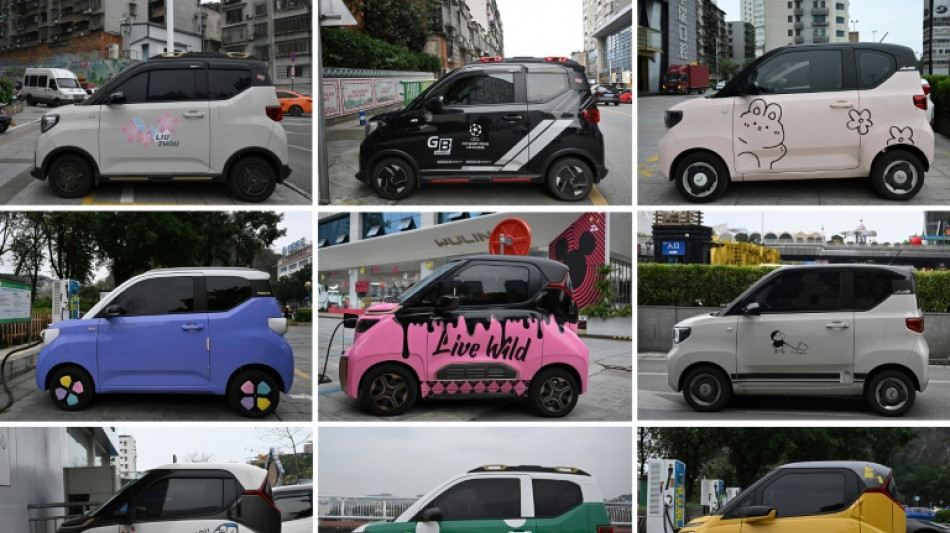
Tiny electric cars weave through traffic in southern China, their cheap and cheerful designs bringing a touch of colour to the EV revolution in the country's overlooked cities.
China is the world's largest market for electric vehicles (EVs), with premium models by Tesla and homegrown giant BYD a common sight in the nation's affluent megacities.
But in a growing number of less-developed areas, the face of greener transport is the Wuling Hongguang Mini -- a dinky two-door runaround that sells for a fraction of the price.
China's most popular EV to date, it has sold more than 1.2 million units, often to consumers with lower incomes in provincial cities and smaller towns.
"This car is small and convenient, easy to park and charge, and it's cheap -- that's why I chose it," a driver surnamed Cao told AFP as she loaded shopping bags into her vehicle in Liuzhou, in the southern Guangxi region.
"(It is) mainly used for picking up the kids, grocery shopping and work commutes," the 47-year-old said.
Liuzhou, a city of around four million people, is more famous in China for misty mountains and pungent river-snail noodles than advanced technology.
But its locally made mini-EVs are proving a breakout success, and authorities have responded by providing charging stations, discounted parking spots and preferential policies for buyers.
Driver Tang Wenhui said he barely considered the environmental benefits when he and his family paid around 60,000 yuan ($8,300) -- the equivalent of a year's wages -- for a new Wuling a year ago.
"I just wanted something to get me around town... not necessarily to travel long distances," the 23-year-old programmer told AFP.
"As a fresh graduate, it's just made life a bit easier."
- 'Style accessory' -
According to company specifications, the latest Hongguang Mini is around three metres (9.8 feet) long and less than 1.5 metres wide, seats four people and contains a lithium battery that runs for up to 215 kilometres (134 miles) on a single charge.
Prices start at 41,800 yuan ($5,800), but older editions sell for around 30,000 yuan –- an eighth of what Tesla's flagship Model 3 costs.
Wuling is not the only player in the sector, with domestic automakers Dongfeng Motor, Chery and Geely all producing their own miniature EVs.
But Wuling has given itself some staying power by nurturing a devoted community of younger female fans calling themselves "Wuling girls".
The cars embrace cuteness with pastel-pink and lemon-yellow bodywork, with editions named after French pastries and Japanese gaming consoles.
And many buyers spend additional sums to personalise their motors with brightly coloured polka dots, racing stripes and anime cartoons.
Cao's ruby-red car is adorned with a large white decal in the shape of Mickey Mouse alongside smaller stickers of other cartoon characters.
"I feel it's cute," the Liuzhou resident told AFP as she recharged her car near the riverside, adding that her friends had done the same.
Tu Le, founder of consultancy Sino Auto Insights, said the affordability meant "many people in smaller cities tend to treat them less as a vehicle and more as a style accessory".
"That's why it's popular to purchase aftermarket products to decorate them and make them more unique," he said. "But they are still able to provide transportation to their buyers for their daily commute."
- Leading the charge -
China views new-energy vehicles as a critical emerging industry and has ramped up state support as it seeks to make its economy more self-sufficient and based on high-end manufacturing.
The sector is also an important component of Beijing's pledge to bring emissions of planet-warming carbon dioxide to a peak by 2030 and reduce them to net zero by 2060.
The domestic industry hit an inflection point when homegrown giant BYD dethroned Elon Musk's Tesla as the world's top EV seller in the fourth quarter of last year.
But lower-end cars like the Hongguang Mini are "extremely important for the China market", said Tu of Sino Auto Insights.
Online, some prospective buyers voice concern that the cars may not be safe, pointing to their lightweight construction and the lack of airbags and other features in older models.
A lack of charging infrastructure in many smaller cities and long-running struggles by some automakers to make the cars profitable also cloud the sector's future.
Still, Tu said, the cars help to rein in a global trend towards bigger, gas-guzzling cars that make traffic and pollution worse.
And they "create options for those that wouldn't otherwise be able to afford their own transportation", he told AFP.
(G.Gruner--BBZ)