Berliner Boersenzeitung - 2 million animals dead as extreme winter weather hits Mongolia

EUR -
AED 4.276911
AFN 77.00261
ALL 96.561039
AMD 444.455439
ANG 2.084659
AOA 1067.918724
ARS 1670.580382
AUD 1.753592
AWG 2.099152
AZN 1.98201
BAM 1.955612
BBD 2.346285
BDT 142.406334
BGN 1.956282
BHD 0.439022
BIF 3441.169761
BMD 1.164578
BND 1.510655
BOB 8.078225
BRL 6.329131
BSD 1.164893
BTN 104.857487
BWP 15.497513
BYN 3.368991
BYR 22825.733483
BZD 2.342885
CAD 1.612865
CDF 2599.338258
CHF 0.937992
CLF 0.027397
CLP 1074.765709
CNY 8.235549
CNH 8.227437
COP 4451.018029
CRC 568.84541
CUC 1.164578
CUP 30.861323
CVE 110.254419
CZK 24.274232
DJF 207.440983
DKK 7.469133
DOP 74.682833
DZD 151.520998
EGP 55.351124
ERN 17.468674
ETB 181.088421
FJD 2.645691
FKP 0.873468
GBP 0.872491
GEL 3.138508
GGP 0.873468
GHS 13.308723
GIP 0.873468
GMD 85.589934
GNF 10126.028236
GTQ 8.923105
GYD 243.716611
HKD 9.061671
HNL 30.593578
HRK 7.535056
HTG 152.525363
HUF 384.021425
IDR 19437.858928
ILS 3.744486
IMP 0.873468
INR 104.745194
IQD 1525.597493
IRR 49057.858566
ISK 148.82132
JEP 0.873468
JMD 186.752078
JOD 0.825704
JPY 181.933909
KES 150.521616
KGS 101.84268
KHR 4663.572474
KMF 493.780761
KPW 1048.120262
KRW 1709.965829
KWD 0.357554
KYD 0.970811
KZT 595.26543
LAK 25263.683987
LBP 104326.769319
LKR 359.467046
LRD 205.609386
LSL 19.780687
LTL 3.438697
LVL 0.704442
LYD 6.33042
MAD 10.786908
MDL 19.751189
MGA 5194.501499
MKD 61.63435
MMK 2445.6481
MNT 4131.893999
MOP 9.335644
MRU 46.347949
MUR 53.745547
MVR 17.946518
MWK 2022.292297
MXN 21.261125
MYR 4.789875
MZN 74.418489
NAD 19.780687
NGN 1691.082209
NIO 42.865886
NOK 11.795012
NPR 167.772899
NZD 2.012281
OMR 0.447779
PAB 1.164888
PEN 3.916481
PGK 4.947009
PHP 69.07816
PKR 326.778058
PLN 4.238873
PYG 8011.265579
QAR 4.240204
RON 5.090026
RSD 117.41628
RUB 89.031619
RWF 1694.937342
SAR 4.370562
SBD 9.577286
SCR 15.828219
SDG 700.501887
SEK 10.920955
SGD 1.510499
SHP 0.873735
SLE 27.823965
SLL 24420.621214
SOS 665.555232
SRD 45.021424
STD 24104.418272
STN 24.497649
SVC 10.193066
SYP 12876.544773
SZL 19.775187
THB 37.066776
TJS 10.688028
TMT 4.076024
TND 3.421757
TOP 2.804025
TRY 49.586224
TTD 7.892276
TWD 36.271887
TZS 2853.216319
UAH 49.109787
UGX 4121.604462
USD 1.164578
UYU 45.505438
UZS 13967.719529
VES 300.002576
VND 30704.105269
VUV 141.895799
WST 3.247554
XAF 655.894056
XAG 0.019829
XAU 0.000277
XCD 3.147331
XCG 2.099508
XDR 0.815722
XOF 655.896872
XPF 119.331742
YER 277.810358
ZAR 19.844134
ZMK 10482.599985
ZMW 26.93853
ZWL 374.993718
  • RBGPF

    0.7600

    79.11

    +0.96%

  • CMSD

    -0.0800

    23.17

    -0.35%

  • RYCEF

    0.2100

    14.83

    +1.42%

  • SCS

    -0.0200

    16.12

    -0.12%

  • RIO

    -0.0400

    73.02

    -0.05%

  • CMSC

    -0.2100

    23.22

    -0.9%

  • RELX

    -0.8400

    39.48

    -2.13%

  • NGG

    -0.0800

    75.33

    -0.11%

  • GSK

    0.0600

    48.47

    +0.12%

  • VOD

    0.0300

    12.5

    +0.24%

  • BCC

    -1.2400

    71.81

    -1.73%

  • BCE

    -0.2100

    23.34

    -0.9%

  • BTI

    0.4000

    57.41

    +0.7%

  • BP

    -0.0500

    35.78

    -0.14%

  • AZN

    1.1000

    91.28

    +1.21%

  • JRI

    -0.0700

    13.72

    -0.51%

2 million animals dead as extreme winter weather hits Mongolia
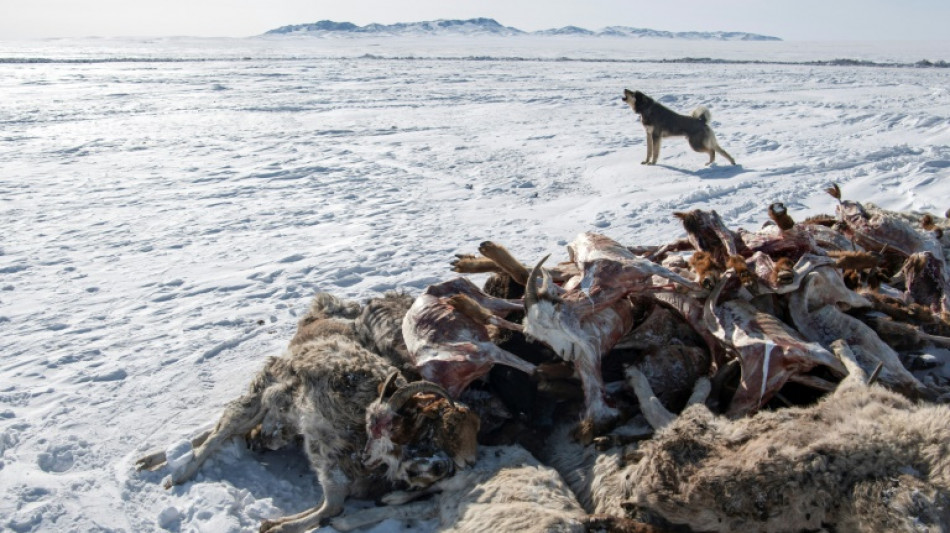
2 million animals dead as extreme winter weather hits Mongolia / Photo: Byambasuren BYAMBA-OCHIR - AFP

2 million animals dead as extreme winter weather hits Mongolia

More than two million animals have died in Mongolia so far this winter, a government official said Monday, as the country endures extreme cold and snow.

Text size:

The landlocked country is no stranger to severe weather from December to March, when temperatures plummet as low as minus 50 degrees Celsius (minus 58 Fahrenheit) in some areas.

But this winter has been more severe than usual, with lower than normal temperatures and very heavy snowfall, the United Nations said in a recent report.

As of Monday, 2.1 million head of livestock had died from starvation and exhaustion, Gantulga Batsaikhan of the country's agriculture ministry said.

Mongolia had 64.7 million such animals, including sheep, goats, horses and cows, at the end of 2023, official statistics show.

The extreme weather is known as "dzud" and typically results in the deaths of huge numbers of livestock.

The United Nations said climate change is increasing the frequency and intensity of dzuds.

Mongolia has experienced six dzuds in the past decade, including the winter of 2022-23 when 4.4 million head of livestock perished.

This year's dzud has been exacerbated by a summer drought that prevented animals from building up enough fatty stores to survive the harsh winter.

- 'Praying for warmer weather' -

Seventy percent of Mongolia is experiencing "dzud or near dzud" conditions, the UN said.

That compares with 17 percent of the country at the same time in 2023.

"The winter started with heavy snow but suddenly air temperatures rose, and the snow melted," herder Tuvshinbayar Byambaa told AFP.

"Then the temperatures dropped again, turning the melting snow into ice."

That ice makes it hard for the livestock to break through to the grass below, he said, preventing them from grazing and forcing many herders to borrow money for feed.

"The weather changes are so sudden these days," Tuvshinbayar said.

The deadliest dzud on record was the winter of 2010-11, when more than 10 million animals died -- almost a quarter of the country's total livestock at the time.

Snowfall this year -- the heaviest since 1975 -- has compounded herders' woes, trapping them in colder areas and making them unable to buy food and hay for their animals from the nearby towns.

Mongolia is one of the most sparsely populated countries in the world and about one-third of its population of 3.3 million people is nomadic.

The government has promised to help, launching a campaign to deliver hay fodder to herders in a bid to prevent further losses of crucial commodities like meat and cashmere, one of the country's top exports.

But for now, Tuvshinbayar and his fellow herders can only pray for warmer weather.

"It is becoming too hard to be a herder -- we suffer drought and flood in summer and dzud in winter," he told AFP.

"I'll start losing my animals if the snow does not melt in the coming months," he added.

"All herders are praying for warmer weather to melt this ice, so our animals can reach the grass."

(Y.Berger--BBZ)