Berliner Boersenzeitung - Fear for rhinos as poachers kill 500 in South Africa

EUR -
AED 4.238556
AFN 72.7108
ALL 96.082026
AMD 435.639205
ANG 2.065997
AOA 1058.341098
ARS 1611.474574
AUD 1.62305
AWG 2.077442
AZN 1.963632
BAM 1.955918
BBD 2.31787
BDT 141.20853
BGN 1.972773
BHD 0.435694
BIF 3416.932404
BMD 1.154135
BND 1.470557
BOB 7.968499
BRL 5.995037
BSD 1.150835
BTN 106.274197
BWP 15.639471
BYN 3.451804
BYR 22621.040548
BZD 2.31447
CAD 1.580039
CDF 2614.114822
CHF 0.90569
CLF 0.026523
CLP 1047.273231
CNY 7.948352
CNH 7.943419
COP 4271.614184
CRC 539.416228
CUC 1.154135
CUP 30.58457
CVE 112.12455
CZK 24.430957
DJF 204.926165
DKK 7.472578
DOP 70.242113
DZD 152.435303
EGP 60.293726
ERN 17.312021
ETB 181.199444
FJD 2.548387
FKP 0.867712
GBP 0.863752
GEL 3.127505
GGP 0.867712
GHS 12.562759
GIP 0.867712
GMD 84.823045
GNF 10085.390801
GTQ 8.833022
GYD 241.259546
HKD 9.044873
HNL 30.665647
HRK 7.534209
HTG 150.955849
HUF 388.755308
IDR 19579.029955
ILS 3.577183
IMP 0.867712
INR 106.631949
IQD 1511.916486
IRR 1516533.02462
ISK 143.597326
JEP 0.867712
JMD 181.035446
JOD 0.818281
JPY 183.34598
KES 149.517795
KGS 100.928472
KHR 4618.158943
KMF 492.815153
KPW 1038.771922
KRW 1714.698012
KWD 0.353939
KYD 0.959025
KZT 554.50428
LAK 24695.742965
LBP 103230.386068
LKR 358.370781
LRD 210.596336
LSL 19.262967
LTL 3.40786
LVL 0.698125
LYD 7.380713
MAD 10.807029
MDL 20.075604
MGA 4806.971373
MKD 61.658341
MMK 2423.859761
MNT 4125.451781
MOP 9.288979
MRU 46.286555
MUR 53.805255
MVR 17.831543
MWK 2004.732168
MXN 20.373478
MYR 4.52077
MZN 73.760321
NAD 19.262575
NGN 1561.405647
NIO 42.379283
NOK 11.063172
NPR 170.039116
NZD 1.969052
OMR 0.44376
PAB 1.153188
PEN 3.94426
PGK 4.963644
PHP 69.028664
PKR 322.29194
PLN 4.26136
PYG 7460.224439
QAR 4.205087
RON 5.093888
RSD 117.41474
RUB 95.070643
RWF 1683.882559
SAR 4.333138
SBD 9.285224
SCR 16.472922
SDG 693.635342
SEK 10.706002
SGD 1.472688
SHP 0.8659
SLE 28.391892
SLL 24201.640544
SOS 656.519751
SRD 43.42429
STD 23888.258553
STN 24.497553
SVC 10.069259
SYP 127.96572
SZL 19.262124
THB 37.301872
TJS 11.030575
TMT 4.051013
TND 3.384495
TOP 2.778879
TRY 51.033419
TTD 7.808201
TWD 36.781758
TZS 3010.825447
UAH 50.563121
UGX 4352.843167
USD 1.154135
UYU 46.875638
UZS 14008.314214
VES 516.830947
VND 30353.743184
VUV 138.019678
WST 3.178729
XAF 655.976735
XAG 0.014505
XAU 0.00023
XCD 3.119107
XCG 2.074053
XDR 0.815825
XOF 658.432219
XPF 119.331742
YER 275.31915
ZAR 19.247972
ZMK 10388.594502
ZMW 22.446675
ZWL 371.63091
  • RBGPF

    0.1000

    82.5

    +0.12%

  • CMSC

    -0.0400

    22.95

    -0.17%

  • NGG

    -0.4700

    90.42

    -0.52%

  • AZN

    -0.7200

    191.29

    -0.38%

  • RELX

    -0.1800

    34.29

    -0.52%

  • RIO

    -0.0600

    89.8

    -0.07%

  • BP

    0.9500

    43.85

    +2.17%

  • RYCEF

    0.3800

    16.5

    +2.3%

  • GSK

    -0.3600

    53.41

    -0.67%

  • BCE

    0.1100

    26.01

    +0.42%

  • BTI

    -0.3900

    60.55

    -0.64%

  • CMSD

    -0.0700

    22.88

    -0.31%

  • JRI

    -0.0800

    12.46

    -0.64%

  • BCC

    1.2000

    72.92

    +1.65%

  • VOD

    0.1500

    14.75

    +1.02%

Fear for rhinos as poachers kill 500 in South Africa
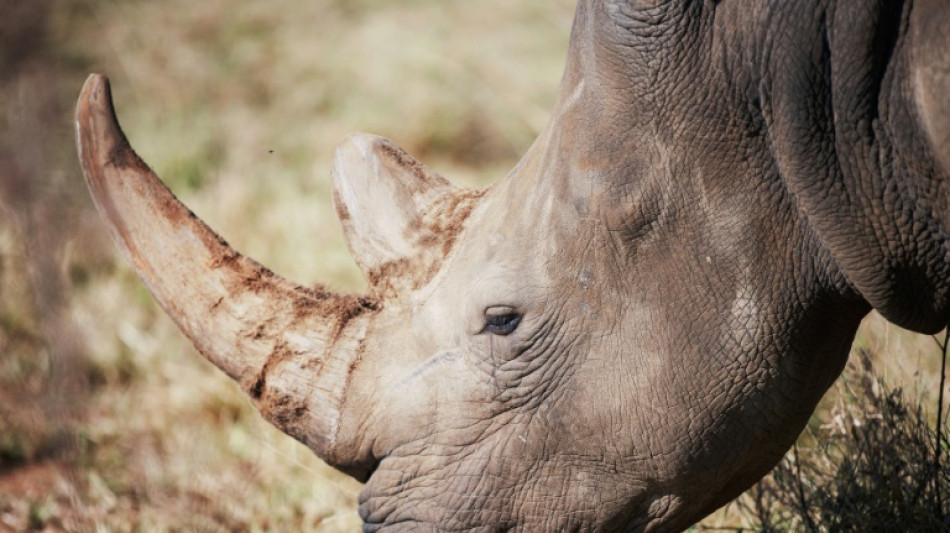
Fear for rhinos as poachers kill 500 in South Africa / Photo: Luca Sola - AFP/File

Fear for rhinos as poachers kill 500 in South Africa

Conservationists raised the alarm on Tuesday as South Africa reported a sharp increase in rhino poaching, with almost 500 animals killed last year.

Text size:

The country is home to a large majority of the world's rhinos and a hotspot for poaching, which is driven by demand from Asia, where horns are used in traditional medicine for their supposed therapeutic effect.

The environment ministry said that, despite government efforts to tackle the illicit trade, 499 of the thick-skinned herbivores were killed in 2023, mostly in state-run parks. This represents an 11 percent increase over the 2022 figure.

The figures paint "a worrying picture", conservation group Save the Rhino International said, calling for more resources to be urgently deployed against poaching rings.

"There isn't an overnight solution, but with a rhino poached every 17 hours in South Africa, we can't afford to lose any more time," said Jo Shaw, the group's CEO.

The lion's share were poached in eastern KwaZulu-Natal province, with the Hluhluwe–Imfolozi park -- Africa's oldest reserve -- alone losing 307 animals, according to the government.

"This is the highest poaching loss within this province," said South Africa's Environment Minister Barbara Creecy. "Multi-disciplinary teams continue to work tirelessly in an attempt to slow this relentless pressure."

- Hopes and concerns -

In recent years authorities have tightened security, particularly around the Kruger National Park, a tourist magnet bordering Mozambique that has seen its rhino population fall drastically from more than 10,000 to less than 3,000 over the past 15 years.

This has resulted in lower losses there -- 78 rhinos were killed in 2023, 37 percent fewer than in 2022.

But it has also pushed poachers towards regional and private reserves like Hluhluwe–Imfolozi.

Law enforcement agencies arrested 49 suspected poachers in KwaZulu-Natal last year, Creecy said.

Across the country, 45 poachers and horn traffickers were convicted in court, she added.

Among them was a former field ranger sentenced to 10 years behind bars for killing a rhino he later claimed had charged him.

As of 2023, the national parks authority requires new employees to take a lie detector test amid concerns that some workers might be in cahoots with poachers.

Rhino horns are highly sought after in black markets, where the price by weight rivals that of gold and cocaine.

Nevertheless, in September last year the International Union for Conservation of Nature (IUCN) reported that thanks to conservation efforts rhino numbers had grown across Africa.

Nearly 23,300 specimens roamed the continent at the end of 2022, up 5.2 percent on 2021, IUCN said, adding the increase was the first bit of "good news" for the animals in over a decade.

About 15,000 live in South Africa, according to a separate estimate by the International Rhino Foundation.

"While these updated IUCN population figures provide hope, these gains remain tenuous as long as the poaching crisis continues," Jeff Cooke of the World Wildlife Fund warned Tuesday.

And he described the spike in killings in South Africa's KwaZulu-Natal, in particular, as "of grave concern".

(Y.Berger--BBZ)