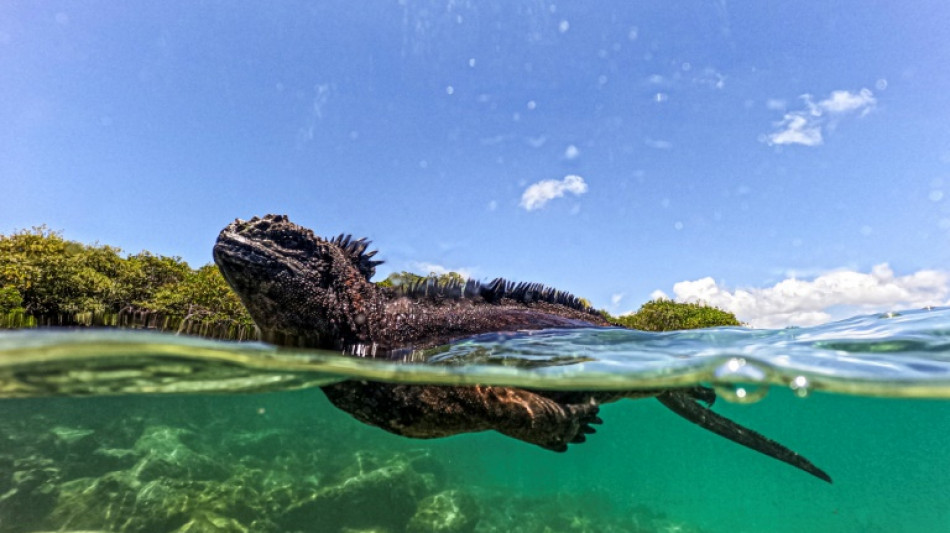
Darwin's Galapagos island species, protected yet still at risk / Photo: Ernesto BENAVIDES - AFP

Industrial fishing boats hover menacingly on the edges of Ecuador's Galapagos Marine Reserve, where schools of multicolored fish and hammerhead sharks frolic in the protected Pacific waters.
The reserve is a haven for the flurry of creatures and plants living in the waters around the Galapagos Islands where naturalist Charles Darwin found the inspiration for his theory of natural selection.
But outside its boundaries, not delineated by any physical barrier, there is no protection on the high seas where these same species also venture.
The sharks, turtles, iguanas, sea lions and fish that thrive in the Galapagos "don't understand political boundaries," Stuart Banks, a senior marine scientist at the Charles Darwin Foundation, told AFP on board Greenpeace's Arctic Sunrise research vessel.
"So they're going to be moving between different territories and that's when they're most at risk, particularly to things like industrial fishing and bycatch."
The solution, according to Greenpeace, is to secure a much larger area of ocean by creating the first-ever marine protected area on the high seas bordering the Galapagos Marine Reserve.
But for this to happen, at least 60 countries must ratify the High Seas Treaty adopted by United Nations member states last June. Only two have done so to date.
- Like a jigsaw puzzle -
AFP accompanied an Arctic Sunrise scientific mission to the area this month to investigate the threats posed to the Galapagos Marine Reserve, which Greenpeace describes as "probably the best conservation project carried out in the oceans."
The reserve of nearly 200,000 square kilometers (some 77,000 square miles) is one of the world's largest and most biodiverse with more than 3,000 species, many of them found nowhere else.
Biologist Paola Sangolqui explained she was testing water samples to analyze "which marine species have been in this area and have left some kind of DNA trace."
For his part, Daniel Armijos was in charge of underwater video monitoring of fish numbers and prevalence.
"It is kind of like putting together a big jigsaw puzzle because everything is integrated in some way," explained Banks.
"And if you're looking to prioritize the most important regions to start working, to know where those corridors are (along which species migrate), you need to use genetics so you can start to look at how particular populations are connected from one region to another."
- Hammerhead haven -
From the Arctic Sunrise, scientists also descended a robot to explore the coral reefs that serve as key feeding and breeding grounds for many fish, said expedition leader Sophie Cooke, for whom "the abundance of marine life in this national park is simply staggering."
Marine reserve employee Eduardo Espinoza, in charge of day-to-day monitoring, told AFP the archipelago is a rare sanctuary for hammerhead sharks, whose fins are a delicacy in some Asian countries.
Hammerheads were at particular risk of "overfishing and illegal fishing," Espinoza said as he fixed an identifying label to a young specimen.
"In the Galapagos, hammerhead sharks are always abundant. They have a refuge here to reproduce, from where they move throughout the Pacific," he added.
- Free species worth more -
Cooke said the Galapagos was an important migratory stop for many species, which is "why we need to connect all these different marine protected areas and protect these reserves: so the migration routes of these species can be kept safe."
The Galapagos Islands are designated a UNESCO Natural World Heritage site.
Another reason to protect the area is its attraction for tens of thousands of visitors every year, like American diver Ryan Doyle, 24.
"In comparison to Florida, where I'd also dive recreationally, there's so much life here," Doyle told AFP. "There's so many sharks and everything looks so healthy. So you can kind of like see the conservation" at work.
Diving instructor Anthony Gavilanes, 30, said locals like himself nowadays "live off tourism" more than fishing, as before.
"For us, species swimming freely in the water are worth more than they are on a plate served at a table."
(Y.Berger--BBZ)