Berliner Boersenzeitung - 'Extreme' climate blamed for world's worst wine harvest in 62 years

EUR -
AED 4.24008
AFN 72.724514
ALL 96.508212
AMD 435.724665
ANG 2.066402
AOA 1058.549174
ARS 1611.776544
AUD 1.622763
AWG 2.07785
AZN 1.960194
BAM 1.960182
BBD 2.322973
BDT 141.516394
BGN 1.973159
BHD 0.435859
BIF 3429.606086
BMD 1.154361
BND 1.473795
BOB 7.970061
BRL 5.979824
BSD 1.153369
BTN 106.512363
BWP 15.674587
BYN 3.459434
BYR 22625.472664
BZD 2.319656
CAD 1.580741
CDF 2614.627194
CHF 0.905599
CLF 0.02653
CLP 1047.652011
CNY 7.94991
CNH 7.94404
COP 4269.692195
CRC 540.627436
CUC 1.154361
CUP 30.590563
CVE 112.146595
CZK 24.429622
DJF 205.153016
DKK 7.472137
DOP 70.358441
DZD 152.479986
EGP 60.311659
ERN 17.315413
ETB 181.6675
FJD 2.547792
FKP 0.867882
GBP 0.863953
GEL 3.139771
GGP 0.867882
GHS 12.565224
GIP 0.867882
GMD 84.83615
GNF 10135.288544
GTQ 8.834752
GYD 241.306816
HKD 9.046783
HNL 30.67094
HRK 7.536837
HTG 151.288898
HUF 388.410086
IDR 19588.349267
ILS 3.577884
IMP 0.867882
INR 106.666809
IQD 1512.212714
IRR 1516830.157279
ISK 143.59058
JEP 0.867882
JMD 181.435643
JOD 0.818461
JPY 183.486813
KES 149.548017
KGS 100.949257
KHR 4628.986439
KMF 492.91224
KPW 1038.975448
KRW 1713.590561
KWD 0.35402
KYD 0.961182
KZT 555.751774
LAK 24789.899418
LBP 103373.014559
LKR 359.166113
LRD 211.823654
LSL 19.26605
LTL 3.408527
LVL 0.698261
LYD 7.385146
MAD 10.845186
MDL 20.120682
MGA 4796.368931
MKD 61.715884
MMK 2424.334665
MNT 4126.260076
MOP 9.309756
MRU 46.295668
MUR 53.839473
MVR 17.834634
MWK 2003.970748
MXN 20.387028
MYR 4.530836
MZN 73.758321
NAD 19.266689
NGN 1566.110086
NIO 42.388525
NOK 11.057172
NPR 170.421662
NZD 1.967464
OMR 0.443817
PAB 1.153414
PEN 3.957729
PGK 4.966642
PHP 68.797607
PKR 322.384125
PLN 4.259188
PYG 7476.71599
QAR 4.205625
RON 5.092578
RSD 117.444885
RUB 95.089628
RWF 1684.21248
SAR 4.334119
SBD 9.294521
SCR 17.340571
SDG 693.770822
SEK 10.702431
SGD 1.472937
SHP 0.86607
SLE 28.396756
SLL 24206.382345
SOS 659.717532
SRD 43.432838
STD 23892.938954
STN 24.934194
SVC 10.091562
SYP 127.990792
SZL 19.266786
THB 37.228589
TJS 11.055152
TMT 4.051807
TND 3.385164
TOP 2.779423
TRY 51.000472
TTD 7.825462
TWD 36.765236
TZS 3018.653819
UAH 50.674456
UGX 4353.696015
USD 1.154361
UYU 46.884822
UZS 13973.538209
VES 516.932208
VND 30359.69036
VUV 138.04672
WST 3.179352
XAF 657.452522
XAG 0.014506
XAU 0.000231
XCD 3.119718
XCG 2.07872
XDR 0.819389
XOF 664.332234
XPF 119.331742
YER 275.373143
ZAR 19.214417
ZMK 10390.613359
ZMW 22.496979
ZWL 371.703723
  • RBGPF

    0.1000

    82.5

    +0.12%

  • CMSC

    -0.0400

    22.95

    -0.17%

  • NGG

    -0.4650

    90.425

    -0.51%

  • BCC

    1.2200

    72.94

    +1.67%

  • RYCEF

    0.3800

    16.5

    +2.3%

  • AZN

    -0.6400

    191.37

    -0.33%

  • GSK

    -0.3700

    53.4

    -0.69%

  • CMSD

    -0.0200

    22.93

    -0.09%

  • RIO

    -0.0700

    89.79

    -0.08%

  • BCE

    0.1150

    26.015

    +0.44%

  • JRI

    -0.0800

    12.46

    -0.64%

  • RELX

    -0.1750

    34.295

    -0.51%

  • VOD

    0.1500

    14.75

    +1.02%

  • BTI

    -0.3900

    60.55

    -0.64%

  • BP

    0.9000

    43.8

    +2.05%

'Extreme' climate blamed for world's worst wine harvest in 62 years
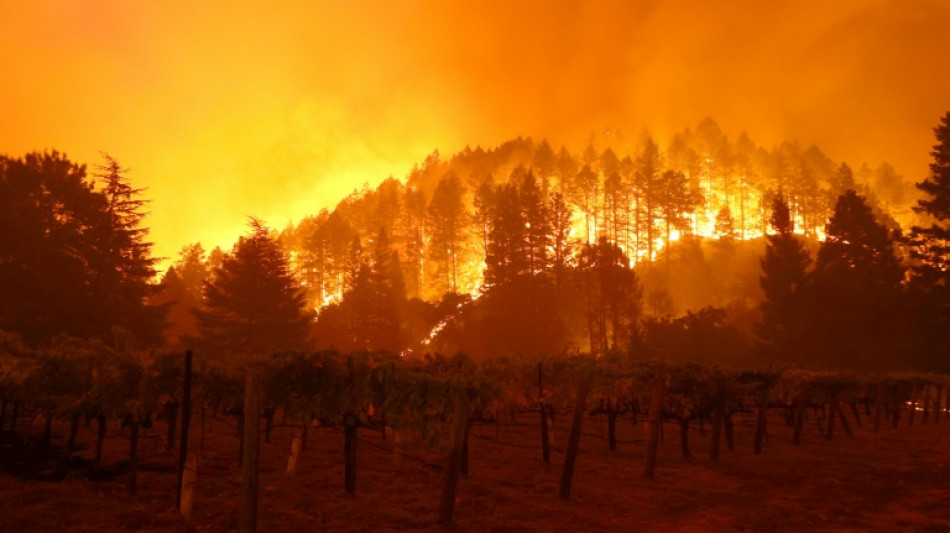
'Extreme' climate blamed for world's worst wine harvest in 62 years / Photo: JUSTIN SULLIVAN - GETTY IMAGES NORTH AMERICA/AFP

'Extreme' climate blamed for world's worst wine harvest in 62 years

World wine production dropped 10 percent last year, the biggest fall in more than six decades, because of "extreme" climate changes, the body that monitors the trade said Thursday.

Text size:

"Extreme environmental conditions" including droughts, fires and other problems with climate were mostly to blame for the drastic fall, said the International Organisation of Vine and Wine (OIV) that covers nearly 50 wine producing countries.

Australia and Italy suffered the worst, with 26 and 23 percent drops. Spain lost more than a fifth of its production. Harvests in Chile and South Africa were down by more than 10 percent.

The OIV said the global grape harvest was the worst since 1961, and worse even than its early estimates in November.

In further bad news for winemakers, customers drank three per cent less wine in 2023, the French-based intergovernmental body said.

Director John Barker highlighted "drought, extreme heat and fires, as well as heavy rain causing flooding and fungal diseases across major northern and southern hemisphere wine producing regions."

Although he said climate problems were not solely to blame for the drastic fall, "the most important challenge that the sector faces is climate change.

"We know that the grapevine, as a long-lived plant cultivated in often vulnerable areas, is strongly affected by climate change," he added.

France bucked the falling harvest trend, with a four percent rise, making it by far the world's biggest wine producer.

- Less wine being drunk -

Wine consumption last year was however at its lowest level since 1996, confirming a fall-off over the last five years, according to the figures.

The trend is partly due to price rises caused by inflation and a sharp fall in wine drinking in China -- down a quarter -- due to its economic slowdown.

The Portuguese, French and Italians remain the world's biggest wine drinkers per capita.

Barker said the underlying decrease in consumption is being "driven by demographic and lifestyle changes. But given the very complicated influences on global demand at the moment," it is difficult to know whether the fall will continue.

"What is clear is that inflation is the dominant factor affecting demand in 2023," he said.

Land given over to growing grapes to eat or for wine fell for the third consecutive year to 7.2 million hectares (17.7 million acres).

But India became one of the global top 10 grape producers for the first time with a three percent rise in the size of its vineyards.

France, however, has been pruning its vineyards back slightly, with its government paying winemakers to pull up vines or to distil their grapes.

The collapse of the Italian harvest to its lowest level since 1950 does not necessarily mean there will be a similar contraction there, said Barker.

Between floods and hailstones, and damp weather causing mildew in the centre and south of the country, the fall was "clearly linked to meteorological conditions", he said.

(S.G.Stein--BBZ)