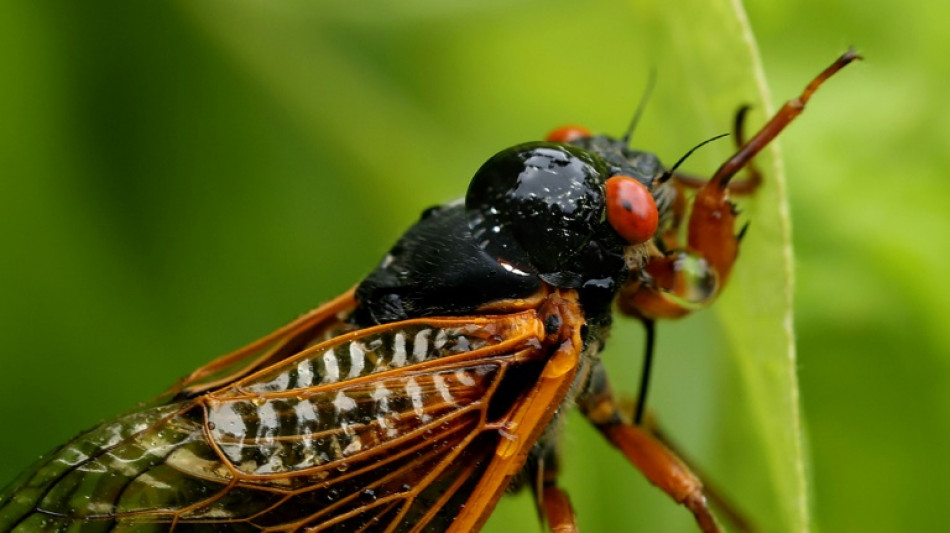
Cicada-palooza! Billions of bugs to blanket America / Photo: CHIP SOMODEVILLA - GETTY IMAGES NORTH AMERICA/AFP/File

They're loud. They're sexually aroused. And for one special, cacophonous month up to a trillion of them will engulf suburbs and woodlands across America.
Two cicada "broods" are set for a rare double emergence that last occurred in 1803, when Thomas Jefferson was president and the United States purchased Louisiana from France.
The prospect of another natural wonder just weeks after a total solar eclipse across much of the country has gripped scientists and the public alike.
- 'Insects of history' -
Cicadas comprise a diverse family of over 3,000 insect species found globally, with the majority of their lives spent underground in a larval state.
They emerge as adults to transform and mate, with some species appearing annually and others, known as periodical cicadas, synchronizing their emergence every 13 or 17 years. Mathematicians have long been intrigued by the question of why periodical cicadas follow prime number cycles, despite the lack of a clear evolutionary explanation.
This year's event involves the 13-year Brood XIX, currently emerging in the Carolinas, followed by the 17-year Brood XIII in the Midwest. There could be a small area of overlap in central Illinois.
"When they do come out, they come out in big numbers, parents get excited, the kids get excited," said entomologist Gene Kritsky of Mount St. Joseph University, who developed the Cicada Safari app for citizen-scientists to gather data, explaining the appeal of the harmless red-eyed bugs.
They're also "creatures of history": People vividly recall where they were when the cicadas last appeared in their area, and these personal stories become embedded in family lore, passed down to the next generation.
Just like witnessing a rare eclipse, Kritsky notes that there's a unique value in seeing scientific predictions come to life. "That's what science does: you come up with hypotheses that lead to predictions, the predictions are verified...and there's something valuable about this in a time when some people have thought to disregard science."
- Scientific marvel -
Relatively defenseless, periodical cicadas' strength lies in their sheer numbers that satiates the appetites of the birds, foxes, racoons, turtles and other predators, John Lill, a professor of biology at the George Washington University told AFP.
In a recent paper published in Science, Lill and colleagues revealed a number of broader impacts on the wider ecosystem. They found the 2021 emergence of Brood X in the capital Washington proved a windfall for insectivorous birds, leading to a surge in caterpillar populations as the birds focused on feasting on the cicadas.
This reprieve allowed caterpillars to thrive, resulting in increased consumption of oak saplings.
Other new research showed that "mast years" -- when oak trees produce an abundance of acorns -- follow like clockwork two years after cicada emergence. More acorns support larger populations of the mammals that feed on them, ultimately leading to more Lyme disease risk for humans.
"The fact that the cicadas determine when the masting event occurs, which then determine when the Lyme disease occurs, just sort of highlights that there are these potentially longer term ecological impacts that reverberate for years after the cicada emergence events," said Lill.
Then of course there's the males' distinctive -- and deafening -- mating chorus.
"We have had several calls about a noise in the air that sounds like a siren, or a whine, or a roar," Newberry Sheriff's Office in South Carolina posted this week on Facebook.
- Human impacts -
Chris Simon of the University of Connecticut, who studies the chemical changes in cicada DNA that track their life cycle, warns that climate change is disrupting their internal clocks. As the US warms up, a longer plant growing season provides more food, accelerating cicada growth.
"I predict that more 17 year cicadas will turn into permanent 13 year cicadas," she says, "and eventually that trait will be genetically assimilated."
What that means for the species in the long run is hard to know. It's also unclear whether drastic land transformation since the colonial period has been a net positive or negative for cicadas, said Lill.
On the one hand, many historic broods have been lost to rampant deforestation. But the remaining broods are flourishing in suburban environments where well-lit trees provide ideal conditions for females to lay their eggs.
Then the adults die, the newly hatched cicada nymphs fall off the trees and burrow underground, and the cycle begins anew.
(O.Joost--BBZ)