In US national parks, a historical wound begins to heal / Photo: Lucie AUBOURG - AFP

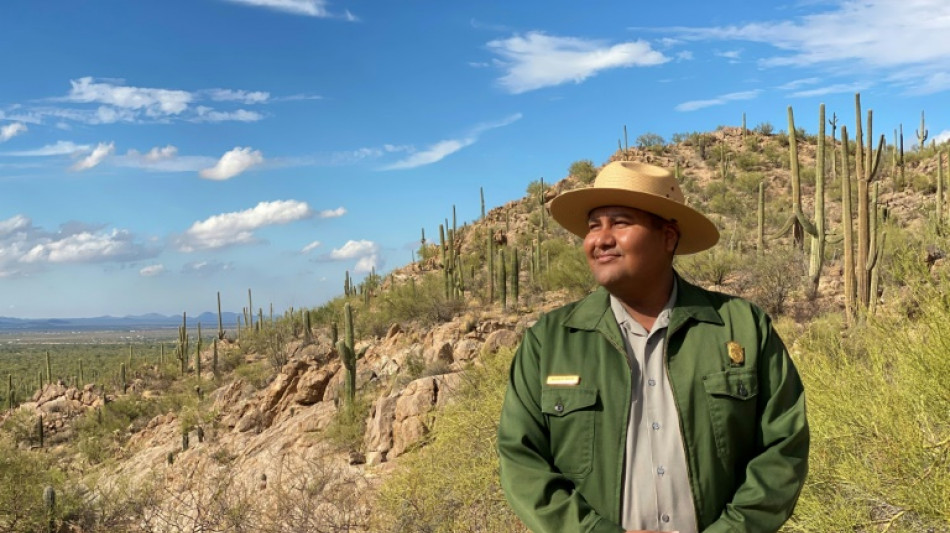
When Raeshaun Ramon first donned the distinctive green and gray uniform of a US National Park Service ranger, he feared his Native American tribe would judge him for his choice.
As a member of the Tohono O'odham nation, he didn't want to talk too much about his new job at Saguaro National Park in Arizona.
"I was afraid of what my people might think of me," the 28-year-old confides. "Why work for a place that has done us so much harm in the past?"
Most national parks were set up in areas that are Indigenous ancestral lands. From the 19th century onwards, Native Americans were expelled from those lands or forced to cede them via treaties with unequal terms.
It is a disturbing history not often associated with the natural beauty of the nation's parks.
Ramon is the first ranger at Saguaro to belong to the Tohono O'odham nation -- literally, the "desert people" -- even though the park is their historic territory.
Amid expanses of cacti, he tells AFP of his relief when his community rejoiced that "someone who looks like them" was finally represented at the park.
Today, he sees himself as a "bridge" between his colleagues, park visitors and his tribe, although he describes it as a "heavy responsibility."
His story illustrates the changes slowly underway within the National Park Service (NPS) -- the agency within the Department of the Interior in charge of national parks -- to improve its relations with Indigenous peoples.
For the first time, the agency's director is Native American -- a strong signal of the attempt to repair historical wounds.
- Traditional harvest -
"The visitors need to realize that this is Indian country," stresses Mike Turek, author of one of the few books on the relationship between Native Americans and the national parks.
"These are native lands, managed by the natives and used for centuries."
"The violence was a taking of the land," Turek says, adding that Indigenous access was restricted.
At Yellowstone, one of the crown jewels of the park system established in 1873, early administrators claimed that Native Americans had never entered the area for fear of geysers, Turek says.
In other cases, conflicts led to bloodshed. Shortly before the creation of Yosemite National Park, Native Americans were forcibly evicted or killed.
Today, the traditional use of land by these communities is one of the bones of contention, Turek says.
Jacelle Ramon-Sauberan, 35, also a member of the Tohono O'odham nation, recalls difficult interactions with Saguaro park employees who "shouted at them" when she and other family members came to pick the fruit of the cacti, considered sacred, during her childhood.
This tradition has been practiced by her people since "time immemorial," recounts Ramon-Sauberan, who has a doctorate in American Indian studies from the University of Arizona.
Syrup made from Saguaro cactus fruit is used for ceremonies and as medicine.
She said that the NPS even tried to ban harvesting of the fruit in the middle of the last century. Today, harvests are regulated by permits.
"I will truthfully speak that the relationship between the park and the Tohono O'odham wasn't always the best," she says. "It's a lot better than it used to be... We are heading in the right direction of really being partners with each other."
- Partnerships -
In 2021, Native American author David Treuer put forth a provocative idea in an article for The Atlantic magazine: "return the National Parks to the tribes," a move he wrote "would restore dignity that was rightfully ours."
For now, NPS Director Chuck Sams supports the development of partnerships.
There are currently some 80 co-management agreements between the NPS, in charge of more than 400 sites across the country, and some of the more than 500 Native American tribes currently active in the United States.
In northern Montana, Termaine Edmo takes part in the Native America Speaks program, which each summer brings members of her tribe, the Blackfeet Nation, to share their history with visitors to Glacier National Park.
But the 35-year-old activist, her eyebrows furrowed, speaks harshly of those who administer the land "stolen" from her people.
"They're still oppressing us," says Edmo, whose license plate begins with the letters "DECO," for "decolonization."
The past has left its mark: Native American reservations established for those driven from ancestral homes are predominantly poor and often wracked by high suicide and drug overdose rates.
Edmo regrets that so few visitors stop at her reservation, which is adjacent to the park, with the economic influx going to other towns.
As climate change coordinator for her nation, she would like to develop ecotourism to attract travelers to natural preservation projects, such as snow fencing, and regenerative grazing.
Despite all this, park officials are "trying to be open," she says. "They're willing to work with us. They're willing to step out of that box."
Last year, some 40 bison were reintroduced to repopulate the park.
- Rehabilitation -
New guidelines issued in 2022 aim to strengthen cooperative agreements which, according to Sams, should make it possible to "recognize the existence of deep wounds and hopefully heal some of them."
But they also aim to make better preservation decisions, drawing on deep tribal knowledge.
Recently, for example, Native American techniques of controlled burning -- to clear vegetation and avoid catastrophic fires -- have been re-established.
The increased hiring of Native American employees should also help bring change.
Of the 20,000 or so NPS employees, around 2.5 percent are American Indian or native Alaskan -- a figure that is "still remarkably low," the agency notes.
Ramon, the new ranger at Saguaro, would like to start by redesigning some information panels to include names in his traditional language, or because some signs "say that there was once a population living here" but "it stops there," he says.
"Visitors ask me: 'What happened to the people who lived here?' I smile at them and say: 'They're still here. Because I'm here.'"
(S.G.Stein--BBZ)