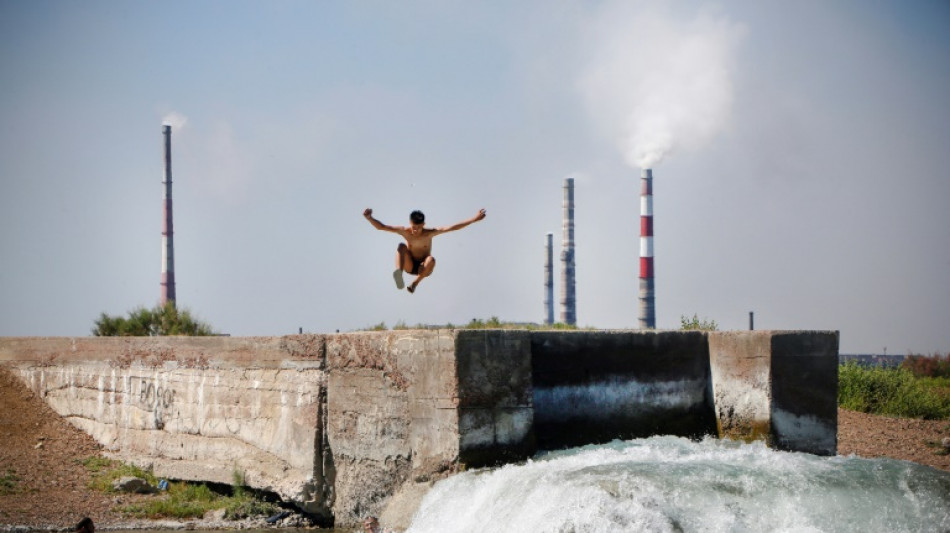
'Miseries of the Balkhash': Fears for Kazakhstan's magical lake / Photo: Ruslan PRYANIKOV - AFP

Seen from the sky, with its turquoise waters stretching out into the desert expanses in the shape of a crescent, you can see why they call Lake Balkhash the "pearl of Kazakhstan".
But pollution, climate change and its overuse are threatening the existence of one of the most unique stretches of water in the world.
One side of the Balkhash -- the biggest lake in Central Asia after the Caspian Sea -- has salt water, but on the other it is fresh. In such a strange environment, rare species have abounded. Until now.
"All the miseries of the Balkhash are right under my eyes," fisherman Alexei Grebennikov told AFP from the deck of his boat on the northern shores, which sometimes has salty water, sometimes fresh.
"There are fewer and fewer fish, it's catastrophic, the lake is silting up," warned the 50-year-old.
A dredger to clear the little harbour lay anchored, rusting and unused, off the industrial town of Balkhack, itself seemingly stuck in a Soviet timewarp.
"We used to take tourists underwater fishing. Now the place has become a swamp," said Grebennikov.
In town, scientist Olga Sharipova was studying the changes.
"The Balkhash is the country's largest fishery. But the quantity of fish goes down when the water level drops, because the conditions for reproduction are disrupted," she told AFP.
And its level is now only a metre from the critical threshold where it could tilt towards disaster.
There was an unexpected respite this spring when unprecedented floods allowed the Kazakh authorities to divert 3.3 million cubic metres of water to the Balkhash.
The Caspian also got a six-billion-cubic-metre fill-up.
- China 'overusing' water -
But the few extra centimetres has not changed the longterm trend.
"The level of the Balkhash has been falling everywhere since 2019, mainly due to a decrease in the flow of the Ili River" from neighbouring China, said Sharipova.
All the great lakes of Central Asia, also known as enclosed seas, share a similar worrying fate.
The Aral Sea has almost disappeared, the situation is alarming for the Caspian Sea and Lake Issyk-Kul in neighbouring Kyrgyzstan.
Located on dry lands isolated from the ocean, they are particularly vulnerable to disturbances "exacerbated by global warming and human activities", according to leading scientific journal Nature.
Rising temperatures accelerate evaporation, as water resources dwindle due to the melting of surrounding glaciers.
These issues are compounded by the economic importance of the Balkhash, which is on the path of China's Belt and Road Initiative, a massive infrastructure project also known as the New Silk Road.
A 2021 study by Oxford University scientists published in the journal "Water" concluded the lake's decline resulted from China's overuse of the Ili River which feeds it for its agriculture, including cotton.
"If the hydro-climatic regime of the Ili for 2020–2060 remains unchanged compared to the past 50 years and agriculture continues to expand in China, future water supplies will become increasingly strained," the study said.
Beijing is a key economic partner for Kazakhstan but it is less keen to collaborate on water issues.
"The drafting and signing of an agreement with China on the sharing of water in transborder rivers is a key issue," the Kazakh Ministry of Water Resources told AFP.
"The main objective is to supply the volumes of water needed to preserve the Balkhash," it said.
- Heavy pollution -
The water being syphoned away adds to "pollution from heavy metals, pesticides and other harmful substances", authorities said, without citing culprits.
The town of Balkhash was founded around Kazakhstan's largest copper producer, Kazakhmys.
Holidaymakers bathing on Balkhash's municipal beach have a view of the smoking chimneys of its metal plant.
Lung cancer rates here are almost 10 times the regional average, which is already among the highest in the country, health authorities said.
Despite being sanctioned for breaking environmental standards, Kazakhmys denies it is the main polluter of the lake and has vowed to to reduce pollution by renewing its equipment.
In the meantime, the plant continues to discharge industrial waste into another huge body of water, right next to the lake.
(F.Schuster--BBZ)