Berliner Boersenzeitung - Pollution level in Pakistan megacity hits new high, says official

EUR -
AED 4.244615
AFN 76.271918
ALL 93.366197
AMD 423.127183
AOA 1059.724062
ARS 1729.175777
AUD 1.636562
AWG 2.083045
AZN 1.957641
BAM 1.957599
BBD 2.326338
BDT 142.971375
BHD 0.43579
BIF 3458.258419
BMD 1.155642
BND 1.481061
BOB 14.027586
BRL 5.93827
BSD 1.155061
BTN 109.807426
BWP 15.663325
BYN 3.416139
BYR 22650.58146
BZD 2.322984
CAD 1.618806
CDF 2612.906548
CHF 0.932447
CLF 0.026736
CLP 1055.7021
CNY 7.800486
CNH 7.79785
COP 3677.241005
CRC 523.781299
CUC 1.155642
CUP 30.624511
CVE 110.59024
CZK 24.186025
DJF 205.38031
DKK 7.475767
DOP 67.315816
DZD 153.48698
EGP 57.552815
ERN 17.334629
ETB 186.42297
FJD 2.553387
FKP 0.8589
GBP 0.857966
GEL 3.016319
GGP 0.8589
GHS 13.549949
GIP 0.8589
GMD 84.931373
GNF 10149.421488
GTQ 8.810096
GYD 241.612608
HKD 9.064618
HNL 30.958447
HRK 7.535247
HTG 151.01877
HUF 361.674896
IDR 20654.036712
ILS 3.47126
IMP 0.8589
INR 109.880802
IQD 1513.090368
IRR 1588776.499747
ISK 141.785837
JEP 0.8589
JMD 183.548662
JOD 0.819314
JPY 182.194461
KES 149.505174
KGS 101.061253
KHR 4681.281342
KMF 494.614915
KRW 1642.617952
KWD 0.357348
KYD 0.96258
KZT 542.015709
LAK 26109.426943
LBP 103430.10369
LKR 387.596159
LRD 208.480669
LSL 18.948812
LTL 3.412309
LVL 0.699036
LYD 7.351755
MAD 10.765192
MDL 20.068354
MGA 4916.411299
MKD 61.586591
MMK 2426.04177
MNT 4158.228086
MOP 9.331434
MRU 46.31656
MUR 54.303823
MVR 17.866105
MWK 2002.762338
MXN 19.920816
MYR 4.731317
MZN 73.845071
NAD 18.948812
NGN 1573.810703
NIO 42.509061
NOK 10.997146
NPR 175.693203
NZD 1.961696
OMR 0.444347
PAB 1.155036
PEN 3.909993
PGK 5.178759
PHP 70.091418
PKR 320.721208
PLN 4.300372
PYG 6888.329638
QAR 4.22278
RON 5.246149
RSD 117.338123
RUB 93.584616
RWF 1696.751792
SAR 4.33658
SBD 9.327822
SCR 15.500574
SDG 693.961358
SEK 10.955543
SGD 1.480296
SLE 27.6199
SOS 660.109426
SRD 43.530693
STD 23919.45433
STN 24.522534
SVC 10.106287
SZL 18.93348
THB 38.24539
TJS 10.660665
TMT 4.056303
TND 3.389114
TRY 54.972156
TTD 7.8352
TWD 37.31753
TZS 3062.448769
UAH 51.687796
UGX 4307.958553
USD 1.155642
UYU 46.442676
UZS 13730.616967
VES 871.59813
VND 30336.755811
VUV 138.173179
WST 3.162706
XAF 656.557465
XAG 0.018588
XAU 0.000272
XCD 3.12318
XCG 2.081622
XDR 0.817563
XOF 655.82124
XPF 119.331742
YER 275.44734
ZAR 18.845636
ZMK 10402.165875
ZMW 22.048783
ZWL 372.116224
  • RBGPF

    -1.2500

    69.74

    -1.79%

  • RYCEF

    0.6500

    21

    +3.1%

  • CMSC

    -0.0600

    21.73

    -0.28%

  • NGG

    -0.1600

    80.26

    -0.2%

  • GSK

    -0.0700

    51.46

    -0.14%

  • RELX

    -0.1900

    36.61

    -0.52%

  • VOD

    -0.3800

    15.31

    -2.48%

  • BP

    -1.2300

    41.21

    -2.98%

  • BTI

    0.1500

    59.27

    +0.25%

  • RIO

    2.5000

    101.51

    +2.46%

  • BCC

    -1.6900

    84.8

    -1.99%

  • AZN

    5.8800

    161.5

    +3.64%

  • BCE

    0.0600

    22.06

    +0.27%

  • CMSD

    0.0200

    22.04

    +0.09%

  • JRI

    -0.0500

    12.67

    -0.39%

Pollution level in Pakistan megacity hits new high, says official
Pollution level in Pakistan megacity hits new high, says official / Photo: Arif ALI - AFP

Pollution level in Pakistan megacity hits new high, says official

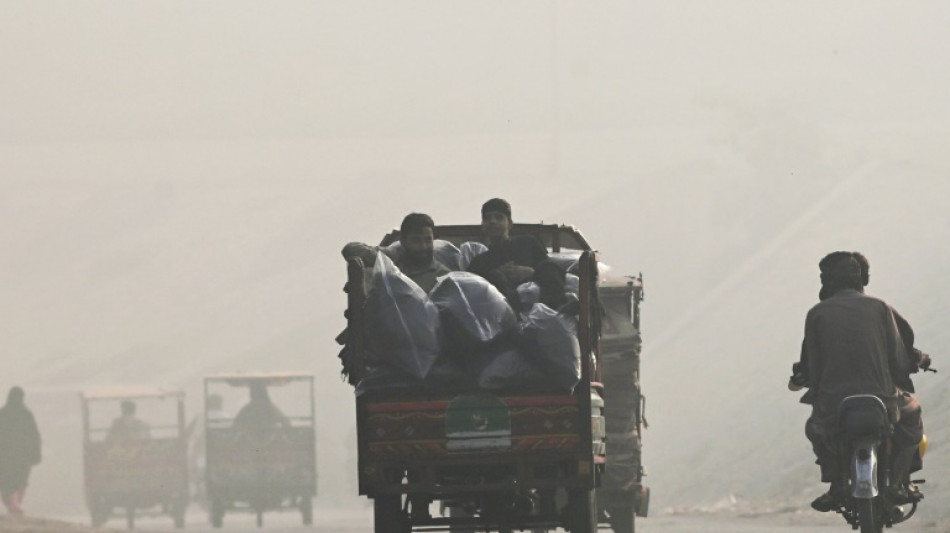
Air pollution in Pakistan's second biggest city Lahore soared on Saturday, with an official calling it a record high for the smog-choked mega city.

Text size:

For days, the city of 14 million people has been enveloped by smog, a mix of fog and pollutants caused by low-grade diesel fumes, smoke from seasonal agricultural burning and winter cooling.

The air quality index, which measures a range of pollutants, spiked at 1,067 –- well above the level of 300 considered 'dangerous' – according to data from IQAir.

"We have never reached a level of 1,000," Jahangir Anwar, a senior environmental protection official in Lahore told AFP.

"The air quality index will remain high for the next three to four days," Anwar said.

The level of deadly PM2.5 pollutants -- fine particulate matter in the air that causes the most damage to health -- peaked at 610 -- more than 40 times the limit of 15 in a 24-hour period considered healthy by the WHO.

"As a mother, I am full of anxiety," 42-year-old Lilly Mirza told AFP from the choked city.

"Last year was not this bad, it was much better. Somebody needs to tell us what has happened. Did a pollution bomb explode somewhere?"

Mirza said she felt "completely terrorised" after taking her son to a sports match in one of the pollution hot spots: "I came back home so stressed."

Breathing the toxic air has catastrophic health consequences, with the WHO saying strokes, heart disease, lung cancer and respiratory diseases can be triggered by prolonged exposure.

Smog is particularly pronounced in winter, when cold, denser air traps emissions from poor-quality fuels used to power the city's vehicles and factories at ground level.

The smell of toxic fumes has become familiar to 40-year-old painter Rehmat, who goes by one name.

"What can a poor painter like me do if the government can't fix this? I will keep the mask on and work," he told AFP.

- School hours changed -

Last month, authorities banned schoolchildren from outdoor exercise until January and adjusted school hours to prevent children from travelling when the pollution is most punishing.

Children are particularly vulnerable because they have less developed lungs and breathe more rapidly, taking in more air relative to their size than adults.

Last week, the provincial environmental protection agency announced new restrictions in four "hot spots" in the city.

Tuk-tuks equipped with polluting two-stroke engines are banned, as are restaurants that barbecue without filters.

Government offices and private companies will have half their staff work from home starting Monday.

Construction work has been halted and street and food vendors, who often cook over open fires, must close at 8 pm.

Pollution in excess of levels deemed safe by the WHO shortens the life expectancy of Lahore residents by an average of 7.5 years, according to the University of Chicago's Energy Policy Institute.

According to UNICEF, nearly 600 million children in South Asia are exposed to high levels of air pollution and half of childhood pneumonia deaths are associated with air pollution.

(H.Schneide--BBZ)