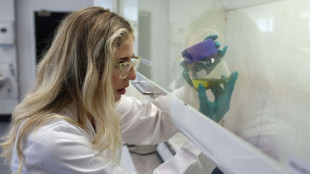
The other greenhouse gases warming the planet / Photo: Nhac NGUYEN - AFP

While carbon dioxide, or CO2, is the best known greenhouse gas, several others, including methane and nitrous oxide, are also driving global warming and altering the Earth's climate.
Atmospheric concentrations of all three hit new highs in 2023, locking in future temperature increases for years to come, the World Meteorological Organization reported in October.
- Methane -
CO2 accounts for about two-thirds of the warming attributed to greenhouse gases, said Piers Forster, an expert at the University of Leeds and author of reports by the IPCC, the UN's climate science panel.
Methane, or CH4, is the second most important greenhouse gas linked to human activity after CO2.
Around 40 percent of methane comes from natural sources, notably wetlands, but the majority (around 60 percent) is linked to human activities such as agriculture (ruminant breeding and rice cultivation), fossil fuels and waste.
Its warming power is more than 80 times greater over 20 years than that of CO2, but its lifespan is shorter, making it an important lever in attempts to limit global warming in the short term.
Reducing methane emissions "would have a strong short-term cooling effect, because atmospheric methane concentrations would drop quickly", said Mathijs Harmsen, a researcher at the PBL Netherlands Environmental Assessment Agency.
Policies should "focus on capturing the low hanging fruit, so the very low-cost measures such as reducing natural gas leaks", he said.
Despite a global commitment to reduce planet-heating emissions signed by many countries, including the European Union and the United States, the trend is not positive.
"Methane is rising faster in relative terms than any major greenhouse gas and is now 2.6-fold higher than in pre-industrial times," said an international group of researchers under the aegis of the Global Carbon Project, in a study published in the academic journal Environmental Research Letters.
- Nitrous oxide -
Nitrous oxide, or nitrous protoxide (N2O), is the third major greenhouse gas and almost 300 times more potent than CO2.
It is mainly emitted by synthetic nitrogen fertilisers and manure used in agriculture.
Other emissions come from human activities (the chemical industry, wastewater, fossil fuels) or natural sources (the soil and oceans).
"Global human-induced emissions, which are dominated by nitrogen additions to croplands, increased by 30 percent over the past four decades," concluded a major study in the journal Nature in 2020.
The key to the problem lies in more efficient use of fertilisers.
"Two-thirds of the climate change mitigation potential of N2O could be realised by reducing fertilisers on just 20 percent of the world's cropland, particularly in humid subtropical agricultural regions," wrote French researcher Philippe Ciais in 2021.
- Fluorinated gases -
Fluorinated greenhouse gases (PFCs, HFCs and SF6) are found in fridges, freezers, heat pumps, air conditioners and electrical networks.
Even when in small quantities, they stand out for their extremely high warming capacity.
For example, SF6, which is found in electrical transformers, has a greenhouse effect 24,000 times greater than CO2 over a 100-year period.
The Montreal Protocol signed in 1987, and ratified by 195 countries, has already significantly reduced the atmospheric presence of CFCs, another ozone-depleting fluorinated gas.
In 2016 the Kigali agreement also provided for the phasing out of HFCs.
And last year the EU sealed a pact to progressively ban the sale of equipment containing fluorinated gases, in particular HFCs, with the aim of eliminating them completely by 2050.
(T.Burkhard--BBZ)