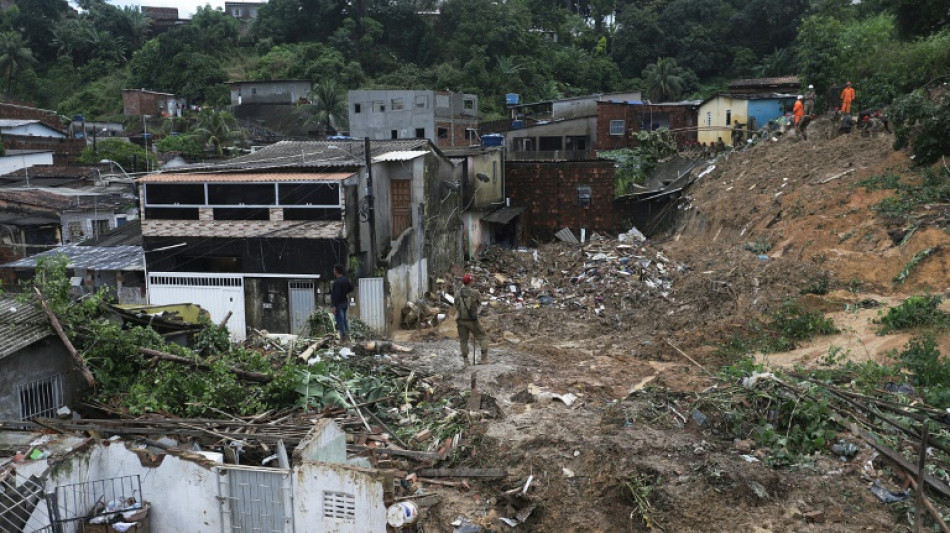
Brazil facing more deadly storms: expert / Photo: Sergio MARANHAO - AFP

Tragedies like the floods and landslides that killed more than 100 people in northeastern Brazil will likely keep happening as climate change advances unless authorities act to protect poor communities in high-risk areas, an expert said.
Torrential rains over the weekend wrought havoc on the city of Recife and surrounding areas, the latest in a series of deadly storms to hit Brazil in recent months.
Jose Marengo, research coordinator at the National Monitoring and Alert Center for Natural Disasters (CEMADEN), told AFP climate change will continue fueling ever heavier rains -- and that "if cities aren't prepared, we'll be mourning more and more deaths."
- Is latest disaster related to climate change? -
"Climate change is a long-term process that is advancing slowly. No one isolated, extreme event can be attributed to it. Rain and disaster are different things.
"In Recife, very intense rains fell on areas near rivers and hills. Any intense rain in places like that will cause similar tragedies in these circumstances, with rivers sweeping away houses and avalanches of mud taking out everything in their path.
"Climate change could be responsible for the rise in extreme, violent rain that is being detected not only in Brazil but around the world. But it can't be blamed for the fact that governments allow people to build in high-risk areas, or that the poor have nowhere to go and have to live in vulnerable areas. Those are urban planning problems."
- What do Brazil's recent storms have in common? -
"In Bahia state (northeast), where 33 people were killed in December, there is a phenomenon called the South Atlantic Convergence Zone that produces rain in the (southern hemisphere) summer. It's always present in southeastern Brazil, but in December it reached Bahia and caused deadly floods.
"In Petropolis (southeast, where 233 people were killed in February), there was an intense meteorological phenomenon, unusual but not impossible, more similar to what happened now in Recife. In both cases, the rain had been correctly forecast, but the problem was vulnerable populations living in high-risk areas.
"If you look at videos of landslides and flash floods from both Petropolis and Recife, it's impossible to tell which is which, because they were very similar disasters."
- How can Brazil, other governments prepare better? -
"Rain is only part of the problem. In Brazil, we're good at forecasting rain. The problem is the weak link in the chain: the vulnerability of the population.
"It's a common mistake to say, 'The rain killed X number of people.' Rain doesn't kill people, except when it combines with the problem of people living in high-risk areas.
"Governments need to prevent people from building on areas such as hillsides and evacuate people from existing houses to safer areas -- every year, not just when there are disasters.
"And cities need to be better-organized, because we can see looking at the climate that phenomena like these rains are getting more intense and violent.
"If people and cities aren't prepared, we'll be mourning more and more deaths. The rainy season is just starting in the northeast, and we may see a lot more such phenomena this year."
(A.Berg--BBZ)