Berliner Boersenzeitung - New coal capacity hit 20-year low in 2024: report

EUR -
AED 4.202809
AFN 72.097162
ALL 95.786655
AMD 431.439057
ANG 2.048573
AOA 1049.415759
ARS 1600.159384
AUD 1.631526
AWG 2.059922
AZN 1.946316
BAM 1.951454
BBD 2.304767
BDT 140.417249
BGN 1.956135
BHD 0.434931
BIF 3397.133571
BMD 1.144401
BND 1.464338
BOB 7.907388
BRL 6.100344
BSD 1.144351
BTN 105.626738
BWP 15.593269
BYN 3.385958
BYR 22430.261126
BZD 2.301374
CAD 1.568877
CDF 2582.913266
CHF 0.903665
CLF 0.026583
CLP 1049.655944
CNY 7.892473
CNH 7.896257
COP 4213.914357
CRC 538.400821
CUC 1.144401
CUP 30.326629
CVE 110.019953
CZK 24.464976
DJF 203.77613
DKK 7.471852
DOP 70.303413
DZD 152.804659
EGP 59.88872
ERN 17.166016
ETB 178.620459
FJD 2.550527
FKP 0.860334
GBP 0.863347
GEL 3.124469
GGP 0.860334
GHS 12.427321
GIP 0.860334
GMD 84.117996
GNF 10031.656512
GTQ 8.775454
GYD 239.40677
HKD 8.958085
HNL 30.290534
HRK 7.538742
HTG 150.045803
HUF 393.085178
IDR 19409.0995
ILS 3.598386
IMP 0.860334
INR 105.954202
IQD 1499.061144
IRR 1512583.514184
ISK 144.53934
JEP 0.860334
JMD 179.550088
JOD 0.811364
JPY 182.495918
KES 148.010337
KGS 100.077533
KHR 4588.779421
KMF 493.237021
KPW 1029.960907
KRW 1719.748978
KWD 0.351823
KYD 0.953576
KZT 560.21224
LAK 24520.385795
LBP 102472.163961
LKR 356.136777
LRD 209.403596
LSL 19.219393
LTL 3.379118
LVL 0.692237
LYD 7.301737
MAD 10.777695
MDL 19.962537
MGA 4751.417178
MKD 61.503014
MMK 2402.567533
MNT 4084.341362
MOP 9.224754
MRU 45.784025
MUR 53.226009
MVR 17.680917
MWK 1984.180639
MXN 20.448216
MYR 4.507221
MZN 73.138831
NAD 19.219393
NGN 1585.566919
NIO 42.106217
NOK 11.172719
NPR 169.002581
NZD 1.97261
OMR 0.440025
PAB 1.144251
PEN 3.946211
PGK 5.003855
PHP 68.194646
PKR 319.517539
PLN 4.27653
PYG 7382.556846
QAR 4.159735
RON 5.107007
RSD 117.109163
RUB 91.651288
RWF 1669.880678
SAR 4.294863
SBD 9.214394
SCR 17.472084
SDG 687.784516
SEK 10.806413
SGD 1.466619
SHP 0.858597
SLE 28.094957
SLL 23997.530791
SOS 652.845918
SRD 42.969965
STD 23686.791775
STN 24.445552
SVC 10.012699
SYP 126.484907
SZL 19.213206
THB 36.996194
TJS 10.968171
TMT 4.005404
TND 3.384162
TOP 2.755443
TRY 50.576857
TTD 7.760715
TWD 36.843533
TZS 2980.860735
UAH 50.462505
UGX 4302.417235
USD 1.144401
UYU 45.967616
UZS 13817.224924
VES 506.63165
VND 30090.881941
VUV 135.32917
WST 3.130183
XAF 654.499235
XAG 0.014083
XAU 0.000228
XCD 3.092801
XCG 2.062307
XDR 0.813987
XOF 654.499235
XPF 119.331742
YER 272.99679
ZAR 19.305382
ZMK 10300.948139
ZMW 22.273391
ZWL 368.49668
  • RBGPF

    0.1000

    82.5

    +0.12%

  • JRI

    -0.2300

    12.59

    -1.83%

  • AZN

    -2.6000

    189.9

    -1.37%

  • CMSD

    -0.1100

    22.99

    -0.48%

  • BCC

    0.3800

    70

    +0.54%

  • BCE

    -0.1100

    25.57

    -0.43%

  • GSK

    -0.8900

    53.39

    -1.67%

  • NGG

    0.0900

    90.9

    +0.1%

  • CMSC

    -0.1500

    22.99

    -0.65%

  • RELX

    -0.0400

    34.14

    -0.12%

  • VOD

    0.1000

    14.41

    +0.69%

  • RYCEF

    -1.1300

    16.12

    -7.01%

  • RIO

    -2.8700

    87.83

    -3.27%

  • BTI

    0.0400

    59.93

    +0.07%

  • BP

    0.5100

    42.67

    +1.2%

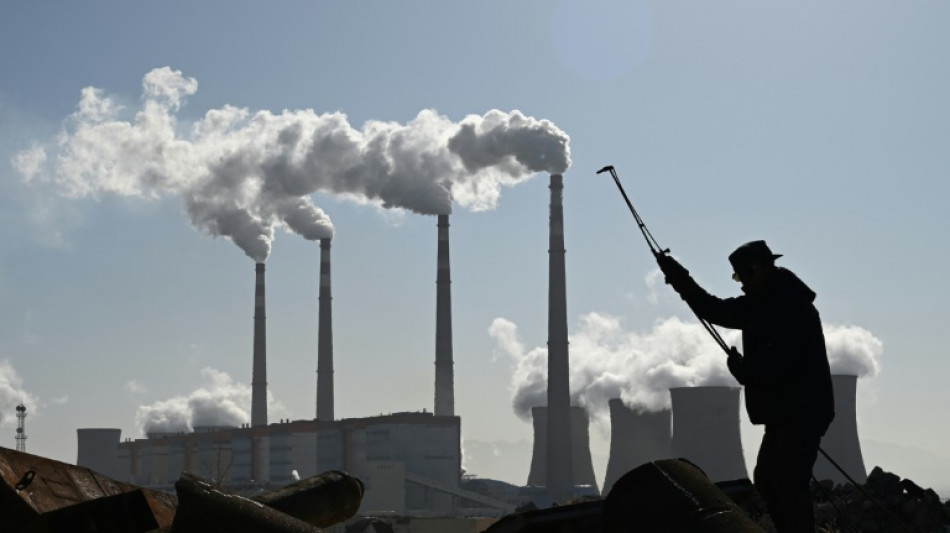
New coal capacity hit 20-year low in 2024: report
New coal capacity hit 20-year low in 2024: report / Photo: GREG BAKER - AFP/File

New coal capacity hit 20-year low in 2024: report

The world added the smallest amount of new coal capacity in two decades last year, a report said Thursday, but use of the fossil fuel is still surging in China and India.

Text size:

Coal accounts for just over a third of global electricity production and phasing it out is fundamental to meeting climate change goals.

Just 44 gigawatts (GW) of new coal power capacity was produced globally last year, the lowest figure since 2004, according to the report by a group of energy- and environment-focussed research organisations and NGOs.

"Last year was a harbinger of things to come for coal as the clean energy transition moves full speed ahead," said Christine Shearer of the Global Energy Monitor, which co-authored the report.

But new capacity still outstripped coal closures, meaning a net increase in the global coal fleet, the report noted.

China began construction on a record number of coal plants last year.

Last year also saw a record number of new coal proposals in India, the report warned.

"Work is still needed to ensure coal power is phased out in line with the Paris climate agreement, particularly in the world's wealthiest nations," Shearer said.

- 'Dubious' coal technologies -

The International Energy Agency (IEA) says global coal demand will plateau from 2024-2027, with declining use in developed countries largely off-set by growth in emerging economies.

China's electricity sector accounts for a third of all coal consumed worldwide, according to the IEA, making its transition from the fuel key to global trends.

While coal construction hit record highs in China last year, new permits in the country fell back from the breakneck levels seen the two years prior, the report said.

And in Southeast Asia, where coal has powered emerging economies like Indonesia, new proposals for the fossil fuel have declined.

That is the result of various deals and pledges in Indonesia, Malaysia, the Philippines and Vietnam to phase out the use of coal, the report said.

But among wealthy economies, Japan and South Korea were singled out for their promotion of "dubious 'decarbonisation' coal technologies domestically and abroad."

The report warned these technologies are "expensive and unlikely to deliver the deep emission cuts needed for climate stability."

Chief among them is co-firing with ammonia at coal-powered plants. Substituting ammonia for some of the coal used in a plant can reduce emissions, but ammonia's emissions profile depends on how it is produced.

And even co-firing with low-emissions ammonia still produces more carbon dioxide than many other power generation technologies, the report warned.

The groups also flagged uncertainty over coal commitments in the United States after Donald Trump returned to the presidency.

But they pointed out that more coal plants were shut during Trump's first term than under his predecessor Barack Obama, or successor Joe Biden.

"Trump's first term shows the difficulty of counteracting the declining economic feasibility of coal power in the US, coupled with the advanced age of the country's coal plants," the report said.

(Y.Yildiz--BBZ)