Tradition stokes pollution at Myanmar 'slash and burn' festival / Photo: STR - AFP

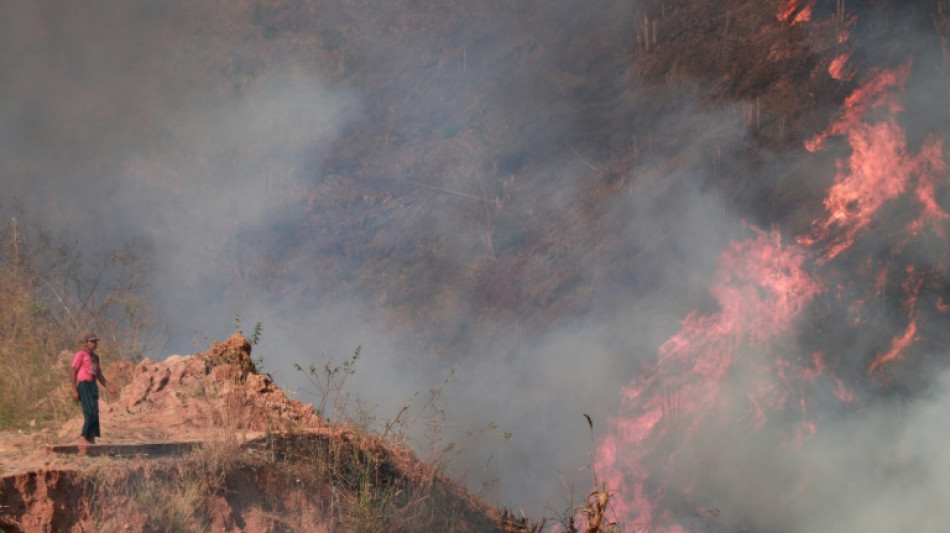
A charred Myanmar hillside is wreathed by flames, spewing ochre smoke that smothers out sunlight in an apocalyptic scene.
But the villagers who set it ablaze dance below in a ceremony celebrating the inferno as a moment of regeneration and hope.
"It's a tradition from our ancestors," said Joseph, a youth leader from Tha Yu village in Myanmar's eastern Shan state.
"It's the only way we survive," added Joseph, who goes by only one name.
Every year between January and April, Southeast Asia is plagued by smog from farmers lighting fires to clear land, emitting microscopic PM 2.5 pollution that lines the lungs and enters the bloodstream.
Myanmar residents lose 2.3 years of life expectancy as a result of pollution from farming fires and other sources, according to analysis of 2022 data by the Energy Policy Institute at the University of Chicago.
Since a 2021 coup, the country has been riven by a civil war between the military and a patchwork of anti-coup partisans and ethnic minority armed groups, leaving the toll from pollution largely ignored.
But in Tha Yu village there are additional tensions -- between the old ways of agriculture and new knowledge about environmental risks.
"We don't have any other work or opportunities in our region," said Joseph, 27, as haze swallowed the hills behind him, scorched to make way for paddy rice, chilli and corn.
"So we are forced into this tradition every year."
- 'Not getting rich' -
Most agricultural burn-off happens when farmers incinerate the stubble of old harvests in their fields to make room for the new, and to fertilise the soil.
But the smoke billowing around Tha Yu village is from "slash and burn" agriculture -- a method also called shifting cultivation, in which patches of wild vegetation are burnt for similar purposes, with crops planted for only a few growing cycles.
"If possible, we want to try other agricultural methods but we don't have any technology and no one has taught us," said Joseph.
Environmentalists generally say slash and burn farming can be twice as harmful because it lays waste to tracts of existing plant life which would otherwise absorb carbon dioxide emissions.
But a 2023 study in Belize suggested Indigenous "slash and burn" farming done in intermediate size patches of land could have a positive effect on forest diversity by opening up space for new growth.
In the Tha Yu ceremony, villagers in white headbands dance on stage before lighting a symbolic bundle of brush, swaying and clapping their hands in rhythmic celebration.
Dark tendrils of smoke creep into the sky.
"I can surely say we are not getting rich from shifting cultivation," said Khun Be Sai, a member of the local area's cultural committee.
"We do it just to get by day to day."
- Shifting mindset -
Air quality monitoring is neither practical nor a priority in war-torn Myanmar, where more than half the population lives in poverty and 3.5 million people are displaced.
But the toll from air pollution only adds to those woes.
"Clean air is very important for your health," said Thailand's Kasetsart University environmental economist Witsanu Attavanich. "It's kind of a basic thing."
"If you don't have it you have less healthy people, a lower quality of human capital. How can the country improve without good health?"
Tha Yu is in an area controlled by the Kayan New Land Party, an ethnic minority armed group.
Khun Be Sai says hundreds of villages in the region still practise slash and burn farming, but Tha Yu is the only place that marks it with a formal ceremony.
But he sees little to celebrate in the landscape altered by climate change around the village.
"We are experiencing more natural disasters. The forests are thinning and water retention is decreasing. We are experiencing soil erosion due to heavy rains," he said.
While the ceremony lauds the practice that sustains their community, Khun Be Sai also sees a dwindling of their way of life.
"People are leaving and living in different places," he said.
"Our identities, our origins, language and literature are disappearing and being swallowed by others."
(A.Berg--BBZ)