US oyster gardeners rebuild nature's own water-cleaning system / Photo: Drew ANGERER - AFP

For many just a tasty delicacy, the oyster may actually be the hero the world needs to fight environmental degradation -- and volunteers like Kimberly Price are battling to repopulate the surprisingly powerful species.
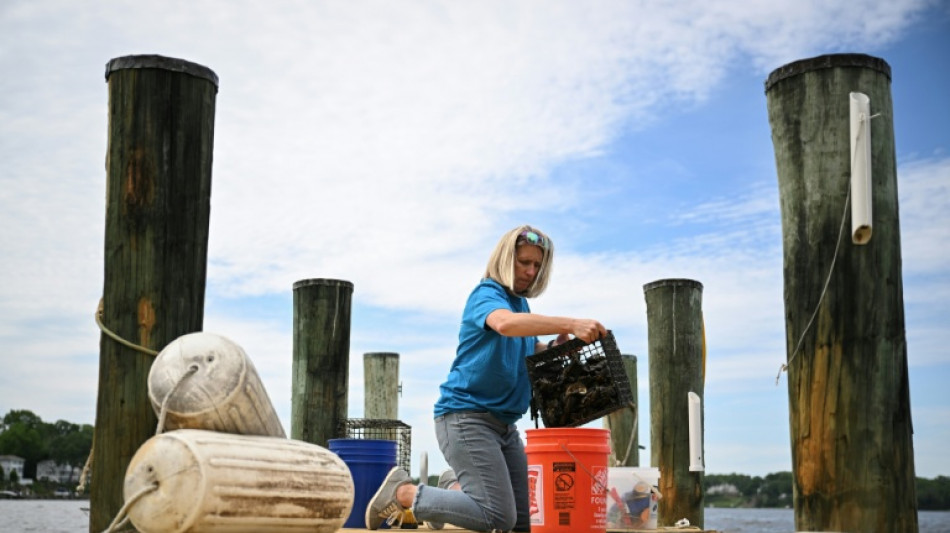
The 53-year-old is an "oyster gardener" who fosters thousands of the mollusks at her waterside home until they are old enough to be planted in the Chesapeake Bay near the US capital Washington, where they clean the water and can even offset climate change.
Far removed from the menus of seafood restaurants, oysters also have a supremely practical use as prolific water filters -- with an adult able to process up to 50 gallons (190 liters) each day.
This produces a healthier habitat, boosting plant and animal life, which experts say can also help waterways capture more planet-warming carbon dioxide.
But today, just one percent of the native oyster population found in the bay before the 1880s remains, due to pollution, disease and overharvesting -- leaving a mammoth task for environmentalists.
Volunteers like Price are crucial to these efforts led by the Chesapeake Bay Foundation (CBF).
For around nine months, they keep infant oysters in cages at their docks to give them the best chance of reaching adulthood. Then they put them to work at helping preserve the planet.
"We humans destroy everything, right? So this is like, let's fix our problems: how do we try and correct this?" Price, a housing consultant, told AFP.
At her Maryland home, where ospreys flew overhead and tiny fish swam below, she pulled up a mesh cage marked "Not for sale or human consumption" suspended by rope in the water.
Inside on large, old oyster shells -- many recycled from restaurants -- were half a dozen smaller live oysters each about the size of a knuckle.
When Price got them last summer, they were no bigger than pinpricks that the CBF had received as oyster larvae from a specialist hatchery before bonding them to shells in setting tanks.
Price's role has involved scrubbing her eight cages and rinsing them with fresh water every two weeks to remove organisms that can restrict oxygen and hinder feeding.
When AFP visited in late May, she was giving them a final clean before joining other volunteers returning the oysters to the CBF to be planted on sanctuary reefs in the bay, where fishing of the mollusks is banned.
- 'We can get there' -
It's part of an ambitious goal that the nonprofit and its partners set in 2018 to add 10 billion new oysters to the bay -- America's largest estuary -- by the end of 2025.
Around 6.7 billion have been planted so far, CBF oyster expert Kellie Fiala said at the group's headquarters, adding that the population is "trending in a positive direction."
"Thinking about how many oysters used to be in the bay, we still have a ways to go," she said, but insisted that "working together, we can get there."
A key challenge is a lack of substrate in the bay -- the hard riverbed material that oysters need to grow on -- because for many years, shells were removed to be used in building driveways and gardens.
"Folks then just didn't understand the importance of putting that shell back so it can be a home for new oysters," Fiala said.
To address this, the organization is encouraging volunteers to make "reef balls" -- igloo-style concrete blocks that can serve as artificial underwater habitats.
This initiative, like oyster gardening, encourages community participation ranging from schoolchildren to retirees.
Some of those volunteers, including Price, arrived at the CBF's office next to the bay to drop off their buckets of homegrown oysters ready for planting.
Each got a rough tally of how many they had brought based on the average number of babies on a handful of shells. For Price, it was what she celebrated as a "very good" total of around 7,500.
Her oysters were loaded with others onto a small, single-engine boat that the captain, 61-year-old Dan Johannes, steered towards a sanctuary reef in a tidal tributary of the bay.
There, two interns began dumping the 20 buckets overboard, with the oysters splashing into the water.
The planting process took no longer than a minute -- 75,000 oysters, raised for almost a year -- returning to the bay.
(B.Hartmann--BBZ)