Chinese sub discovers deepest-ever creatures 10 km undersea / Photo: STAFF - AFP/File

A Chinese submersible has discovered thousands of worms and molluscs nearly 10 kilometres (six miles) below sea level in the Mariana Trench, the deepest colony of creatures ever observed, a study revealed on Wednesday.
The discovery in Earth's deepest underwater valley suggests that there could be much more life thriving in the hostile conditions at the bottom of our planet's largely unexplored oceans than previously thought, the China-led team of scientists said.
Almost all life on Earth is supported by light from the Sun. However in the total darkness at the bottom of the world, these creatures live off of chemicals such as methane seeping through cracks in the seafloor, a process called chemosynthesis.
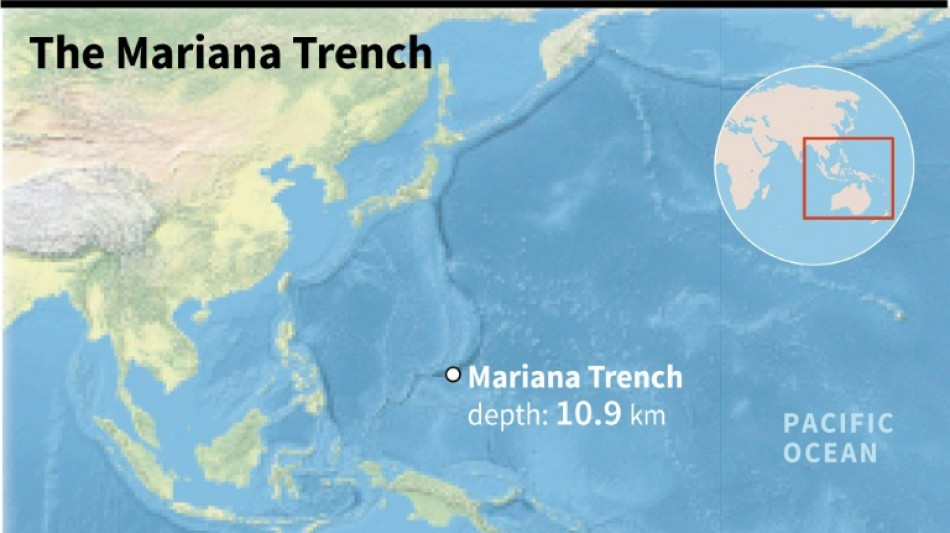
Last year, the Chinese submersible "Fendouzhe" -- or "Striver" -- dove 23 times into the depths of the Mariana Trench in the western Pacific Ocean with researchers on board, according to the study in the journal Nature.
They found colonies of thousands of marine tubeworms and molluscs called bivalves at depths ranging from 2,500 to 9,533 metres (8,200 to 31,000 feet) deep.
Video released alongside the study showed fields of tubeworms, which grew up to 30 centimetres (12 inches) long, as well as piles of molluscs and clams.
Spiky crustaceans, free-floating marine worms, sea cucumbers, feathery-armed sea lilies and other invertebrates were also recorded in the depths.
The study marked "the discovery of the deepest and the most extensive chemosynthesis-based communities known to exist on Earth," its authors said.
Given that other ocean trenches are similar, "such chemosynthesis-based communities might be more widespread than previously anticipated," they added.
The researchers said they also found "compelling evidence" that methane was being produced by microbes, with the tubeworms tending to cluster around microbial mats that resemble snow.
Previous studies have found thriving communities of single-cell organisms on the ocean floor, but few large animals.
But a remotely operated vehicle discovered tubeworms and other marine invertebrates living in hydrothermal vents in the crust below the seafloor two kilometres deep in the Pacific, research said last year.
- Pressure rising -
The new study was published as nations wrangle over the contentious issue of deep-sea mining. China, the United States and others have expressed interest in mining the depths for valuable minerals.
Ocean scientists warn that mining the little-explored seafloor, one of the last wild zones on the planet, could decimate fragile ecosystems that are not yet well understood.
Despite recent talks, the International Seabed Authority -- which oversees deep-sea mining in international waters -- has yet to adopt long-awaited rules governing the industry.
Chinese media has previously reported that the Fendouzhe submersible mission will conduct research on "deep-sea materials".
Only a handful of people have ever visited the bottom of the Mariana Trench, which is a crescent-shaped depression in the Earth's crust that is deeper than Mount Everest is high.
The first explorers visited the trench in 1960 on a brief expedition.
But after that, there were no missions until Hollywood director James Cameron made the first solo trip to the bottom in 2012, describing a "desolate" and "alien" environment.
The water pressure at the bottom of the trench is a crushing eight tons per square inch, more than a thousand times the atmospheric pressure at sea level.
(S.G.Stein--BBZ)