Berliner Boersenzeitung - Climate-driven wildfires reversing pollution progress in N. America: study

EUR -
AED 4.232967
AFN 75.479359
ALL 93.095382
AMD 422.092766
AOA 1057.968242
ARS 1728.428661
AUD 1.638336
AWG 2.074448
AZN 1.961602
BAM 1.952566
BBD 2.320646
BDT 142.623742
BHD 0.434608
BIF 3445.888043
BMD 1.152471
BND 1.477446
BOB 13.935975
BRL 5.897421
BSD 1.152186
BTN 109.652359
BWP 15.583119
BYN 3.411334
BYR 22588.429982
BZD 2.317251
CAD 1.615251
CDF 2604.584378
CHF 0.936272
CLF 0.026727
CLP 1055.271199
CNY 7.778084
CNH 7.777151
COP 3641.324061
CRC 524.099988
CUC 1.152471
CUP 30.540479
CVE 110.809379
CZK 24.24407
DJF 204.817306
DKK 7.476217
DOP 67.193733
DZD 153.365094
EGP 57.264782
ERN 17.287064
ETB 185.968128
FJD 2.552089
FKP 0.856077
GBP 0.85641
GEL 3.013725
GGP 0.856077
GHS 13.524239
GIP 0.856077
GMD 85.282572
GNF 10118.69464
GTQ 8.791437
GYD 241.048608
HKD 9.04099
HNL 30.88171
HRK 7.536585
HTG 150.649793
HUF 364.625083
IDR 20648.821428
ILS 3.46629
IMP 0.856077
INR 109.809273
IQD 1509.393123
IRR 1584474.640687
ISK 142.41109
JEP 0.856077
JMD 182.637459
JOD 0.81708
JPY 182.544457
KES 149.083075
KGS 100.783234
KHR 4675.235131
KMF 492.105126
KRW 1640.600173
KWD 0.356874
KYD 0.960205
KZT 539.927945
LAK 26033.64904
LBP 103179.229954
LKR 387.028882
LRD 207.974585
LSL 18.793369
LTL 3.402947
LVL 0.697118
LYD 7.344833
MAD 10.750192
MDL 20.047704
MGA 4953.772522
MKD 61.427977
MMK 2419.54797
MNT 4144.10128
MOP 9.310037
MRU 46.191483
MUR 54.096679
MVR 17.805023
MWK 1997.873162
MXN 19.839187
MYR 4.713377
MZN 73.654852
NAD 18.793287
NGN 1570.218621
NIO 42.399764
NOK 10.999988
NPR 175.441856
NZD 1.96294
OMR 0.443115
PAB 1.152181
PEN 3.894648
PGK 5.090567
PHP 70.070805
PKR 319.87712
PLN 4.300443
PYG 6853.617163
QAR 4.211823
RON 5.256075
RSD 117.326118
RUB 93.901208
RWF 1692.588862
SAR 4.32768
SBD 9.298537
SCR 16.618402
SDG 692.059091
SEK 10.953862
SGD 1.478943
SLE 28.350098
SOS 658.506319
SRD 43.640038
STD 23853.821162
STN 24.459377
SVC 10.0813
SZL 18.777732
THB 38.150825
TJS 10.628901
TMT 4.033648
TND 3.379417
TRY 54.852312
TTD 7.801044
TWD 37.188047
TZS 3059.807971
UAH 51.592237
UGX 4291.87184
USD 1.152471
UYU 46.403133
UZS 13731.254005
VES 869.206532
VND 30235.07452
VUV 137.540809
WST 3.145342
XAF 654.86936
XAG 0.018742
XAU 0.000271
XCD 3.11461
XCG 2.076569
XDR 0.813514
XOF 654.872196
XPF 119.331742
YER 272.991507
ZAR 18.833743
ZMK 10373.622108
ZMW 21.920498
ZWL 371.095165
  • RYCEF

    -0.0500

    20.95

    -0.24%

  • RBGPF

    0.0000

    69.74

    0%

  • NGG

    0.1200

    80.38

    +0.15%

  • GSK

    0.7050

    52.165

    +1.35%

  • CMSD

    -0.0850

    21.955

    -0.39%

  • BCE

    0.7050

    22.765

    +3.1%

  • BTI

    -0.6200

    58.65

    -1.06%

  • VOD

    0.6650

    15.975

    +4.16%

  • BCC

    -0.3000

    84.5

    -0.36%

  • CMSC

    0.0050

    21.735

    +0.02%

  • AZN

    -0.9480

    160.552

    -0.59%

  • BP

    1.0000

    42.21

    +2.37%

  • RIO

    -1.6500

    99.86

    -1.65%

  • RELX

    -1.0500

    35.56

    -2.95%

  • JRI

    0.0000

    12.67

    0%

Climate-driven wildfires reversing pollution progress in N. America: study
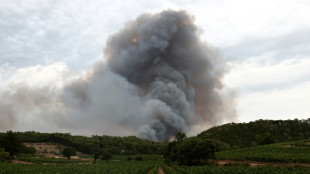
Climate-driven wildfires reversing pollution progress in N. America: study / Photo: Colby Rex O'Neill - AFP/File

Climate-driven wildfires reversing pollution progress in N. America: study

Global air pollution is worsening, with the United States and Canada experiencing the sharpest increases due to record-breaking, climate-supercharged wildfires that are undoing decades of progress, a study said Thursday.

Text size:

The Air Quality Life Index (AQLI) annual report uses satellite data to assess levels of particulate matter worldwide, with records dating back to 1998. It translates concentrations into years of life expectancy lost, based on peer-reviewed science.

"I just don't think this can be repeated enough: particulate matter remains the greatest external threat to human health on the planet, period," Michael Greenstone, an economics professor at the University of Chicago who co-created AQLI, told AFP.

"It's worse than tobacco smoke. It's worse than child and maternal malnutrition. It's worse than road accidents. It's worse than HIV-AIDS, worse than anything in terms of losses."

According to the report, Canada's catastrophic 2023 wildfire season drove a more than 50 percent rise in particulate levels compared to 2022, while the United States saw a 20 percent increase.

Although the data currently only extends until 2023, the trend is likely to have continued as both countries face intensifying wildfire seasons, driven by warming temperatures and drought fueled by human-caused greenhouse gas emissions.

The year 2025 already ranks as Canada's second worst wildfire season.

"The very surprising finding to me is that in parts of the world, certainly Canada, certainly the US and it looks like parts of Europe as well, air pollution is like the zombie that we thought we had killed, and now it's back," said Greenstone.

While the most polluted counties in the US have historically been found in California, that's now shifting to states downwind of Canadian wildfires including Wisconsin, Illinois, Indiana, and Ohio but also further south.

More than half of Canadians breathed air with pollution above their national standard of 8.8 micrograms per cubic meter -- a dramatic shift from less than five percent in the previous five years.

The hardest-hit regions were provinces of Northwest Territories, British Columbia, and Alberta, where particulate pollution levels rivaled those of Bolivia and Honduras, shortening lifespans by two years.

Globally, fine particulate levels -- defined as 2.5 micrometers and smaller -- were up from 23.7 micrograms per cubic meter in 2022 to 24.1 in 2023. This is nearly five times greater than the World Health Organization guideline of five.

Latin America saw its highest level since 1998, with Bolivia the worst affected country.

In South Asia -- the world's most polluted zone — pollution increased by 2.8 percent. Even China saw a small rebound of 2.8 percent after a decade of steady declines following under its "War on Pollution."

There were some bright spots: within the European Union, particulate concentrations fell by six percent, while in Central and West Africa, they dropped by eight percent.

(T.Renner--BBZ)