Berliner Boersenzeitung - Once king of the seas, a giant iceberg is finally breaking up

EUR -
AED 4.280203
AFN 77.000073
ALL 96.57559
AMD 443.823316
ANG 2.086262
AOA 1068.739166
ARS 1671.282351
AUD 1.755774
AWG 2.097853
AZN 1.98038
BAM 1.956318
BBD 2.346322
BDT 142.527767
BGN 1.954785
BHD 0.439375
BIF 3442.01206
BMD 1.165474
BND 1.5091
BOB 8.050133
BRL 6.360338
BSD 1.164909
BTN 104.741102
BWP 15.477101
BYN 3.349173
BYR 22843.286986
BZD 2.342911
CAD 1.610941
CDF 2601.337209
CHF 0.937187
CLF 0.027427
CLP 1075.962229
CNY 8.240016
CNH 8.238437
COP 4478.461378
CRC 569.050786
CUC 1.165474
CUP 30.885056
CVE 110.295172
CZK 24.239177
DJF 207.444969
DKK 7.468665
DOP 74.559757
DZD 151.547804
EGP 55.36114
ERN 17.482107
ETB 180.69398
FJD 2.630941
FKP 0.873749
GBP 0.874746
GEL 3.140953
GGP 0.873749
GHS 13.251455
GIP 0.873749
GMD 85.079658
GNF 10122.638857
GTQ 8.923479
GYD 243.723536
HKD 9.068365
HNL 30.68213
HRK 7.537128
HTG 152.500409
HUF 382.475294
IDR 19452.9819
ILS 3.756907
IMP 0.873749
INR 105.10185
IQD 1526.097836
IRR 49081.01224
ISK 148.982371
JEP 0.873749
JMD 186.459408
JOD 0.826376
JPY 181.18333
KES 150.637314
KGS 101.920781
KHR 4664.235923
KMF 491.829497
KPW 1048.92586
KRW 1710.636421
KWD 0.357768
KYD 0.970853
KZT 589.13358
LAK 25261.585409
LBP 104320.495171
LKR 359.323672
LRD 205.036969
LSL 19.743447
LTL 3.441342
LVL 0.704984
LYD 6.332678
MAD 10.759551
MDL 19.821167
MGA 5196.37693
MKD 61.591075
MMK 2447.025873
MNT 4134.371135
MOP 9.341635
MRU 46.45531
MUR 53.751762
MVR 17.95086
MWK 2020.035266
MXN 21.197224
MYR 4.795336
MZN 74.485711
NAD 19.743447
NGN 1690.751905
NIO 42.871176
NOK 11.786181
NPR 167.583406
NZD 2.015885
OMR 0.448105
PAB 1.165009
PEN 3.915838
PGK 4.943289
PHP 68.783904
PKR 326.59264
PLN 4.230548
PYG 8012.123043
QAR 4.24628
RON 5.089639
RSD 117.393521
RUB 89.601892
RWF 1694.949126
SAR 4.375093
SBD 9.59254
SCR 15.753107
SDG 701.037435
SEK 10.947267
SGD 1.511124
SHP 0.874407
SLE 27.621604
SLL 24439.401222
SOS 664.576099
SRD 45.02106
STD 24122.955112
STN 24.506389
SVC 10.193657
SYP 12886.454671
SZL 19.728228
THB 37.129082
TJS 10.68857
TMT 4.090813
TND 3.41735
TOP 2.806181
TRY 49.586523
TTD 7.897872
TWD 36.329569
TZS 2855.410928
UAH 48.906159
UGX 4121.074317
USD 1.165474
UYU 45.56266
UZS 13936.752734
VES 296.673618
VND 30723.638259
VUV 141.443193
WST 3.250054
XAF 656.130861
XAG 0.019942
XAU 0.000277
XCD 3.149751
XCG 2.099547
XDR 0.816016
XOF 656.130861
XPF 119.331742
YER 278.023491
ZAR 19.796503
ZMK 10490.655378
ZMW 26.933137
ZWL 375.282096
  • RBGPF

    0.0000

    78.35

    0%

  • CMSC

    -0.0500

    23.43

    -0.21%

  • NGG

    -0.5000

    75.41

    -0.66%

  • CMSD

    -0.0700

    23.25

    -0.3%

  • RIO

    -0.6700

    73.06

    -0.92%

  • RELX

    -0.2200

    40.32

    -0.55%

  • SCS

    -0.0900

    16.14

    -0.56%

  • GSK

    -0.1600

    48.41

    -0.33%

  • VOD

    -0.1630

    12.47

    -1.31%

  • RYCEF

    -0.0500

    14.62

    -0.34%

  • AZN

    0.1500

    90.18

    +0.17%

  • BTI

    -1.0300

    57.01

    -1.81%

  • BCC

    -1.2100

    73.05

    -1.66%

  • BCE

    0.3300

    23.55

    +1.4%

  • BP

    -1.4000

    35.83

    -3.91%

  • JRI

    0.0400

    13.79

    +0.29%

Once king of the seas, a giant iceberg is finally breaking up
Once king of the seas, a giant iceberg is finally breaking up / Photo: Valentin RAKOVSKY, Valentina BRESCHI - AFP

Once king of the seas, a giant iceberg is finally breaking up

Nearly 40 years after breaking off Antarctica, a colossal iceberg ranked among the oldest and largest ever recorded is finally crumbling apart in warmer waters, and could disappear within weeks.

Text size:

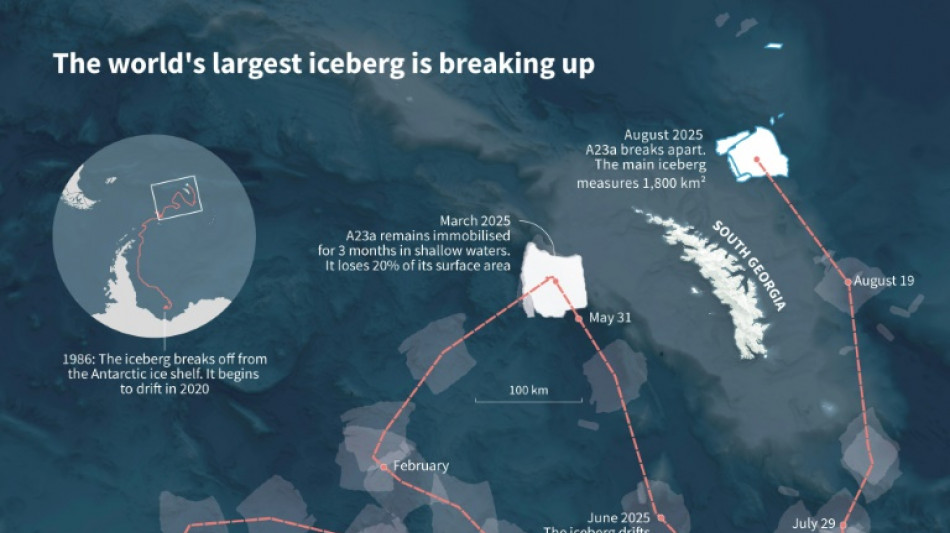
Earlier this year, the "megaberg" known as A23a weighed a little under a trillion tonnes and was more than twice the size of Greater London, a behemoth unrivalled at the time.

The gigantic slab of frozen freshwater was so large it even briefly threatened penguin feeding grounds on a remote island in the South Atlantic Ocean, but ended up moving on.

It is now less than half its original size, but still a hefty 1,770 square kilometres (683 square miles) and 60 kilometres (37 miles) at its widest point, according to AFP analysis of satellite images by the EU earth observation monitor Copernicus.

In recent weeks, enormous chunks -- some 400 square kilometres in their own right -- have broken off while smaller chips, many still large enough to threaten ships, litter the sea around it.

It was "breaking up fairly dramatically" as it drifted further north, Andrew Meijers, a physical oceanographer from the British Antarctic Survey, told AFP.

"I'd say it's very much on its way out... it's basically rotting underneath. The water is way too warm for it to maintain. It's constantly melting," he said.

"I expect that to continue in the coming weeks, and expect it won't be really identifiable within a few weeks."

- 'Doomed' -

A23a calved from the Antarctic shelf in 1986 but quickly grounded in the Weddell Sea, remaining stuck on the ocean floor for over 30 years.

It finally escaped in 2020 and, like other giants before it, was carried along "iceberg alley" into the South Atlantic Ocean by the powerful Antarctic Circumpolar Current.

Around March, it ran aground in shallow waters off distant South Georgia island, raising fears it could disrupt large colonies of adult penguins and seals there from feeding their young.

But it dislodged in late May, and moved on.

Swinging around the island and tracking north, in recent weeks the iceberg has picked up speed, sometimes travelling up to 20 kilometres in a single day, satellite images analysed by AFP showed.

Exposed to increasingly warmer waters, and buffeted by huge waves, A23a has rapidly disintegrated.

Scientists were "surprised" how long the iceberg had kept together, said Meijers.

"Most icebergs don't make it this far. This one's really big so it has lasted longer and gone further than others."

But ultimately, icebergs are "doomed" once they leave the freezing protection of Antarctica, he added.

Iceberg calving is a natural process. But scientists say the rate at which they were being lost from Antarctica is increasing, probably because of human induced climate change.

(K.Müller--BBZ)