Berliner Boersenzeitung - Sea life thriving on unexploded Nazi bombs, sub discovers

EUR -
AED 4.297817
AFN 73.727012
ALL 95.43889
AMD 432.532408
ANG 2.094649
AOA 1074.307947
ARS 1627.839384
AUD 1.636719
AWG 2.109412
AZN 1.984973
BAM 1.953997
BBD 2.357557
BDT 143.621624
BGN 1.95213
BHD 0.442113
BIF 3531.904009
BMD 1.17027
BND 1.493144
BOB 8.088126
BRL 5.83266
BSD 1.170535
BTN 111.037378
BWP 15.907481
BYN 3.303121
BYR 22937.300519
BZD 2.35415
CAD 1.598946
CDF 2715.027033
CHF 0.91923
CLF 0.026916
CLP 1059.293538
CNY 8.002602
CNH 7.996604
COP 4255.1033
CRC 532.163651
CUC 1.17027
CUP 31.012167
CVE 110.174192
CZK 24.366025
DJF 208.436421
DKK 7.472235
DOP 69.672872
DZD 155.025252
EGP 62.78532
ERN 17.554057
ETB 182.77157
FJD 2.573782
FKP 0.867517
GBP 0.86624
GEL 3.148217
GGP 0.867517
GHS 13.103864
GIP 0.867517
GMD 85.429481
GNF 10271.533952
GTQ 8.942629
GYD 244.881885
HKD 9.16667
HNL 31.120616
HRK 7.533503
HTG 153.334273
HUF 364.735257
IDR 20300.915284
ILS 3.456276
IMP 0.867517
INR 111.185463
IQD 1533.349279
IRR 1539490.756479
ISK 143.80299
JEP 0.867517
JMD 183.410805
JOD 0.829696
JPY 183.23685
KES 151.175473
KGS 102.305628
KHR 4693.0116
KMF 493.854107
KPW 1053.068655
KRW 1728.887052
KWD 0.35987
KYD 0.975471
KZT 542.172394
LAK 25704.813468
LBP 104876.17
LKR 374.101656
LRD 214.787461
LSL 19.622726
LTL 3.455504
LVL 0.707885
LYD 7.442135
MAD 10.811789
MDL 20.16786
MGA 4867.987686
MKD 61.602386
MMK 2457.196354
MNT 4187.344358
MOP 9.445073
MRU 46.418741
MUR 55.037072
MVR 18.086506
MWK 2029.70972
MXN 20.495789
MYR 4.646194
MZN 74.786162
NAD 19.622894
NGN 1609.250543
NIO 43.074497
NOK 10.90967
NPR 177.651262
NZD 1.995754
OMR 0.449982
PAB 1.170505
PEN 4.1253
PGK 5.087807
PHP 71.841783
PKR 326.195442
PLN 4.259937
PYG 7199.066354
QAR 4.280972
RON 5.182428
RSD 117.355892
RUB 87.685907
RWF 1711.245682
SAR 4.389139
SBD 9.407616
SCR 16.035934
SDG 702.744172
SEK 10.852679
SGD 1.493341
SHP 0.873725
SLE 28.734019
SLL 24539.981393
SOS 668.928647
SRD 43.839489
STD 24222.235231
STN 24.479823
SVC 10.242558
SYP 129.483494
SZL 19.627822
THB 38.065372
TJS 10.979269
TMT 4.101798
TND 3.416548
TOP 2.817731
TRY 52.878901
TTD 7.945417
TWD 37.001633
TZS 3048.554094
UAH 51.432608
UGX 4401.372282
USD 1.17027
UYU 46.681524
UZS 13970.485186
VES 568.268993
VND 30843.647576
VUV 138.684442
WST 3.173994
XAF 655.400002
XAG 0.015888
XAU 0.000253
XCD 3.162715
XCG 2.109588
XDR 0.816519
XOF 655.41679
XPF 119.331742
YER 279.255762
ZAR 19.641111
ZMK 10533.840681
ZMW 21.859423
ZWL 376.826602
  • CMSD

    -0.0400

    23.04

    -0.17%

  • RIO

    2.3050

    98.815

    +2.33%

  • BCE

    0.1650

    23.42

    +0.7%

  • RBGPF

    0.2800

    63.75

    +0.44%

  • NGG

    2.4400

    88.39

    +2.76%

  • RELX

    0.6400

    36.45

    +1.76%

  • BCC

    -0.1600

    78.84

    -0.2%

  • JRI

    0.1560

    12.896

    +1.21%

  • RYCEF

    -0.4000

    14.9

    -2.68%

  • BTI

    1.2150

    58.68

    +2.07%

  • GSK

    0.6900

    52.09

    +1.32%

  • AZN

    2.6150

    187.905

    +1.39%

  • BP

    -0.1250

    46.685

    -0.27%

  • VOD

    0.3500

    15.69

    +2.23%

  • CMSC

    -0.0100

    22.82

    -0.04%

Sea life thriving on unexploded Nazi bombs, sub discovers
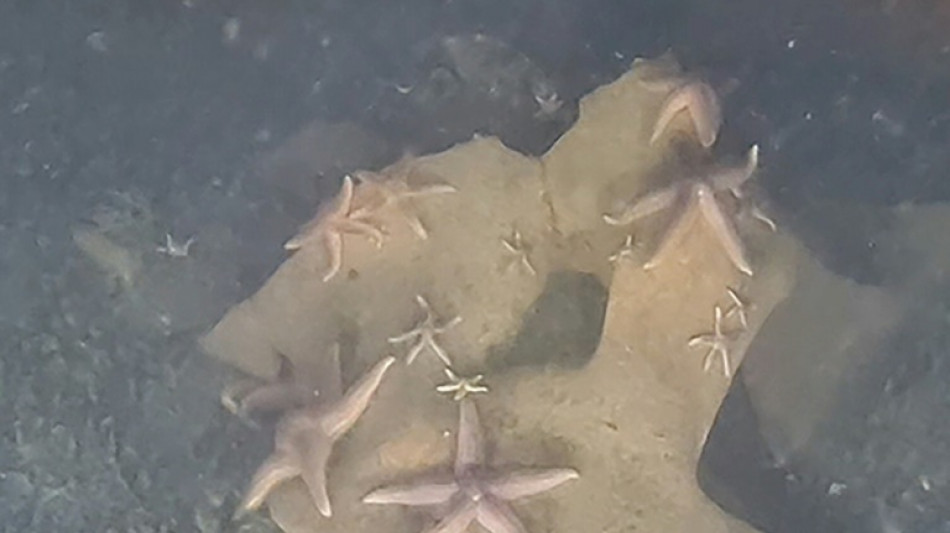
Sea life thriving on unexploded Nazi bombs, sub discovers / Photo: Andrey VEDENIN - DeepSea Monitoring Group/AFP

Sea life thriving on unexploded Nazi bombs, sub discovers

Marine life is thriving on unexploded Nazi bombs sitting at the bottom of a German bay, a submersible has discovered, even capturing footage of starfishes creeping across a huge chunk of TNT.

Text size:

The discovery, which was revealed in a study published Thursday, was "one of those rare but remarkable eureka moments," marine biologist Andrey Vedenin told AFP.

The waters off Germany's coast are estimated to be littered with 1.6 million tons of unexploded munitions left behind from both world wars.

In October last year, a team of German scientists went to a previously uncharted dump site in the Baltic Sea's Luebeck Bay and sent an unmanned submersible 20 metres down to the seafloor.

They were surprised when footage from the sub revealed 10 Nazi-era cruise missiles. Then they were stunned when they saw animals covering the surface of the bombs.

There were roughly 40,000 animals per square metre -- mostly marine worms -- living on the munitions, the scientists wrote in the journal Communications Earth & Environment.

They also counted three species of fish, a crab, sea anemones, a jellyfish relative called hydroids and plenty of starfishes.

While animals covered the hard casing of the bombs, they mostly avoided the yellow explosive material -- except for one instance.

The researchers were baffled to see that more than 40 starfishes had piled on to an exposed chunk of TNT.

"It looked really weird," said Vedenin, a scientist at Germany's Carl von Ossietzky University and the study's lead author.

Exactly why the starfishes were there was unclear, but Vedenin theorised they could be eating bacterial film collecting on the corroding TNT.

- Life on weapons of death -

The explosive chemicals are highly toxic, but the animals appeared to have found a way to live near it.

Other than the death-wish starfishes, they did not seem to be behaving strangely.

"The crabs were just sitting and picking something with their claws," Vedenin said.

To find out what kind of bombs they were dealing with, he went online and found a manual from the Nazi air force Luftwaffe describing how to handle and store V-1 flying bombs. The cruise missile exactly matched the 10 bombs from the footage.

Vedenin said "there is some irony" in the discovery that these "things that are meant to kill everything are now attracting so much life."

He compared it to how animals such as deer now thrive in radioactive areas abandoned by humans near the site of the Chernobyl nuclear disaster.

Hard surfaces on the seafloor are important for marine life that want more than mud and sand.

Animals once flocked to huge boulders that littered the Baltic Sea, however humans removed the stones to build infrastructure such as roads at the start of the 20th century.

So when the Nazi bombs are eventually cleared from the bay, the researchers called for more stones -- or concrete structures -- to be put in place to continue supporting the sea life.

The scientists also plan to return to the spot next month to set up a time-lapse camera to watch what the starfishes do next.

(U.Gruber--BBZ)