Winter Olympics: high in the Alps, artificial snow will still play role / Photo: Charly TRIBALLEAU - AFP/File

One hundred days before the start of the 2026 Winter Olympics, it's too early for the weather forecast, but one thing is certain -- there will be artificial snow, much to the dismay of environmental activists.
After three Winter Games criticised for being located in traditionally non-ski areas -- Sochi, Russia (2014), Pyeongchang, South Korea (2018) and Beijing, China (2022) -- next year's Olympics return to the Alps.
The Milano-Cortina Games will be scattered across the mountains of northern Italy, with Cortina and Bormio hosting the alpine skiing, Anterselva the biathlon, Livigno the freestyle skiing and snowboarding, and Val di Fiemme the Nordic skiing.
These resorts -- most of which are within the soaring Dolomites range -- are perched between 1,200 and 1,800 metres above sea level, a height that should ensure sufficient snow cover for the February 6-22 event.
But artificial snow will play a key role in the fourth Olympics Italy has hosted.
"No matter what, even if there is completely sufficient snowfall... there will also be some fake snow," said Jake W. Ward, a researcher at the University of California Santa Barbara.
"These kind of high-level snow sport competitions at this point have started to move towards fake snow at least as a portion of the coverage," he said.
Doing so, he said, allows them to "specify the track conditions and make everything kind of exactly how they want for the races".
- Just in case -
The international federations that govern skiing and biathlon both require organisers to have snow production equipment on hand, should it be needed.
The 2026 organising committee has said it plans to make 2.4 million cubic metres of artificial snow, which will require 948,000 cubic metress of water.
That includes more than half, or 580,000 cubic metres, for the Livigno Mottolino site alone, whose features will include a snowpark with a half-pipe as well as a Big Air ramp.
The artificial snow planned for next year will certainly use far less water than that required during the Beijing Winter Olympics, when 890,000 cubic metres was used for the alpine skiing site at Yanqing and 1.9 million cubic metres for all other snow sports, according to Olympic statistics.
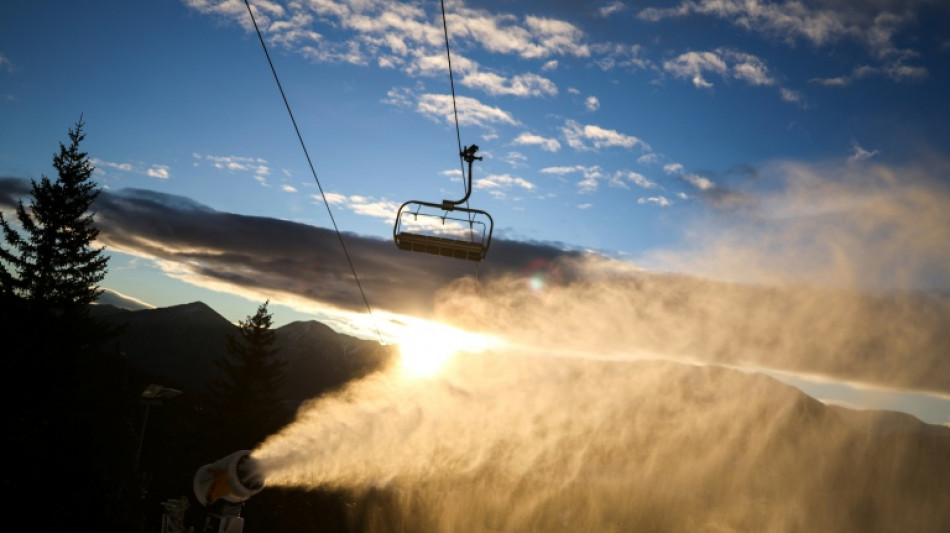
Artificial snow is made using snow cannons and guns, which spray water using a stream of compressed air into the cold air, turning it into fine snow.
Environmentalists condemn the energy consumption required and the vast resources of water needed.
The International Commission for the Protection of the Alps (CIPRA) says it takes one cubic metre of water to make around 2.5 cubic metres of snow.
In Italy, eight national environmental groups in 2023 denounced what they considered a lack of respect for the environment and local communities by the Milan-Cortina 2026 Foundation.
- Over-reliance -
Italy is the European country that uses the most artificial snow, with over 90 percent of Italy's ski slopes using artificial snowmaking systems, according to an April report from Italian environmental group Legambiente.
For Vanda Bonardo of Legambiente's Lombardy chapter, "the ever-increasing weight of this industry on the mountains" is worrying.
"We have to ask ourselves whether it still makes sense to organise major events and concentrate them in very fragile spaces like the Alps. Natural snow is practically becoming the exception," she told AFP.
According to a December 2024 study published in the International Journal of Climatology, the snow cover in the Italian Alps had decreased by half in the past 100 years.
The president of the Italian Alpine Club, Antonio Montani, said the issue went far beyond next year's Olympics.
"The Games are the tip of the iceberg, they shine a light on the real problem, which is the hundreds of ski resorts that are only able to operate with artificial snow, with huge energy costs and funded by public subsidies, because otherwise they wouldn't be able to open."
The International Olympic Committee itself has recognised a problem. According to its estimates, only 10 countries would still have the snow necessary to host the Winter Olympics in 2040.
(U.Gruber--BBZ)