Berliner Boersenzeitung - Rivers of salt: life on Bangladesh's climate frontline

EUR -
AED 4.231967
AFN 75.483595
ALL 93.084804
AMD 422.04403
AOA 1057.848456
ARS 1727.972826
AUD 1.638476
AWG 2.074212
AZN 1.960615
BAM 1.952344
BBD 2.320382
BDT 142.607535
BHD 0.434558
BIF 3445.496469
BMD 1.15234
BND 1.477278
BOB 13.934392
BRL 5.903903
BSD 1.152055
BTN 109.639899
BWP 15.581348
BYN 3.410947
BYR 22585.863139
BZD 2.316988
CAD 1.614976
CDF 2604.28847
CHF 0.936438
CLF 0.026729
CLP 1055.405144
CNY 7.7772
CNH 7.775921
COP 3641.809104
CRC 524.040432
CUC 1.15234
CUP 30.537009
CVE 110.797088
CZK 24.246042
DJF 204.79359
DKK 7.476071
DOP 67.179284
DZD 153.12335
EGP 57.264041
ERN 17.285099
ETB 185.946995
FJD 2.551799
FKP 0.85598
GBP 0.856476
GEL 3.013365
GGP 0.85598
GHS 13.522718
GIP 0.85598
GMD 85.273513
GNF 10117.544985
GTQ 8.790438
GYD 241.021217
HKD 9.039583
HNL 30.878201
HRK 7.534341
HTG 150.632674
HUF 365.29112
IDR 20648.779673
ILS 3.465894
IMP 0.85598
INR 109.832114
IQD 1510.141512
IRR 1584294.588378
ISK 142.406399
JEP 0.85598
JMD 182.616705
JOD 0.817025
JPY 182.571559
KES 149.066921
KGS 100.772506
KHR 4671.006893
KMF 492.049525
KRW 1640.978088
KWD 0.356833
KYD 0.960096
KZT 539.86659
LAK 26045.837925
LBP 103192.042878
LKR 386.984902
LRD 209.293797
LSL 18.829049
LTL 3.402561
LVL 0.697039
LYD 7.340541
MAD 10.750759
MDL 20.045426
MGA 4953.209598
MKD 61.530604
MMK 2419.273024
MNT 4143.630364
MOP 9.308979
MRU 46.227284
MUR 54.091068
MVR 17.814877
MWK 2000.462131
MXN 19.827749
MYR 4.717706
MZN 73.617371
NAD 18.828873
NGN 1570.51294
NIO 42.394946
NOK 10.986524
NPR 175.42192
NZD 1.963847
OMR 0.443071
PAB 1.15205
PEN 3.894206
PGK 5.089989
PHP 70.051904
PKR 319.84077
PLN 4.303407
PYG 6852.83835
QAR 4.211344
RON 5.255707
RSD 117.398041
RUB 95.645946
RWF 1692.396524
SAR 4.327188
SBD 9.29748
SCR 16.61684
SDG 691.979475
SEK 10.964174
SGD 1.479029
SLE 28.346301
SOS 658.43149
SRD 43.635078
STD 23851.110525
STN 24.456597
SVC 10.080155
SZL 18.828757
THB 38.165456
TJS 10.627693
TMT 4.038952
TND 3.379033
TRY 54.97307
TTD 7.800157
TWD 37.128162
TZS 3059.460279
UAH 51.586374
UGX 4291.384132
USD 1.15234
UYU 46.39786
UZS 13729.69365
VES 869.107758
VND 30231.638747
VUV 137.52518
WST 3.144985
XAF 654.794943
XAG 0.018699
XAU 0.000271
XCD 3.114256
XCG 2.076333
XDR 0.813421
XOF 654.797779
XPF 119.331742
YER 272.931152
ZAR 18.84682
ZMK 10372.434694
ZMW 21.918007
ZWL 371.052996
  • RBGPF

    0.0000

    69.74

    0%

  • CMSC

    -0.0100

    21.72

    -0.05%

  • RYCEF

    -0.0500

    20.95

    -0.24%

  • GSK

    0.7100

    52.17

    +1.36%

  • AZN

    -0.4300

    161.07

    -0.27%

  • BP

    1.0200

    42.23

    +2.42%

  • RIO

    -1.8600

    99.65

    -1.87%

  • RELX

    -0.8600

    35.75

    -2.41%

  • BTI

    -0.5400

    58.73

    -0.92%

  • BCE

    0.7100

    22.77

    +3.12%

  • NGG

    0.1500

    80.41

    +0.19%

  • CMSD

    -0.0600

    21.98

    -0.27%

  • BCC

    -0.5400

    84.26

    -0.64%

  • VOD

    0.6900

    16

    +4.31%

  • JRI

    -0.0100

    12.66

    -0.08%

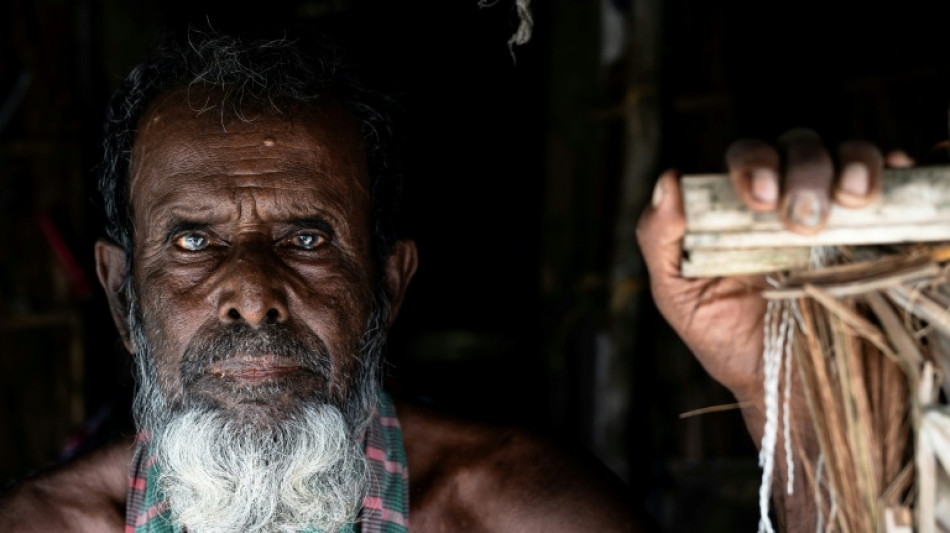
Rivers of salt: life on Bangladesh's climate frontline
Rivers of salt: life on Bangladesh's climate frontline / Photo: Muhammad Amdad HOSSAIN - AFP

Rivers of salt: life on Bangladesh's climate frontline

On Bangladesh's coast, where mighty Himalayan rivers meet the sea, water defines every rhythm of life, and every struggle.

Text size:

Rising seas driven by climate change are swallowing low-lying areas, while stronger storms push saltwater further inland, turning wells and lakes brackish, according to government scientists.

For the millions living in the ecologically sensitive deltas of mudflats and mangrove forests, finding clean drinking water has become an escalating challenge.

Cyclone Aila in 2009 was a turning point.

Embankments broke and saltwater swept inland, flooding not only homes, but seeping into once-fertile land.

The water that once sustained communities became undrinkable, and the land began to crack under layers of salt.

The people of Khulna and Satkhira districts today live in a fragile balancing act between land and sea.

Many families live in houses built on bamboo stilts to escape tidal floods.

Children bathe in yellow, saline water and grow up in a landscape of constant change, where rivers erode their homes and schools, and displacement has become the norm.

Men migrate for months seeking work.

Women and children walk for hours across parched, cracked soil to fetch water from distant ponds, or harvest rainwater, and store it in tanks supplied by charities.

Each household stores a few thousand litres, rationed carefully until the next monsoon arrives.

The daily act of collecting and storing water has become a quiet ritual of endurance.

This reporting accompanies a photography series carried out by Muhammad Amdad Hossain for AFP's 2025 Marai Photo Grant, an award open to photographers from South Asia aged 25 or under.

The theme for 2025 was "climate change" and its impact on daily life and the community of the photographers who enter.

The award is organised by Agence France-Presse in honour of Shah Marai, the former photo chief at AFP's Kabul bureau.

Shah Marai, who was an inspiration for Afghan photographers throughout his career, was killed in the line of duty at the age of 41 in a suicide attack on April 30, 2018 in Kabul.

(B.Hartmann--BBZ)