Berliner Boersenzeitung - Lethal virus hits last rare blue macaws in Brazil wild

EUR -
AED 4.211393
AFN 72.244796
ALL 95.982096
AMD 432.319357
ANG 2.052753
AOA 1051.557417
ARS 1603.424201
AUD 1.641243
AWG 2.064125
AZN 1.954004
BAM 1.955435
BBD 2.309469
BDT 140.703754
BGN 1.960126
BHD 0.435819
BIF 3404.065016
BMD 1.146736
BND 1.467326
BOB 7.923522
BRL 6.112796
BSD 1.146686
BTN 105.842257
BWP 15.625085
BYN 3.392867
BYR 22476.027392
BZD 2.30607
CAD 1.583471
CDF 2588.183773
CHF 0.912745
CLF 0.026638
CLP 1051.798264
CNY 7.908585
CNH 7.921286
COP 4222.512346
CRC 539.499363
CUC 1.146736
CUP 30.388506
CVE 110.244435
CZK 24.575006
DJF 204.191911
DKK 7.505507
DOP 70.446859
DZD 153.116438
EGP 59.873831
ERN 17.201041
ETB 178.984913
FJD 2.555735
FKP 0.866182
GBP 0.866311
GEL 3.131037
GGP 0.866182
GHS 12.452677
GIP 0.866182
GMD 84.289519
GNF 10052.124908
GTQ 8.79336
GYD 239.895251
HKD 8.97946
HNL 30.352338
HRK 7.568004
HTG 150.351954
HUF 394.179508
IDR 19448.701448
ILS 3.605729
IMP 0.866182
INR 106.170389
IQD 1502.119799
IRR 1515669.760861
ISK 144.837141
JEP 0.866182
JMD 179.916439
JOD 0.813081
JPY 183.185402
KES 148.312334
KGS 100.281732
KHR 4598.142277
KMF 494.243657
KPW 1032.019272
KRW 1723.258101
KWD 0.352542
KYD 0.955522
KZT 561.355287
LAK 24570.416711
LBP 102681.246162
LKR 356.863432
LRD 209.830859
LSL 19.258608
LTL 3.386014
LVL 0.69365
LYD 7.316635
MAD 10.799685
MDL 20.003269
MGA 4761.111877
MKD 61.628504
MMK 2408.293814
MNT 4109.908675
MOP 9.243576
MRU 45.877442
MUR 53.33513
MVR 17.717506
MWK 1988.229122
MXN 20.584147
MYR 4.516425
MZN 73.288336
NAD 19.258608
NGN 1588.807126
NIO 42.19213
NOK 11.176343
NPR 169.34741
NZD 1.985003
OMR 0.440925
PAB 1.146586
PEN 3.954262
PGK 5.014065
PHP 68.334433
PKR 320.169477
PLN 4.298483
PYG 7397.620071
QAR 4.168222
RON 5.117429
RSD 117.34811
RUB 91.632507
RWF 1673.28787
SAR 4.303626
SBD 9.233195
SCR 17.507734
SDG 689.18878
SEK 10.871865
SGD 1.469547
SHP 0.860349
SLE 28.152796
SLL 24046.494883
SOS 654.177972
SRD 43.05769
STD 23735.121842
STN 24.495431
SVC 10.033128
SYP 126.777699
SZL 19.252409
THB 37.071728
TJS 10.99055
TMT 4.013576
TND 3.391067
TOP 2.761065
TRY 50.645643
TTD 7.776549
TWD 36.918714
TZS 2986.942825
UAH 50.565468
UGX 4311.195803
USD 1.146736
UYU 46.061408
UZS 13845.417319
VES 507.665371
VND 30152.278788
VUV 137.132233
WST 3.13652
XAF 655.834663
XAG 0.014239
XAU 0.000228
XCD 3.099112
XCG 2.066515
XDR 0.815648
XOF 655.834663
XPF 119.331742
YER 273.554311
ZAR 19.360243
ZMK 10322.005017
ZMW 22.318837
ZWL 369.248554
  • RBGPF

    0.1000

    82.5

    +0.12%

  • CMSD

    -0.1100

    22.99

    -0.48%

  • JRI

    -0.2300

    12.59

    -1.83%

  • NGG

    0.0900

    90.9

    +0.1%

  • AZN

    -2.6000

    189.9

    -1.37%

  • BCE

    -0.1100

    25.57

    -0.43%

  • GSK

    -0.8900

    53.39

    -1.67%

  • BCC

    0.3800

    70

    +0.54%

  • RIO

    -2.8700

    87.83

    -3.27%

  • RELX

    -0.0400

    34.14

    -0.12%

  • CMSC

    -0.1500

    22.99

    -0.65%

  • BTI

    0.0400

    59.93

    +0.07%

  • VOD

    0.1000

    14.41

    +0.69%

  • RYCEF

    -1.1300

    16.12

    -7.01%

  • BP

    0.5100

    42.67

    +1.2%

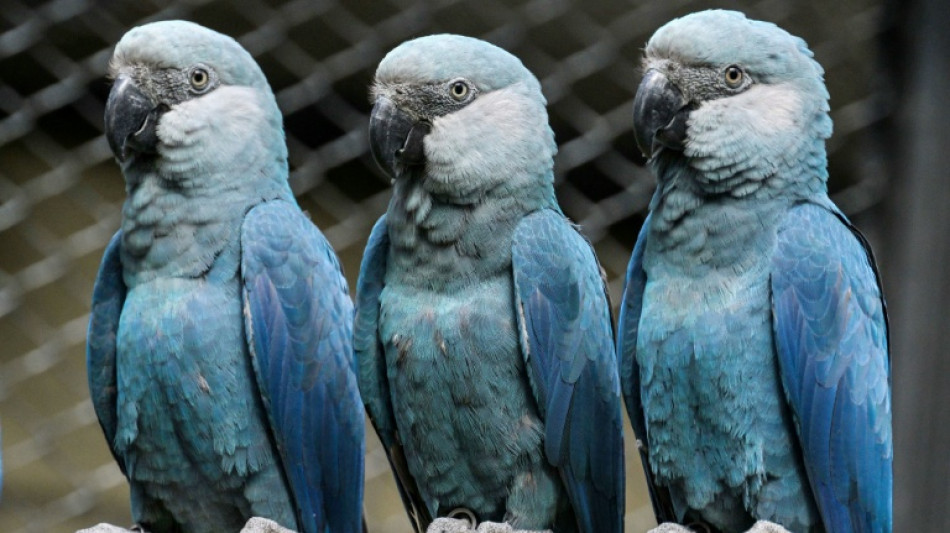
Lethal virus hits last rare blue macaws in Brazil wild
Lethal virus hits last rare blue macaws in Brazil wild / Photo: Nelson ALMEIDA - AFP

Lethal virus hits last rare blue macaws in Brazil wild

The only wild specimens of a rare blue parrot which had only recently been returned to its natural habitat in Brazil have been diagnosed with a lethal, incurable virus, the government said in a statement sent to AFP Thursday.

Text size:

The disease strikes a major blow to a program seeking to return the Spix's macaw -- featured in the 2011 animated film "Rio" -- to its semi-arid natural habitat in northeast Brazil, 25 years after they were declared extinct in the wild.

The species is one of the world's rarest birds.

Brazil's conservation agency, ICMBio, told AFP that since a group of Spix's macaws arrived in the country from Germany in 2020, around 20 had been freed and only 11 had survived.

Now all of the survivors have tested positive for circovirus, which causes beak and feather disease in parrots.

"The disease has no cure and kills the bird in most cases," ICMbio said in a statement.

Another 21 birds still in captivity at a breeding centre in the state of Bahia also tested positive.

Investigations are underway to determine the origin of the virus, which poses no danger to humans.

The film "Rio" is about a Spix macaw that is raised in captivity in the United States and returns to Brazil to try save its species.

Real-life efforts to save the parrot are more worthy of a high-stakes drama, marked by concerns over unscrupulous breeders and sales to private collectors.

The Bluesky breeding center is a partner of the German Association for the Conservation of Threatened Parrots (ACTP), which holds 75 percent of the world's registered Spix's macaws, according to ICMBio.

Brazil terminated its partnership with ATCP in 2024 after the German organization sold 26 of the birds to a private zoo in India without its consent.

Brazil has repeatedly raised concerns at meetings of CITES, the global wildlife trade regulator, over loopholes that allow for the sale of captive-bred Spix's macaws and fuel demand for the fragile species.

Aside from habitat loss, demand from private collectors drove the extinction of the bird in the wild.

ICMBio has fined the BlueSky breeding centre 1.8 million reais ($336,000) for failing to implement biosafety protocols to curb the spread of the virus.

Inspectors found "extremely dirty" bird feeders encrusted with faeces, while workers were handling the birds "wearing flip-flops, shorts and t-shirts."

(T.Burkhard--BBZ)