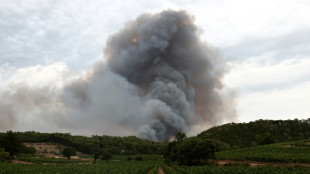
2025 was third hottest year on record: EU, US experts / Photo: Thibaud MORITZ - AFP/File

The planet logged its third hottest year on record in 2025, extending a run of unprecedented heat, with no relief expected in 2026, US researchers and EU climate monitors said Wednesday.
The last 11 years have now been the warmest ever recorded, with 2024 topping the podium and 2023 in second place, according to the EU's Copernicus Climate Change Service and Berkeley Earth, a California-based non-profit research organisation.
For the first time, global temperatures exceeded 1.5C relative to pre-industrial times on average over the last three years, Copernicus said in its annual report.
"The warming spike observed from 2023-2025 has been extreme, and suggests an acceleration in the rate of the Earth's warming," Berkeley Earth said in a separate report.
The landmark 2015 Paris Agreement commits the world to limiting warming to well below 2C and pursuing efforts to hold it at 1.5C -- a long-term target scientists say would help avoid the worst consequences of climate change.
UN chief Antonio Guterres warned in October that breaching 1.5C was "inevitable" but the world could limit this period of overshoot by cutting greenhouse gas emissions as quickly as possible.
Copernicus said the 1.5C limit "could be reached by the end of this decade -– over a decade earlier than predicted".
But efforts to contain global warming were dealt another setback last week as President Donald Trump said he would pull the United States -- the world's second-biggest polluter after China -- out of the bedrock UN climate treaty.
Temperatures were 1.47C above pre-industrial times in 2025 -- just a fraction cooler than in 2023 -- following 1.6C in 2024, according to the EU climate monitor.
Some 770 million people experienced record-warm annual conditions where they live, while no record-cold annual average was logged anywhere, according to Berkeley Earth.
The Antarctic experienced its warmest year on record while it was the second hottest in the Arctic, Copernicus said.
An AFP analysis of Copernicus data last month found that Central Asia, the Sahel region and northern Europe experienced their hottest year on record in 2025.
- 2026: Fourth-warmest? -
Berkeley and Copernicus both warned that 2026 would not break the trend.
If the warming El Nino weather phenomenon appears this year, "this could make 2026 another record-breaking year", Carlo Buontempo, director of the Copernicus Climate Change Service, told AFP.
"Temperatures are going up. So we are bound to see new records. Whether it will be 2026, 2027, 2028 doesn't matter too much. The direction of travel is very, very clear," Buontempo said.
Berkeley Earth said it expected this year to be similar to 2025, "with the most likely outcome being approximately the fourth-warmest year since 1850".
- Emissions fight -
The reports come as efforts to cut greenhouse gas emissions -- the main driver of climate change -- are stalling in developed countries.
Emissions rose in the United States last year, snapping a two-year streak of declines, as bitter winters and the AI boom fuelled demand for energy, the Rhodium Group think tank said Tuesday.
The pace of reductions of greenhouse gas emissions slowed in Germany and France.
"While greenhouse gas emissions remain the dominant driver of global warming, the magnitude of this recent spike suggests additional factors have amplified recent warming beyond what we would expect from greenhouse gases and natural variability alone," said Berkeley Earth chief scientist Robert Rohde.
The organisation said international rules cutting sulfur in ship fuel since 2020 may have actually added to warming by reducing sulfur dioxide emissions, which form aerosols that reflect sunlight away from Earth.
(T.Burkhard--BBZ)