Berliner Boersenzeitung - War imperils rare vultures' yearly odyssey to the Balkans

EUR -
AED 4.179278
AFN 74.537554
ALL 93.555728
AMD 416.115961
AOA 1043.539341
ARS 1706.700655
AUD 1.639535
AWG 2.048388
AZN 1.942865
BAM 1.954432
BBD 2.291516
BDT 140.45166
BHD 0.429101
BIF 3399.005182
BMD 1.137993
BND 1.47029
BOB 12.942166
BRL 5.827433
BSD 1.137713
BTN 108.765324
BWP 15.652247
BYN 3.320419
BYR 22304.666923
BZD 2.288218
CAD 1.60502
CDF 2588.934431
CHF 0.933149
CLF 0.027026
CLP 1063.685539
CNY 7.705636
CNH 7.703122
COP 3652.525768
CRC 517.742042
CUC 1.137993
CUP 30.15682
CVE 110.188333
CZK 24.189924
DJF 202.610808
DKK 7.474925
DOP 66.003786
DZD 151.764091
EGP 57.731764
ERN 17.069898
ETB 183.638229
FJD 2.542502
FKP 0.855103
GBP 0.85638
GEL 2.987273
GGP 0.855103
GHS 13.305859
GIP 0.855103
GMD 83.642027
GNF 9988.050543
GTQ 8.680884
GYD 237.996499
HKD 8.924882
HNL 30.482657
HRK 7.532494
HTG 148.755845
HUF 362.144718
IDR 20564.675304
ILS 3.484171
IMP 0.855103
INR 108.867771
IQD 1490.456426
IRR 1564882.913665
ISK 142.593106
JEP 0.855103
JMD 179.834085
JOD 0.806836
JPY 186.266326
KES 147.313545
KGS 99.517433
KHR 4599.839957
KMF 492.751328
KRW 1652.912603
KWD 0.353572
KYD 0.948149
KZT 542.83231
LAK 25799.162886
LBP 101886.452713
LKR 382.222379
LRD 205.939427
LSL 19.077742
LTL 3.360198
LVL 0.688361
LYD 7.294924
MAD 10.674573
MDL 20.132169
MGA 4917.600053
MKD 61.477226
MMK 2389.061563
MNT 4093.171941
MOP 9.191326
MRU 45.487151
MUR 53.918088
MVR 17.582019
MWK 1972.844676
MXN 19.884827
MYR 4.65382
MZN 72.710067
NAD 19.077742
NGN 1553.656122
NIO 41.870867
NOK 10.998584
NPR 174.026446
NZD 1.970634
OMR 0.437545
PAB 1.137708
PEN 3.862596
PGK 5.092457
PHP 69.883752
PKR 315.979061
PLN 4.327048
PYG 6833.215582
QAR 4.148196
RON 5.235109
RSD 117.364583
RUB 90.471633
RWF 1674.749464
SAR 4.275857
SBD 9.196243
SCR 15.337763
SDG 682.79594
SEK 11.052224
SGD 1.471021
SLE 27.567877
SOS 650.253283
SRD 43.07475
STD 23554.161855
STN 24.483073
SVC 9.955073
SZL 19.072562
THB 38.151254
TJS 10.501486
TMT 3.982976
TND 3.372539
TRY 53.93813
TTD 7.728657
TWD 36.910015
TZS 2998.645793
UAH 51.010008
UGX 4249.043613
USD 1.137993
UYU 45.758163
UZS 13695.410873
VES 845.865918
VND 29954.82628
VUV 135.672436
WST 3.13413
XAF 655.506674
XAG 0.019733
XAU 0.000282
XCD 3.075483
XCG 2.050473
XDR 0.815007
XOF 655.500917
XPF 119.331742
YER 271.126434
ZAR 19.057887
ZMK 10243.30542
ZMW 21.247497
ZWL 366.433349
  • RBGPF

    0.0000

    66

    0%

  • GSK

    1.7300

    53.71

    +3.22%

  • CMSD

    0.0700

    22.12

    +0.32%

  • RIO

    -0.3100

    91.64

    -0.34%

  • NGG

    -0.3500

    80.86

    -0.43%

  • RELX

    2.1100

    37.76

    +5.59%

  • RYCEF

    -0.1700

    18.7

    -0.91%

  • AZN

    2.8400

    172.48

    +1.65%

  • BCE

    0.5700

    21.81

    +2.61%

  • VOD

    0.5900

    16.39

    +3.6%

  • CMSC

    0.0600

    21.81

    +0.28%

  • JRI

    0.0000

    12.91

    0%

  • BTI

    1.4800

    62.3

    +2.38%

  • BCC

    2.1600

    80.38

    +2.69%

  • BP

    -0.6400

    41.67

    -1.54%

War imperils rare vultures' yearly odyssey to the Balkans
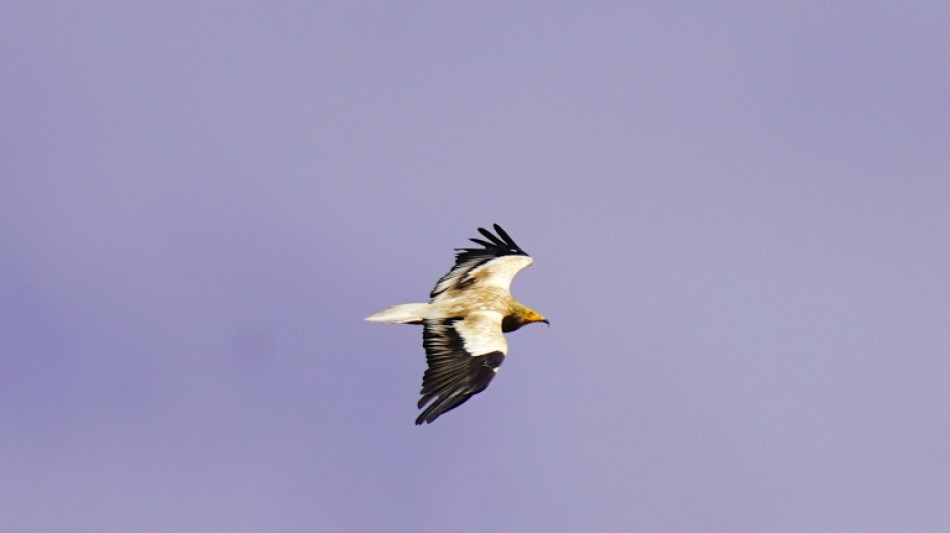
War imperils rare vultures' yearly odyssey to the Balkans / Photo: Raimond Kola - AFP

War imperils rare vultures' yearly odyssey to the Balkans

Endangered Egyptian vultures, with their vivid yellow face and white plumes, would usually be nesting across the Balkans in their dozens by April.

Text size:

But experts tracking the rare birds say local teams have struggled to find more than a handful in recent weeks, raising fears that the wars in the Middle East may have further disrupted their already perilous journey from Africa.

"The war is adding to the risks already present along this species' migration route," Nikolai Petkov, project manager at the Bulgarian Society for the Protection of Birds, told AFP.

From electrocution to poaching, the scavenger faces many hazards on its 5,000-kilometre (3,100-mile) annual migration to its Balkan breeding sites.

"The Middle East is a crucial migration corridor, and the war can have a considerable impact on this already sharply declining population," said Xhemal Xherri from the group Protection and Preservation of Natural Environment in Albania (PPNEA).

With thousands of people killed in bombing campaigns and the threat of further military action, any information on the impact on wildlife is hard to find, even for experts.

"Bombardments disturb not only Egyptian vultures, but also many other birds," he said, warning that the decline of the specific species could be a wider signal.

- A stark decline -

In the last 30 years, their numbers have fallen by 80 percent in the Balkans, according to Petkov, and the International Union for Conservation of Nature classifies the species as endangered worldwide.

Due to their key role in clearing carcasses -- which prevents the spread of disease -- conservationists and NGOs have long pushed efforts to protect the animal across their range.

Protecting resting places along with breeding programmes has helped their numbers improve slightly in Bulgaria, where the majority of the vultures now nest in the Balkans, Petkov said.

But they remain particularly vulnerable to accidental poisoning from bait use on farmland, which often means the birds eat tainted carrion.

- A hopeful wait -

In the rugged wilderness of southern Albania, the shepherds of Salaria are usually the first to notice the vultures return as a signal of the coming European spring.

As the season nears its end, they have recently spotted two soaring over their flocks.

Even for experts like Xherri, it took hours of scouring mountainous nesting sites to confirm the shepherds' report.

"Good news!" he exclaimed, as he squinted through binoculars at the white dot descending onto a ledge about 400 metres up a rockface.

He would have another long wait before confirming that a second of Europe's smallest vultures had also safely returned to its lofty perch.

The painstaking nature of the work makes it almost impossible to know how many animals actually reached nests in Albania, even before the war.

But Petkov remained optimistic, suggesting they may have delayed their journey due to colder weather earlier this year.

"So they might be a bit late, but hopefully, as we often say, you count the birds in autumn."

(T.Renner--BBZ)