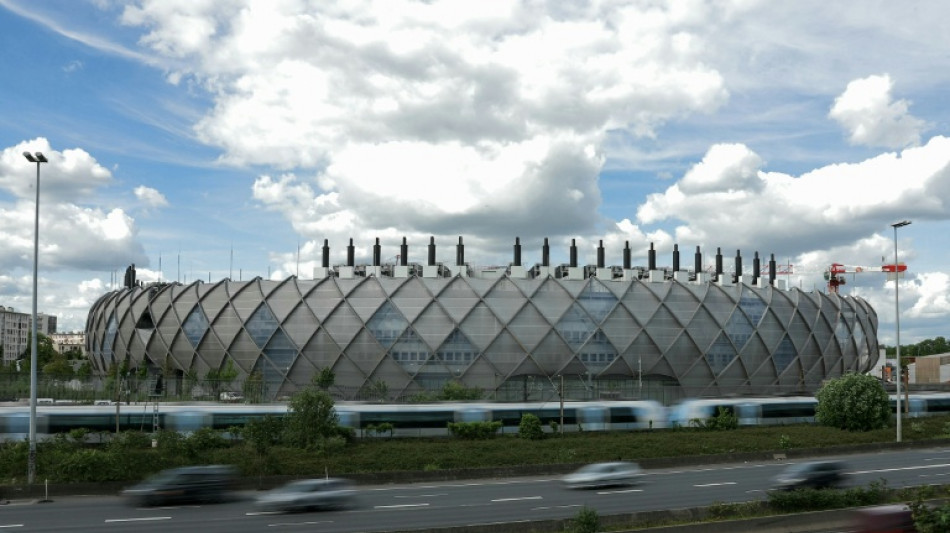
UN urges AI firms to reveal environmental footprint / Photo: Thomas SAMSON - AFP/File

A UN report on Wednesday urged artificial intelligence firms to disclose their environmental footprint, warning that the AI boom is putting growing pressure on power grids, water supplies and land resources.
The study also urged governments to require standardised environmental reporting from AI providers, and called on users to choose less energy-intensive tools that can accomplish the same task.
"What we are showing here is probably just the tip of the iceberg," Kaveh Madani, director of the United Nations University Institute for Water, Environment and Health (UNU-INWEH), told AFP.
"We need to require more transparency. We need the providers to provide that information," Madani said.
The authors of the report, "Environmental Cost of AI's Energy Use: Carbon, Water and Land Footprints", used primary data from a range of sources to make their estimates, Madani said.
- 'Not an anti-AI report' -
The global AI market is expected to grow from $189 billion in 2023 to $4.8 trillion by 2033, the UNU-INWEH report said.
Data centres, the warehouses of servers that power AI and other digital services, consumed 448 terawatt-hours (TWh) of electricity in 2025.
If data centres were a country, their consumption would have ranked in 11th place -- just under France with 468 TWh, the study said.
AI workloads accounted for a fifth of the total electricity use at data centres last year, and they are expected to rise to 40 percent by 2030.
Consumption by data centres is projected to exceed 945 TWh by 2030, ranking sixth among countries and emitting 399 million tonnes of CO2 equivalent. By comparison, the UK's net emissions reached 367 million tonnes last year.
The report cautioned that reducing carbon emissions did not automatically reduce water or land impacts.
Data centres could guzzle 9.32 trillion litres of water by 2030, enough to meet the annual basic water needs of the entire population of sub-Saharan Africa, the report said. The land they occupy would be 18 times bigger than New York City.
ChatGPT alone is estimated to process around 2.5 billion prompts per day, translating into roughly 383 GWh of electricity a year -- enough to meet the annual demand of nearly three million people in sub-Saharan Africa, the report said.
AI videos are the the most energy-hungry product. A single short AI-generated clip can draw as much electricity as hundreds of AI-generated images.
The report also warned of a growing digital divide, with most AI-specialised data centres located in the United States, China and the European Union while many developing countries bear environmental costs linked to mineral extraction and waste disposal.
"This is not an anti-AI report," Madani said. "We are simply saying that we have to proactively monitor their impacts to be able to curb them, to be able to control them before it's too late."
- Chatbot or cookbook? -
The report said AI developers and service providers should "make the invisible visible" by publishing clear, standardised accounts of energy and environmental footprints for training models and generating responses for users.
AI firms should also improve efficiency of their systems.
"Governments and regulators should treat environmental disclosure for AI as routine," it said.
Government climate and energy plans should incorporate growing AI demand while efforts should be made to keep data centres away from water-stressed regions.
But individual users should also avoid using AI for tasks that could be done with conventional tools, the authors said.
"All of us can make a huge difference," Madani said.
The report estimates that a single AI‑enhanced internet search may use 10 times more energy than a conventional search.
"Do you need ChatGPT to give you a recipe" or "(do) you have a cookbook that's sitting on your kitchen counter that you could just open?" UNU-INWEH co-author Miriam Aczel told AFP.
"There are a lot of simple behavioural tweaks that people can make that can help reduce their footprint," she said. "But I think all of this starts with knowledge, information and disclosures."
(T.Renner--BBZ)