Greenland treads softly on tourism as icebergs melt / Photo: Odd ANDERSEN - AFP/File

As tourists flock to Greenland to take in its breathtaking icebergs and natural beauty, authorities are mulling ways to control crowds to protect the fragile environment, already threatened by global warming.
"It's a dream destination," said Yves Gleyze, a veteran off-the-beaten-track French tourist in his 60s as he arrived at the airport in Ilulissat.
Visitors to the third-biggest town in the Danish autonomous territory are met by a rugged, austere landscape of grey rock and sparse vegetation.
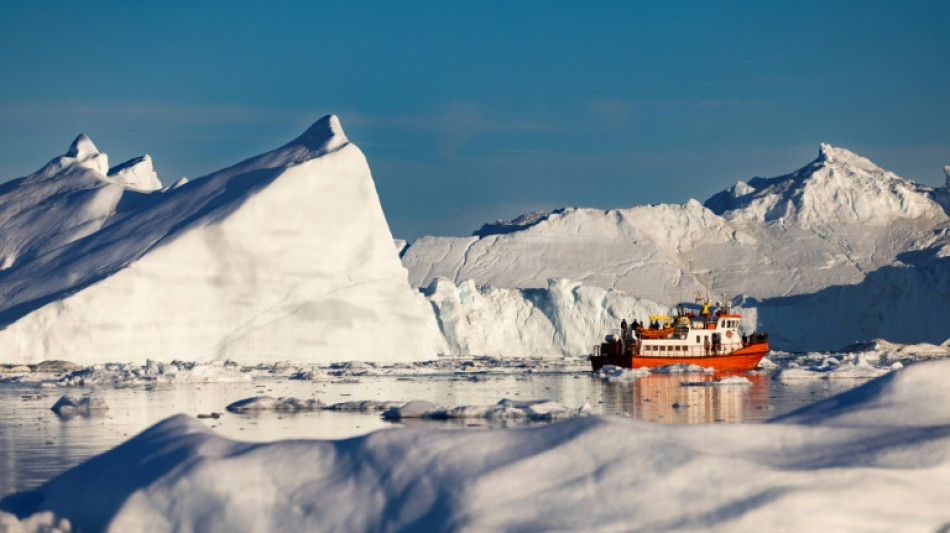
But mesmerising views of massive icebergs come into view after just a short drive.
Breaking off from the Ilulissat glacier in the neighbouring fjord, the majestic blocks of ice drift slowly by in Disko Bay, the occasional whale making an appearance.
The postcard views attracted 50,000 tourists in 2021, more than 10 times the town's population.
More than half make only a short pit stop during an Arctic cruise.
Numbers are expected to swell with the opening of an international airport in the next two years, a welcome boost to the island's revenues but also a challenge, given the delicate -- and melting -- ecosystem.
- 'Icebergs getting smaller' -
In the past 40 years, the Arctic has warmed nearly four times faster than the rest of the planet, according to a recent scientific study.
"We can see changes every day caused by climate change: the icebergs are getting smaller, the glacier is retreating," said mayor Palle Jeremiassen.
Thawing permafrost is also threatening the stability of some buildings and infrastructure.
With the immaculate landscape so coveted by tourists changing, officials are determined to protect it without turning away tourists.
"We want to control the arrival of tourist ships here," said Jeremiassen, noting the risks posed by the highly-polluting vessels.
In order to protect the environment and community, Ilulissat should only welcome "one ship max per day, max one thousand tourists per ship," he said.
Recently, three cruise ships arrived on the same day, spewing out 6,000 visitors.
Jeremiassen said the town's infrastructure is not designed to accommodate such numbers, nor is it able to ensure that tourists respect protected areas, notably in the fjord.
Nearby Iceland, where the tourism industry has been flourishing for two decades, is an example of how not to do things, he insisted.
"We don't want to be like Iceland. We don't want mass tourism. We want to control tourism here. That's the key we have to find."
- Small fish -
Greenland has enjoyed self-rule since 2009 but hopes to gain full independence from Denmark one day.
To do so means it would have to get by without subsidies from Copenhagen, which currently make up a third of its budget. It has yet to find a way to stand alone financially, and for now, its main natural resource is the sea.
In Ilulissat, one in three locals live off fishing, which accounts for most of Greenland's revenues.
But climate change is having a big impact.
"Back when I was young we had pack ice we could walk on," said Lars Noasen, the captain of a tourist boat as he navigated deftly between iceberg debris in Disko Bay.
"Now the pack ice is not so solid anymore. You can't use it for anything, you can't dogsled on the ice and fish like in the old days."
In the past two decades, Greenland's massive ice cap has lost 4.7 trillion tonnes of ice, contributing to a sea level rise of 1.2 centimetres on its own, according to Danish Arctic researchers.
The disappearing ice has affected fishermen.
"The ice conditions are changing. The main fjord used to be closed off by huge icebergs and sea ice and they (the fishermen) were not able to sail in before," said Sascha Schiott, a researcher at the Greenland Institute of Natural Resources.
Now they can.
Boats are also able to head out fishing year-round now, which has increased fishermen's hauls.
But the size of the fish they're catching has decreased, largely due to overfishing, says Schiott.
Ejner Inusgtuk, a craggy-faced fisherman preparing his lines in the port, disagreed and said climate change is to blame.
"The climate is too warm."
(S.G.Stein--BBZ)