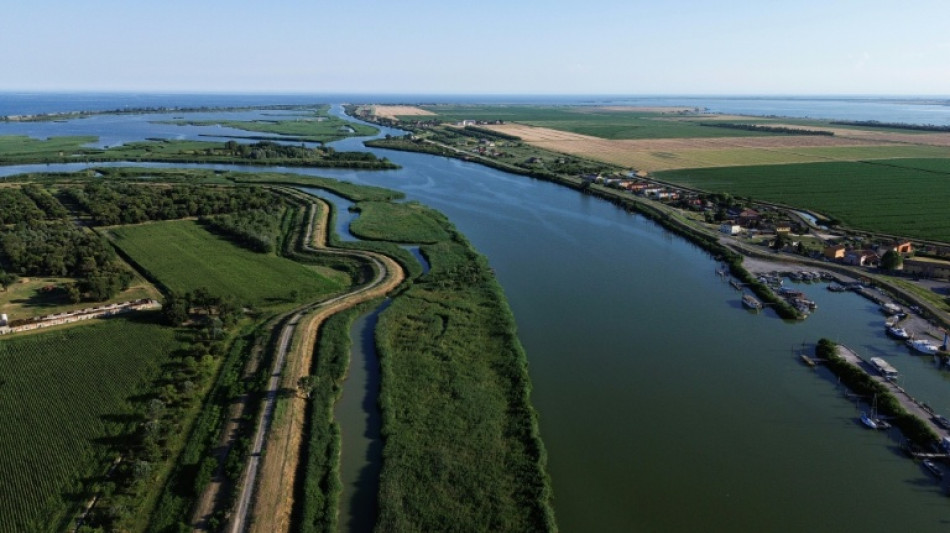
Farmers fear drought as Italy's longest river runs dry / Photo: Stefano RELLANDINI - AFP

Seawater is seeping into Italy's longest river as the waterway starts to run dry in the heatwave, hitting a farming heartland that produces the milk for Parmesan cheese.
The Po River has never fallen this low so early in the year, raising fears of a devastating drought in July in this corner of northern Italy.
On the bank of one of its branches, farmer Federica Vidali looked anxiously at her sunflower field. The first bloom of the season has appeared, but part of the field is already dry and starting to crack.
One of the two canals that irrigate it has been shut because the seawater would enter and damage the crops.
"We're left with the water that others are willing to leave us. But we're not second-division farmers!" Vidali told AFP.
The Po River's flow has collapsed in a matter of days, dropping below 300 cubic meters per second, compared with an average of around 1,500 in June, according to Aipo, the interregional river agency.
"It has never dropped so fast, so early," said Stefano Calderoni of the Italian irrigation association (Anbi).
Sandbanks are multiplying, depths fall to barely one meter in places, and the river's few remaining fishermen swelter in the heat.
"Before, we used to pass on the left; now the passage is to the right of the sandbank, and it's very, very narrow," said Daniela Cuoghi, a surveyor for Aipo.
The many Alpine lakes that feed the Po Valley, Italy's agro-industrial heartland, are still about 60 percent full. But farmers are drawing heavily from the waterways to irrigate fields parched by the heat.
It rained this winter, but the mountain snow that used to replenish the lake has already melted due to climate change.
"We're not in a drought situation yet, but at this rate, there's less than three weeks of water left in reserve," said Damiano Di Simine, an expert with environmental group Legambiente.
Drought last struck the Po Valley in 2022 -- but only at the end of July.
- 'Really big problems' -
Further downstream, at the river's mouth, the situation is already serious: seawater has pushed about 20 kilometres upstream.
Saltwater is beginning to contaminate farmland reclaimed over the past five centuries from the delta marshes.
Barriers have been placed in the river to stop seawater, but they only work if river's flow is strong enough.
"We'd need almost double the current flow for them to work," said Rodolfo Laurenti, the engineer in charge of irrigation in the delta.
Laurenti called for cooperation and solidarity between regions to manage water in the event of a crisis.
Farmers are also considering new dams or water retention basins, but "we're afraid that all these structures will still never be enough," Laurenti said.
A few kilometres closer to the sea, clam fishermen are also struggling with soaring June temperatures. The heat has warmed the lagoons, boosting the growth of algae that cover the shellfish.
They must also clear algae from the nets protecting clams from invasive blue crabs, which arrived from North America in recent years.
"On top of all the problems we already have, we now have this crazy, long, and unexpected heat," said Paolo Mancin, head of the local fishermen's cooperative, standing with in water at 31C.
"Macroalgae are forming, there's a high mortality rate among clams... If it were something that lasted a week, we could get through it.
"But this prolonged heat is now causing really big problems."
(Y.Yildiz--BBZ)