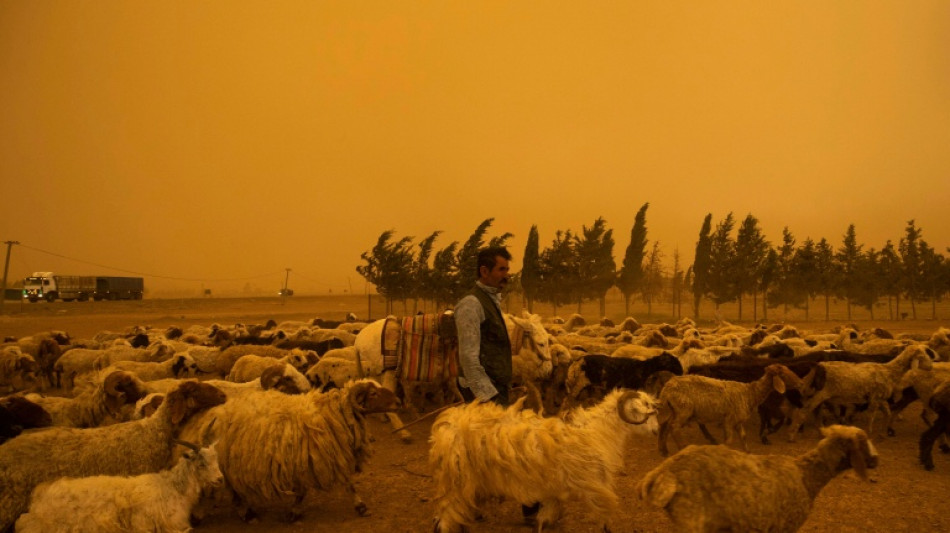
Dust in the wind: intense storms struck China, US in 2025, says UN / Photo: Delil SOULEIMAN - AFP

China and the southern United States were hit last year by some of their worst sand and dust storms in decades, the United Nations said Friday.
The UN's weather and climate agency said the episodes affected public health and the environment, and disrupted economic activity.
The World Meteorological Organization said that every year, around 2,000 million tonnes of dust enters the atmosphere, and can travel for thousands of kilometres across continents and oceans.
The main dust sources are major deserts such as the Sahara in Africa, the Gobi in Asia, and the Arabian Desert in the Middle East.
Though it is a natural process, poor water and land management, drought and environmental degradation "are increasingly to blame", the WMO said.
"Sand and dust storms affect air quality and human health," WMO chief Celeste Saulo said in a statement.
"They reduce agricultural productivity, disrupt transport and aviation, strain water and energy systems, and damage ecosystems. No country is immune to their impacts."
In its 10th annual Airborne Dust Bulletin, the WMO said that globally, overall average dust concentrations last year were 12.1 microgrammes per cubic metre of air -- slightly down on the 12.5 recorded in 2024 -- though with big regional variations.
The highest annual mean dust concentrations worldwide were again in the Bodele Depression in Chad, one of the planet's most active dust source regions, at around 800 to 1,100 microgrammes.
- Texas takes a hit -
The desert border region of Mexico and the United States saw exceptionally frequent, intense and prolonged dust storms in 2025.
The number of dust storms, 12, was the highest since 1935, when the United States was in the midst of its "Dust Bowl" disaster, the WMO said.
El Paso in Texas experienced 50 days with dust weather -- more than double the annual average.
The problem peaked on March 18, with a daily average concentration of PM10 particles at 2,064 microgrammes per cubic metre of air.
PM10 is particulate matter with a diameter of 10 micrometres.
The highest hourly peak hit 8,142 microgrammes -- the highest measured in Texas since hourly PM monitoring began around 27 years ago.
The World Health Organization's recommended air quality guideline average annual level for PM10 is 15 microgrammes, or 45 in a 24-hour period.
"The season in the United States was really extreme," Sara Basart, scientific officer at the WMO's Global Atmosphere Watch, told reporters.
The impact on breathing and on visibility, and the sand "scratching your eyes or your skin", means the recommendation is "you have to stay at home" during such events, she said.
- AI prediction potential -
In April 2025, China suffered its worst dust and sand storm in a decade, in terms of its intensity, duration and influence.
As dust swept in from Mongolia, hourly PM10 concentrations reached 3,000 to 4,000 microgrammes in some places.
North Africa and the Middle East also suffered a series of major dust storms between March and May 2025.
Parts of Iraq and Kuwait saw greater dust activity than the year before, as did central Asia.
Saulo said because sand and dust storms cross borders, countries needed to share early warning data.
The agency said artificial intelligence had the potential to improve sand and dust forecasts, but more research was needed at this stage.
Currently, some AI systems are better at forecasting short-lived, rapidly-developing local dust storms, while others are more consistent on large-scale events that develop and travel over several days.
(L.Kaufmann--BBZ)