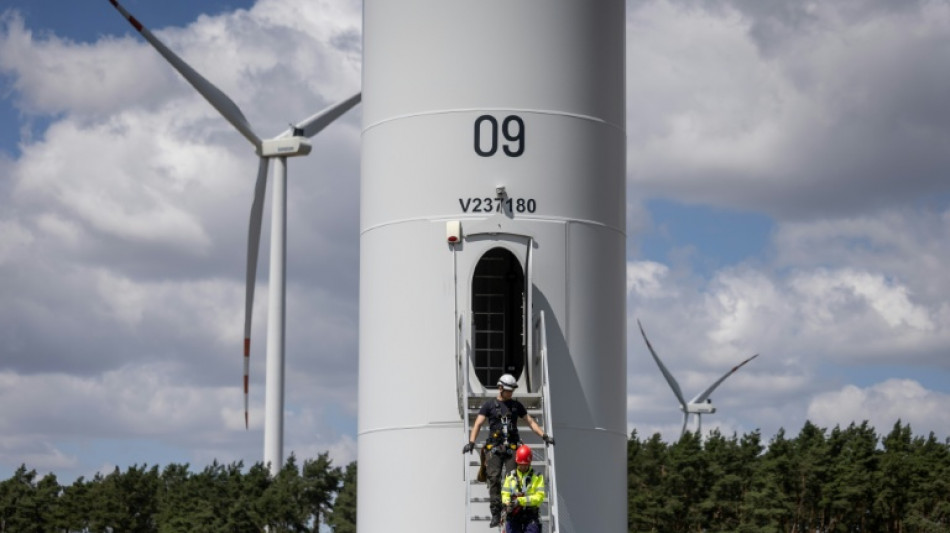
From coal pits to wind turbines, Polish miners rise to the occasion / Photo: Wojtek RADWANSKI - AFP

From the top of a wind turbine nearly 100 metres above the ground, Grzegorz Witek, a coal miner, gazes at the horizon.
It's a far cry from basin depths in Silesia -- a historic coal mining region in southern Poland where he still extracts the ore.
Once Poland's black gold, the sector is now surviving only on life support as the country slowly transitions to cleaner energy sources.
Along with seven other miners, Witek took the hours-long journey to Gorzyca in western Poland to take part in a training programme run by EDF Power Solutions Poland, helping coal miners transition into the wind industry.
Even at the lowest point of a wind turbine, Witek expresses his awe at "the feeling of freedom" compared to the fourteen years he spent at the bottom of a mine.
"Down there it's always dark, there's no outside world, no sun," he tells AFP.
"With wind turbines, we're moving up to the next level," he adds.
Before climbing real pylons, participants completed three weeks of training at the Vulcan centre in Szczecin, a Baltic port city in the north-west of the country, learning maintenance and safety skills such as how to evacuate a tower.
While it is a big transition for workers used to navigating the depths of coal basins, instructor Michal Rak says the miners have valuable advantages.
Already accustomed to extreme environments, they are quick to adapt to the wind farm's conditions.
"After working a kilometre underground, finding themselves hundreds of metres above the ground doesn't really faze them," he says.
Aware of the risks, they "don't take things lightly," he adds.
- Wind is the future -
For 29-year-old Patryk Paja, who spent three years in the mines, wind is the future.
"The mining sector is dying out in Poland and you have to change something in your life," he says, harnessed and ready to take the elevator to the top of a turbine.
In the mine where he works, the tunnels run as deep as 1,300 metres below the surface.
"We're switching to green energy, coal is over," he adds.
Wind turbines are an increasingly common sight around the training area in Gorzyca and throughout the country, where coal still accounts for over half of Poland's electricity production, the highest in the European Union.
More than a valuable economic resource, the dark ore has become one of the pillars of Polish identity -- with miners long wielding political influence.
But Poland's energy model is running out of steam.
Mining companies are racking up losses despite government support -- which totalled 2.1 billion euros ($2.4 billion) in 2024.
Extracting a tonne of coal now costs nearly twice as much as importing it, and domestic production no longer fully covers the country's needs.
Coal's share in electricity production has also fallen -- from around 90 percent in 2008 to nearly 50 percent today.
Sun and wind now produce more than 30 percent of electricity, and the government is counting on 50 percent as early as 2030 and up to 69 percent in 2040.
Poland's first nuclear power plant is expected to go online in 2036.
- Exponential growth -
This transformation goes hand in hand with a steady drop in mining jobs.
The sector, which employed nearly 400,000 people at the end of the communist era, now has a total workforce numbering only 70,000.
Meanwhile, the government is projecting the creation of around 300,000 jobs tied to the energy transition by 2030.
"Recruitment needs in the wind sector will grow exponentially in the coming years," Alicja Chilinska-Zawadzka, president of EDF Power Solutions Poland, tells AFP.
For the past three years, the French group's subsidiary has been funding and organising retraining programs.
Around fifty miners have already taken part, and all of them have received job offers.
Interest in the program is also increasing with time.
"During the first round, there were five miners for ten places. In the end, over the years, we've had four times as many applicants as slots," says Mariusz Tomalik, spokesperson for the Mine Restructuring Company (SRK).
With ten years in the mines behind him, 41-year-old Marek Mikolajczyk is glad he took the leap.
After undergoing training, he has been working on wind turbines for a year and a half.
"The work is more pleasant, lighter, and less dangerous," he says.
What's more, his new job offers a higher salary, a better atmosphere, and the possibility of travel.
There's only one drawback: "long separations from the family during assignments," he says from Kosovo, where he is helping install a wind farm.
Fellow miner Patryk Paja hopes to follow the same path soon.
"I surely won't make it to retirement in the mine, so I might as well move into a sector with a future," he says.
"Instead of going down, we'll be going up," he adds.
(H.Schneide--BBZ)