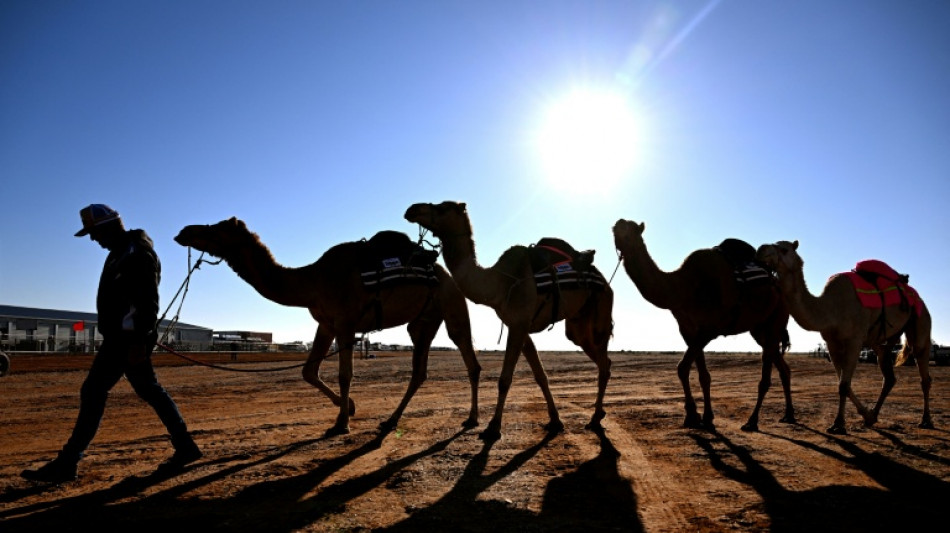
Camels find unlikely home in outback Australia / Photo: William WEST - AFP

Far from their origins in the Arabian desert, hundreds of thousands of camels roam outback Australia where they are used for wild races, an alternative milk source and even to make beer.
Imported by British colonists in the 19th century for transport but set free when the advent of cars rendered them redundant, estimates of the camel population in Australia range from 300,000 to up to a million.
Many of them are feral, roaming the outback and generally causing trouble -- competing with stock for food, destroying fences, fouling waterholes and damaging Indigenous cultural sites, authorities say.
But domesticated they also represent a modest export market, with Australian farmers selling their milk and sometimes even the camels whole -- 68 so far in 2026 heading to Malaysia and Indonesia.
Exports of camel meat totalled over $3.9 million in 2024, according to trade data.
On the Humpalicious farm in the South Australian town of Robe, owner and former sea captain Warwick Hill sings the benefits of his fluffy dromedarian friends.
"They're very nice to work with. They're very easily domesticated," he told AFP between camel cuddles.
"If you're kind and fair with them, they generally reciprocate."
- Milking it -
Camel milk -- which he sells for Aus$20 ($14) a litre -- has a multitude of health benefits, especially for those with allergies, he maintains.
And Hill insists it's a far superior dairy compared to the "overprocessed" mainstream options.
"We haven't met anybody that can't have camel milk," he said.
"It's one of the closest milks to human milk."
Business isn't huge -- the farm supplements its income from the camels with tourism and a homestay.
"The market should be huge, but the price is prohibitive," Hill said, pointing to the costs of labour and the animals' relatively low milk output.
But the milk has a special quality, he says.
"Everybody would, once they tasted camel milk, prefer to drink it over anything else."
Across town, the Robe Town Brewery has found another use for the camel.
The Humpalicious farm's camels are fed grain left over from the brewing process, and their dung is then used to smoke the malt for the beer.
Sold in a dark brown bottle emblazoned with a picture of a camel dressed as the Virgin Mary, "Holy Smokes" porter is sold as a "rich, dark and very smokey" drop.
It's not for the faint hearted -- a bottle comes in at 8.2 percent alcohol volume.
"It doesn't really taste like dung," brewer Maris Biezaitis hastened to add.
"In fact, it tastes and smells a bit more like a peat-smoked malt. Smoky beer."
- To the races -
Further north, others are deploying the camels to more daredevilish ends.
In the remote town of Maree, roughly 600 kilometres (370 miles) north of Adelaide, the camels transform from beasts of burden to powerful racers.
Every year, hundreds of spectators descend on the small town for the annual Marree Camel Cup.
This year's Marree Camel Cup winner was Young Gun, ridden by Patrick Dennis.
Joanne Bell, 55, was racing for the first time -- and took a tumble during the contest.
She told AFP she "fell in love" with camels when she was working at a petting farm.
"Always wanted to be a jockey but never had the opportunity to ride horses," she said.
"So camels was the next thing and a jockey's a jockey, whether it's a camel or a horse."
"I love it because it's just something different," camel racer Kyrraley Woodhouse told AFP.
The key is to pick a camel with the right personality, she explained.
"You would want a little bit of temper, a little bit of fire in them," she said.
"Something that's got a heart, that's going to run."
Muslim cameleers -- many from Afghanistan and other parts of Central and South Asia -- were brought to Australia in the 1860s to harness the animals for transport in the arid interior.
Some of their descendants remain in Marree.
"It all revolved around the camels. The reason the camels were brought here was because they were so resilient," Greg Burk, whose great-grandfather came to Australia in the 1880s, told AFP.
"Camels are still dear to my heart."
Back at Humpalicious, farmer Hill said he hoped his efforts and those of others could teach people to love his humpbacked homies.
"They're quite a pleasant animal," he said.
"People come here and they see 50 well-behaved, very nice, cuddly, smoochy camels."
(T.Renner--BBZ)