Does the Nepal glacier collapse signal a new climate risk? / Photo: PRAKASH MATHEMA, PRAKASH MATHEMA - AFP

Does the devastating flooding unleashed by the collapse of a section of glacier in the Nepalese Himalayas signal a new kind of risk in a world warmed by climate change? Here's what scientists told AFP.
- Repeat collapse risk -
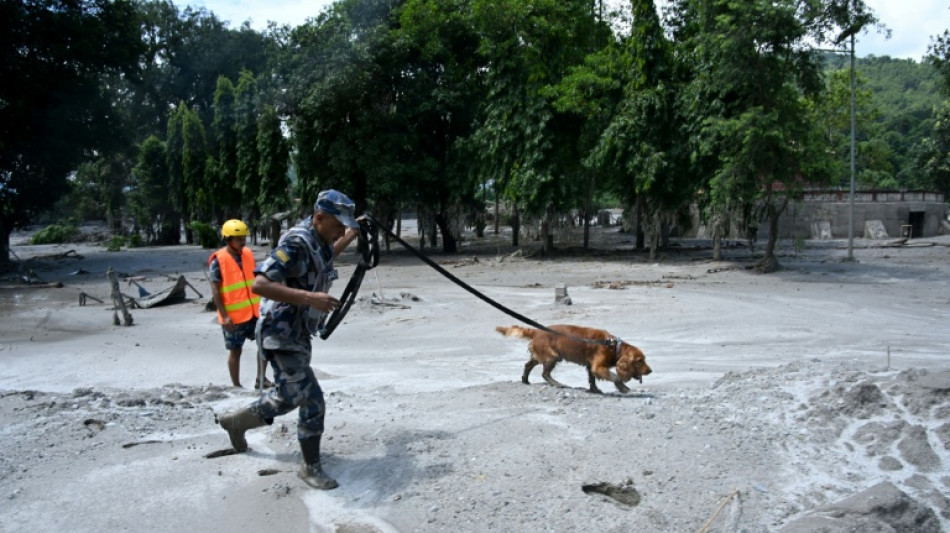
On Friday, Nepal issued an alert about the risks posed by a large body of water formed in China's Tibet region, following the collapse of a glacier section two days ago. That collapse killed at least 584 people, and more than 2,400 remain missing.
"Once you take a piece of mountain away, then there's probably another piece right beside it that's been destabilised by the removal. And so you could have a similar thing collapse," Simon Cox, principal scientist at New Zealand's GNS Science research institute, told AFP.
"You may well have more material to fall down right from up at the source area, and the same thing could happen immediately again."
According to the United States Geological Survey (USGS), the resulting flood was triggered by a glacier collapse so violent that it generated energy equivalent to a magnitude 5.2 earthquake and caused numerous landslides.
- Rising global hazard -
Etienne Berthier, a glaciologist at the French National Centre for Scientific Research (CNRS), told AFP "we can't rule out" the risk of similar phenomena occurring elsewhere.
"They reach such proportions in the Himalayas because the terrain and the region's high tectonic activity amplify the likelihood of such events occurring on that scale," he explained.
Other regions may have similarly "dynamic" glaciers -- such as Alaska -- but "this happens in completely uninhabited areas".
"We have seen a dramatic increase in the number of extremely hazardous flows such as this globally in the past decade or so," Tristram Hales, a professor of environmental hazards at Cardiff University, told AFP, citing events in the Himalayas and Switzerland.
Scientists warn that rockfalls and landslides triggered by earthquakes or the thawing of permafrost -- which is being accelerated by climate change -- are more likely than entire sections of mountain coming down.
These risks are greater for people when towns, roads, or tourist sites are located nearby.
In the Alps, this year's extremely hot summer saw a record number of rockfalls, including some that were fatal -- the vast majority of which can be attributed to the climate crisis, Ludovic Ravanel, a geomorphologist at the CNRS, told AFP recently.
In Switzerland, the municipality of Randa, home to some 400 people, fears a glacier collapse in the coming days and has established safety perimeters following several rockfalls, according to the national press.
- Prediction possible sometimes -
The disaster in Nepal was probably very hard to predict, said Berthier, adding that rock movements will need to be analysed to see if signs of instability were visible in the preceding weeks or months.
But risks are far more apparent when glacial-fed lakes form. These can drain suddenly and catastrophically, a phenomenon known as glacial lake outburst floods (GLOFs).
In the Alps, "we are well-equipped, we monitor these lakes and check for risks of overflowing or sudden drainage", Bernard Francou, a retired glaciologist and former research director at the French National Research Institute for Sustainable Development (IRD), told AFP.
- Climate change link? -
Several scientists urged caution about linking the latest disaster to climate change, even though some experts are already drawing such a connection.
"While climate change is altering glaciers, snow conditions, permafrost and mountain slopes across the Hindu Kush Himalaya, it is too early to determine what role climate change played in this specific event," said the International Centre for Integrated Mountain Development (ICIMOD), an intergovernmental institute.
An "attribution study", which analyses how likely a specific event would occur in today's fossil-fuel warmed climate compared to the pre-industrial climate, will be required to draw firm conclusions either way.
(P.Werner--BBZ)