Berliner Boersenzeitung - Restored Cheshire wetland becomes key UK breeding site for black-necked grebes

EUR -
AED 4.261414
AFN 74.847626
ALL 91.860932
AMD 420.621113
ANG 2.077506
AOA 1065.207702
ARS 1750.68835
AUD 1.617447
AWG 2.090092
AZN 1.977213
BAM 1.954969
BBD 2.333807
BDT 142.989188
BGN 1.956548
BHD 0.436914
BIF 3456.529963
BMD 1.160357
BND 1.469175
BOB 14.425865
BRL 5.942784
BSD 1.158707
BTN 110.658938
BWP 15.610361
BYN 3.519103
BYR 22742.987576
BZD 2.330409
CAD 1.608081
CDF 2676.942886
CHF 0.946838
CLF 0.027681
CLP 1093.009876
CNY 7.783962
CNH 7.782558
COP 3582.776272
CRC 521.978007
CUC 1.160357
CUP 30.749447
CVE 110.218125
CZK 24.254589
DJF 206.342244
DKK 7.477806
DOP 68.200995
DZD 154.700207
EGP 59.51249
ERN 17.405348
ETB 187.040853
FJD 2.582664
FKP 0.858274
GBP 0.857332
GEL 3.021407
GGP 0.858274
GHS 13.279352
GIP 0.858274
GMD 85.290672
GNF 10187.667261
GTQ 8.847237
GYD 242.426898
HKD 9.102537
HNL 31.099773
HRK 7.538725
HTG 151.445591
HUF 363.749008
IDR 20430.397054
ILS 3.517447
IMP 0.858274
INR 110.878451
IQD 1517.954425
IRR 1595026.057673
ISK 139.649353
JEP 0.858274
JMD 183.032158
JOD 0.822739
JPY 178.201797
KES 149.936233
KGS 101.473623
KHR 4699.00155
KMF 493.151923
KPW 1044.321264
KRW 1556.583891
KWD 0.357808
KYD 0.965589
KZT 522.867628
LAK 25924.974301
LBP 103764.469742
LKR 380.93799
LRD 202.194008
LSL 18.710243
LTL 3.426232
LVL 0.701889
LYD 7.328883
MAD 10.828095
MDL 20.08046
MGA 4987.878692
MKD 61.498845
MMK 2436.590155
MNT 4170.546013
MOP 9.359819
MRU 46.593184
MUR 54.502384
MVR 17.927947
MWK 2009.245483
MXN 19.691487
MYR 4.723004
MZN 74.158822
NAD 18.710243
NGN 1539.282968
NIO 42.641865
NOK 10.77786
NPR 177.0547
NZD 1.983685
OMR 0.44629
PAB 1.158707
PEN 3.896743
PGK 5.230775
PHP 72.715486
PKR 321.229583
PLN 4.324823
PYG 6862.081608
QAR 4.223804
RON 5.256187
RSD 117.280122
RUB 97.758424
RWF 1709.173101
SAR 4.358794
SBD 9.297943
SCR 15.981203
SDG 697.958705
SEK 11.251285
SGD 1.470524
SHP 0.858982
SLE 28.487183
SLL 24332.100067
SOS 662.218363
SRD 43.998983
STD 24017.036986
STN 24.489585
SVC 10.138688
SYP 15086.955721
SZL 18.713041
THB 38.344025
TJS 10.718242
TMT 4.072851
TND 3.381862
TOP 2.79386
TRY 55.932437
TTD 7.864655
TWD 36.71821
TZS 3070.594099
UAH 51.613749
UGX 4484.092949
USD 1.160357
UYU 46.640164
UZS 13626.204876
VES 964.775755
VND 30079.341604
VUV 136.986889
WST 3.174772
XAF 655.957
XAG 0.017994
XAU 0.000267
XCD 3.135922
XCG 2.088312
XDR 0.820432
XOF 655.957
XPF 119.331742
YER 275.062932
ZAR 18.706305
ZMK 10444.605168
ZMW 22.363489
ZWL 373.634322
SSP 6555.084378
MXV 2.233452
  • BCC

    0.3900

    75.44

    +0.52%

  • RIO

    0.5700

    99.96

    +0.57%

  • BTI

    0.3800

    55.24

    +0.69%

  • CMSD

    -0.0200

    20.32

    -0.1%

  • NGG

    0.4800

    76.86

    +0.62%

  • CMSC

    0.0100

    20.45

    +0.05%

  • BCE

    0.1400

    23.39

    +0.6%

  • AZN

    0.5300

    160.17

    +0.33%

  • GSK

    0.0100

    48.13

    +0.02%

  • BP

    0.0200

    46.1

    +0.04%

  • RBGPF

    0.2800

    68.02

    +0.41%

  • JRI

    -0.0700

    12.01

    -0.58%

  • RELX

    -0.0200

    33.8

    -0.06%

  • RYCEF

    0.4100

    19.54

    +2.1%

  • VOD

    0.0700

    17.4

    +0.4%

Restored Cheshire wetland becomes key UK breeding site for black-necked grebes


Restored Cheshire wetland becomes key UK breeding site for black-necked grebes

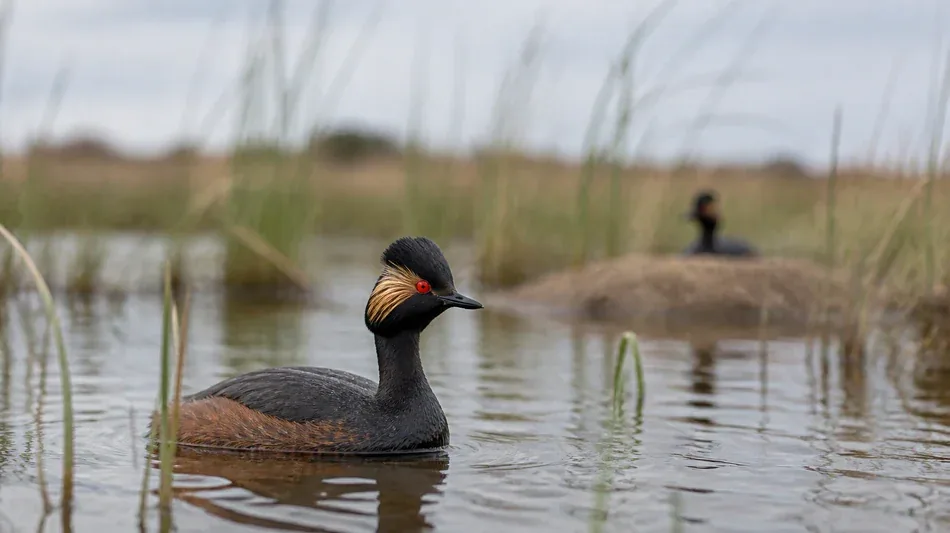
Habitat restoration at Woolston Eyes in Warrington has turned former canal-dredging lagoons into Britain's strongest breeding site for the rare black-necked grebe.

Text size:

Woolston Eyes in Warrington, Cheshire, has become Britain's most important breeding site for the rare black-necked grebe after a multi-year restoration of former settlement lagoons used for dredgings from the Manchester Ship Canal.Since 2021, the RSPB and the Woolston Eyes Conservation Group have restored and expanded the site into a mixture of freshwater pools, reedbeds, willow scrub and rough grassland. Managers revived dried and overgrown wetland areas and created nesting islands intended to attract black-headed gulls, which can provide protection for nesting grebes from predators.The results have been rapid. In 2023, four pairs of black-necked grebes bred in the restored area and raised 15 young. By 2025, 35 breeding pairs had been recorded at Woolston Eyes, including 29 pairs nesting on the newly restored habitat. That total represented 64% of the average number of black-necked grebe breeding pairs recorded annually across the UK.The site, designated as a Site of Special Scientific Interest, also supports other scarce species including willow tit, pochard and grasshopper warbler. Woolston Eyes depends on rainfall to remain wet, but managers can move water between sections so that individual pools can be dried, refreshed and flooded again. That rotation is important because black-necked grebes tend to leave wetlands that become too mature and densely vegetated.RSPB ecologist Gavin Thomas said the increase showed that targeted habitat management can support species recovery and argued that similar wetland restoration should be expanded elsewhere in the UK.

(Y.Yildiz--BBZ)