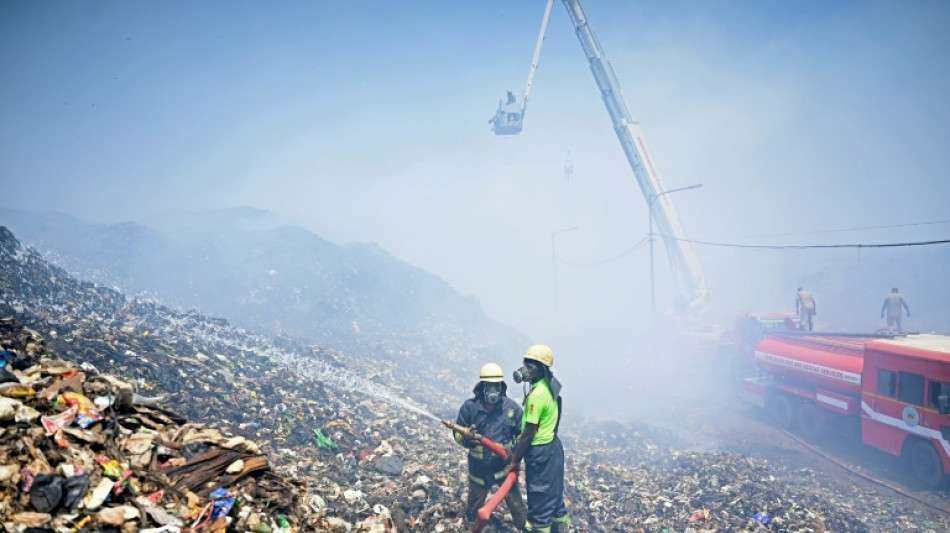
Rubbish reform: changes to waste management could slash emissions / Photo: Arun SANKAR - AFP/File

Reforms to the way that societies collect and treat their waste could slash global emissions of plant-heating methane, a new report said Monday, noting that simple measures like composting were a climate solution "staring us in the face".
Governments around the world have pledged to reduce emissions of methane (CH4) -- which absorbs 80 times more solar radiation over short periods than carbon dioxide -- in their battle to curb global warming.
Human-induced sources of the powerful greenhouse gas are largely from livestock and manure handling, which accounts for some 30 percent of anthropogenic methane emissions, followed by the oil and gas sector (19 percent) and landfills (17 percent), according to UN climate experts.
A new report by the organisation Global Alliance for Incinerator Alternatives (GAIA) found that simple tweaks in the waste sector, particularly in urban areas, could slash carbon emissions by the equivalent of the annual emissions of 300 million cars.
The authors looked at "zero waste" strategies, like separating organic materials, composting, recycling non-organic material and overall reductions in discarded products.
While reforms would not remove methane emissions from the waste system, the report estimated that policies could reduce overall emissions of methane from human sources by as much as 13 percent globally.
- Consumption changes -
The authors said that a focus on waste reduction would not only tackle methane, which leaches from landfills as organic matter rots, but could also make a major dent in the carbon pollution from the manufacture, transport and use of goods.
"Better waste management is a climate change solution staring us in the face," said report co-author Neil Tangri of GAIA.
"It doesn't require flashy or expensive new technology -- it's just about paying more attention to what we produce and consume, and how we deal with it when it is no longer needed."
The authors stressed that tackling waste was a key element of reaching the aspirational Paris deal target of limiting global warming to 1.5 degrees Celsius above pre-industrial levels.
The researchers modelled potential emissions reductions from eight cities around the world and found that, on average, they could cut waste sector emissions by almost 84 percent.
Methane is responsible for roughly 30 percent of the global rise in temperatures to date.
The powerful greenhouse gas lingers in the atmosphere only a fraction as long as CO2, but is far more efficient at trapping heat. Levels of the gas are their highest in at least 800,000 years.
At last year's COP26 climate summit in Glasgow, more than 100 nations agreed under the Global Methane Pledge to reduce emissions 30 percent by 2030. But several major methane emitters -- including China, Russia, Iran and India -- failed to sign.
"This report demonstrates the huge importance of aligning our waste systems with climate goals," said Janez Potocnik, from the International Resource Panel of the UN Environment Programme.
"It highlights the absolute necessity of reducing root sources of waste through changing our production and consumption patterns -- using all the tools at our disposal to achieve the deep emissions reductions we need."
(G.Gruner--BBZ)