Berliner Boersenzeitung - Study eyes US cooperation with Pakistan amid China rise

EUR -
AED 4.231433
AFN 74.892934
ALL 93.964547
AMD 422.42859
AOA 1057.71362
ARS 1715.616549
AUD 1.639899
AWG 2.075388
AZN 1.95509
BAM 1.964441
BBD 2.320889
BDT 142.295919
BHD 0.434489
BIF 3453.699027
BMD 1.152193
BND 1.48453
BOB 13.569099
BRL 5.851763
BSD 1.152359
BTN 110.199606
BWP 15.746469
BYN 3.372033
BYR 22582.986129
BZD 2.317695
CAD 1.614655
CDF 2621.239218
CHF 0.928846
CLF 0.027096
CLP 1066.41274
CNY 7.783353
CNH 7.775587
COP 3599.082761
CRC 523.89994
CUC 1.152193
CUP 30.533119
CVE 111.359268
CZK 24.204641
DJF 204.767487
DKK 7.47521
DOP 67.08644
DZD 152.919167
EGP 58.84239
ERN 17.282898
ETB 186.000011
FJD 2.553149
FKP 0.867174
GBP 0.856051
GEL 3.018565
GGP 0.867174
GHS 13.474877
GIP 0.867174
GMD 85.262595
GNF 10101.857255
GTQ 8.792676
GYD 241.096794
HKD 9.036708
HNL 30.87481
HRK 7.53315
HTG 150.672767
HUF 362.580193
IDR 20794.263843
ILS 3.531443
IMP 0.867174
INR 110.247661
IQD 1509.540037
IRR 1584265.60873
ISK 142.606705
JEP 0.867174
JMD 182.251673
JOD 0.816868
JPY 184.750148
KES 149.070356
KGS 100.758911
KHR 4654.860526
KMF 496.020675
KRW 1644.974733
KWD 0.356892
KYD 0.960337
KZT 546.678406
LAK 26131.741487
LBP 103178.89777
LKR 387.072622
LRD 209.134754
LSL 19.137841
LTL 3.402127
LVL 0.69695
LYD 7.379782
MAD 10.812757
MDL 20.29353
MGA 4926.821346
MKD 61.505418
MMK 2419.425088
MNT 4143.544445
MOP 9.310877
MRU 46.214335
MUR 54.394729
MVR 17.813507
MWK 2000.207131
MXN 19.983063
MYR 4.693692
MZN 73.636643
NAD 19.137958
NGN 1572.121116
NIO 42.407828
NOK 10.978792
NPR 176.313021
NZD 1.961834
OMR 0.443021
PAB 1.152404
PEN 3.904876
PGK 5.084365
PHP 70.89455
PKR 320.191151
PLN 4.307491
PYG 6887.295252
QAR 4.198819
RON 5.246048
RSD 117.399306
RUB 91.859024
RWF 1690.26738
SAR 4.2996
SBD 9.299986
SCR 15.599018
SDG 691.315584
SEK 10.991174
SGD 1.477694
SLE 28.464345
SOS 658.591239
SRD 43.489504
STD 23848.072347
STN 24.60803
SVC 10.083354
SZL 19.113073
THB 38.487877
TJS 10.641818
TMT 4.044198
TND 3.407187
TRY 54.735624
TTD 7.821643
TWD 37.342774
TZS 3050.429113
UAH 51.410942
UGX 4315.984789
USD 1.152193
UYU 46.353898
UZS 13833.851174
VES 856.420682
VND 30281.364793
VUV 137.723124
WST 3.171439
XAF 658.878091
XAG 0.019493
XAU 0.000281
XCD 3.113859
XCG 2.076899
XDR 0.820359
XOF 658.855116
XPF 119.331742
YER 274.596437
ZAR 19.01568
ZMK 10371.122817
ZMW 21.520315
ZWL 371.005731
  • RBGPF

    3.2100

    69.21

    +4.64%

  • CMSC

    0.1200

    21.81

    +0.55%

  • VOD

    0.0100

    16.14

    +0.06%

  • RYCEF

    1.1600

    19.63

    +5.91%

  • NGG

    1.5100

    80.39

    +1.88%

  • AZN

    -1.9600

    171.34

    -1.14%

  • RIO

    3.5200

    97.18

    +3.62%

  • RELX

    -1.6200

    36.61

    -4.43%

  • GSK

    -1.1500

    52.07

    -2.21%

  • BTI

    -1.3800

    61.69

    -2.24%

  • BCC

    -2.3000

    75.38

    -3.05%

  • JRI

    0.1100

    12.87

    +0.85%

  • BCE

    -0.6300

    21.7

    -2.9%

  • CMSD

    -0.0200

    22.02

    -0.09%

  • BP

    0.9000

    44.22

    +2.04%

Study eyes US cooperation with Pakistan amid China rise
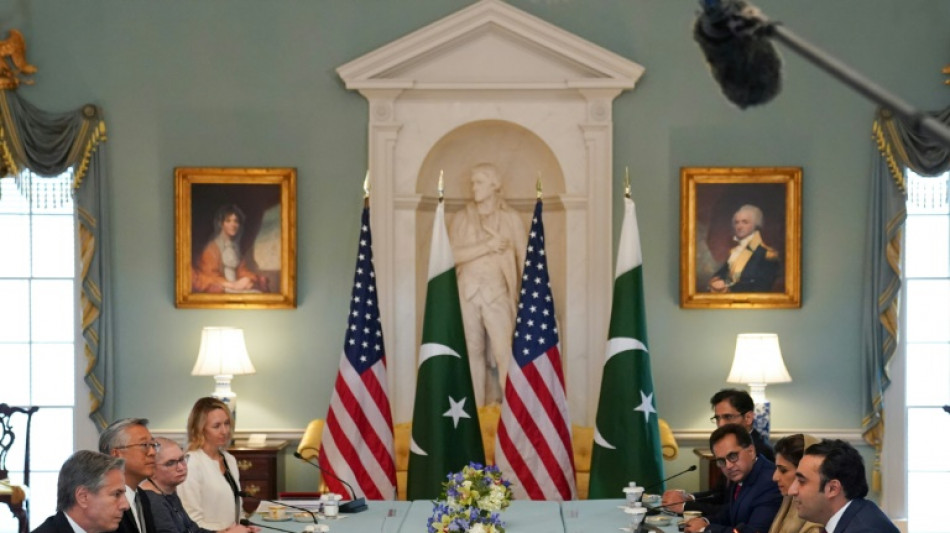
Study eyes US cooperation with Pakistan amid China rise / Photo: KEVIN LAMARQUE - POOL/AFP/File

Study eyes US cooperation with Pakistan amid China rise

The United States needs to keep engaging Pakistan despite lingering distrust over Afghanistan, with investment and climate cooperation key to reducing the South Asian nation's growing reliance on China, a study group recommended Tuesday.

Text size:

The group released its findings during a visit to Washington by the head of Pakistan's powerful military, General Qamar Javed Bajwa, a week after a trip by the civilian foreign minister, Bilawal Bhutto Zardari.

The study group, which did not involve the US government, included scholars and former US ambassadors to Pakistan Ryan Crocker, Cameron Munter and Robin Raphel, along with Husain Haqqani, Pakistan's former ambassador in Washington.

Pakistan and the United States were partners in the Cold War and, officially, in the Afghanistan war. But American officials lost patience with Islamabad which they suspected of quietly maintaining support for the Taliban, who triumphed as US troops withdrew last year.

"Instead of allowing existing differences to define the partnership, it may be time to recognize that both sides need to understand the other's interests so that they can then find a way to work on areas of mutual concern," the study group said.

The United States must move beyond leveraging aid to change Pakistan's policies, a tactic that has been a proven failure.

Islamabad, in turn, needs to accept "that all of Pakistan's problems, especially terrorism and militancy, cannot be laid at the door of the US."

Pakistan has forged increasingly close relations with China, triggering warnings from the United States that Beijing -- seen as Washington's key global competitor -- will saddle the economically troubled nation with debt.

The study group said that after previously linking the Pakistan relationship to Afghanistan or its historic rival India, the United States should avoid now seeing ties through the lens of China.

Instead, the United States can "help build Pakistan's capacity for transparency and compliance" on Chinese loans and can reduce reliance on China by encouraging investment by US companies and others, it said.

The United States can also focus on building climate resilience -- a key challenge for Pakistan, which was recently devastated by floods.

While the United States wants to step back from Afghanistan, the study group said the need for counterterrorism cooperation with Pakistan "has if anything increased" due to the loss of US intelligence assets on the ground.

"While Pakistan and the US often fail to see eye-to-eye when it comes to Afghanistan, China, or India, they do share mutual interests in seeking stability in the region, combatting the problem of extremism and averting armed conflict in nuclear South Asia," it said.

(L.Kaufmann--BBZ)