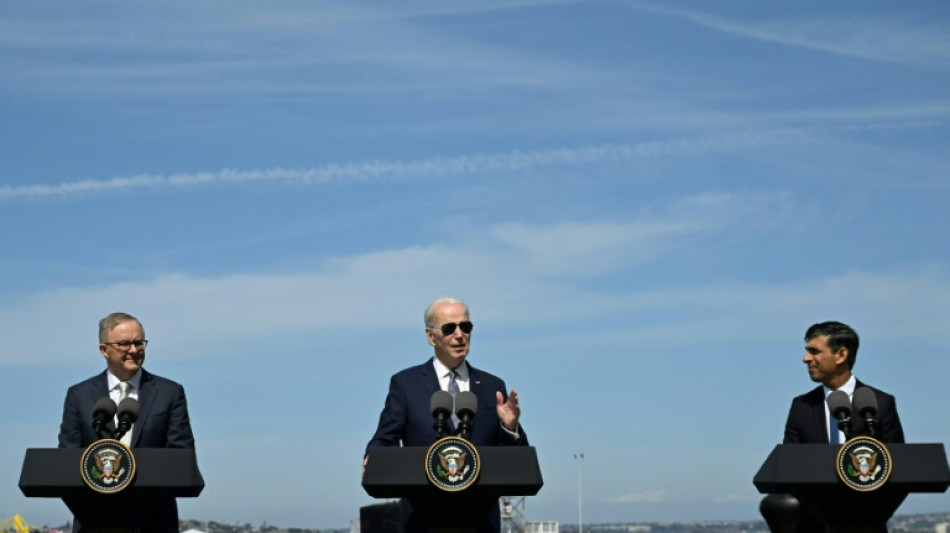
China warns AUKUS allies on 'path of error and danger' with subs pact / Photo: Jim WATSON - AFP

China warned on Tuesday that Australia, Britain and the United States were treading a "path of error and danger" after they unveiled a nuclear-powered submarines deal.
Australia announced on Monday it would buy up to five US nuclear-powered submarines, then build a new model with US and British technology under an ambitious plan to bulk up Western muscle across the Asia-Pacific in the face of a rising China.
US President Joe Biden has stressed that Australia, which joined the alliance with Washington and London known as AUKUS 18 months ago, will not be getting nuclear weapons.
However, acquiring submarines powered by nuclear reactors puts Australia in an elite club and at the forefront of US-led efforts to push back against Chinese military expansion.
Wang Wenbin, China's foreign ministry spokesman, said: "The latest joint statement from the US, UK and Australia demonstrates that the three countries, for the sake of their own geopolitical interests, completely disregard the concerns of the international communities and are walking further and further down the path of error and danger."
Wang accused the three Western allies of inciting an arms race, saying the security deal was "a typical case of Cold War mentality".
The sale of submarines "constitutes a severe nuclear proliferation risk, and violates the aims and objectives of the Non-Proliferation Treaty", Wang said at a regular news conference in Beijing.
- 'Stability for decades' -
Monday's announcement came at an event at a naval base in San Diego, California, where Biden hosted Australian Prime Minister Anthony Albanese and British Prime Minister Rishi Sunak.
With a US Virginia-class nuclear submarine moored behind the trio's podium, Biden said the United States had "safeguarded stability in the Indo-Pacific for decades" and that the submarine alliance would bolster "the prospect of peace for decades to come".
Albanese said the deal represents the biggest single investment in Australia's defence capability "in all of our history".
The submarines are expected to be equipped with long-range cruise missiles, offering a potent deterrent.
Albanese predicted that the wider economic impact at home would be akin to the introduction of the automobile industry in the country after World War II.
The Australian government estimates the multi-decade project will cost almost $40 billion in the first 10 years, and create an estimated 20,000 jobs.
Albanese underlined that Australia was now only the second country, after Britain, to be granted access to US naval nuclear secrets.
Three conventionally armed, nuclear-powered Virginia class vessels will be sold "over the course of the 2030s", with the "possibility of going up to five if that is needed", said Biden's national security advisor, Jake Sullivan.
Britain and Australia will then embark on building a new model, also nuclear-powered and carrying conventional weapons, dubbed the SSN-AUKUS. This will be a British design, with US technology, and with "significant investments in all three industrial bases", Sullivan said.
- Defense spending on the rise -
While Australia has ruled out deploying atomic weapons, its submarine plan marks a significant new stage in the confrontation with China, which has built a sophisticated naval fleet and turned artificial islands into offshore bases in the Pacific.
In the face of the Chinese challenge -- and Russia's invasion of pro-Western Ukraine -- Britain is also moving to beef up its military capabilities, Sunak's office said Monday.
More than $6 billion in additional funding over the next two years will "replenish and bolster vital ammunition stocks, modernise the UK's nuclear enterprise and fund the next phase of the AUKUS submarine programme," Downing Street said.
Australia had previously been on track to replace its ageing fleet of diesel-powered submarines with a $66 billion package of French vessels, also conventionally powered.
The abrupt announcement by Canberra that it was backing out of that deal and entering the AUKUS project sparked a brief but unusually furious row between all three countries and their close ally France.
Compared with the Collins-class submarines due to be retired by Australia, the Virginia-class is almost twice as long and carries 132 crew members, not 48.
However, the longer-term upgrade will require a long wait.
A senior US official said that the British navy should get its "state of the art" SSN-AUKUS vessels in the late 2030s and Australia only in the early 2040s.
In the meantime, Australian sailors, engineers and other personnel will be training with their US and British partners to acquire expertise, while British and US submarines make regular visits to Australian ports.
But Washington says Beijing is alarming countries across the Asia-Pacific with its threats to invade the self-governing democracy of Taiwan.
"What we've seen is a series of provocative steps that China has undertaken under the leadership of Xi Jinping over the last five to 10 years," the senior US official said.
"This is an attempt to defend and secure the operating system of the Indo-Pacific."
burs-je/qan
(S.G.Stein--BBZ)